
What Is Capture Management?
Capture management is the work a government contractor does to win a specific contract before the solicitation is released. It is not proposal writing. By the time the RFP posts, the capture work is either done or it is too late.
Many of the decisions that shape a bid happen before the proposal starts. The agency shapes its requirement with vendors it already knows, a competitor teams with the incumbent, or the price lands outside the range the customer expected. Capture management exists to put your company on the right side of those decisions while they are still being made.
This guide covers what capture management is, why it has to start before the RFP, the capture management process stage by stage, where capture teams find opportunities early, what goes into a capture plan, what a capture manager does, and the mistakes that cost capture teams the most.
Capture management is the process of identifying a specific government opportunity, deciding whether to pursue it, and positioning your company to win it before and during the solicitation. It covers customer engagement, competitive analysis, teaming, solution shaping, pricing strategy and the bid decision, and it ends with a handoff to the proposal team.
The Association of Proposal Management Professionals (APMP) describes the pre-bid, or capture, stage as the phase that “sets the stage for success by assessing opportunities,” “aligning internal capabilities, and developing a winning strategy.”
Capture Management vs Business Development vs Proposal Management
The three functions overlap, but each has a different job:
- Business development works the market. It finds agencies, programs and opportunities that fit the company and builds the pipeline.
- Capture management works one opportunity. It takes a qualified pursuit from the pipeline and builds the plan to win it.
- Proposal management works the document. It turns the capture strategy into a compliant, persuasive response once the solicitation is out.
In small companies one person often does all three. The roles still matter, because each one has a different deadline and a different definition of done.
Why Capture Starts Before the RFP
The FAR expects contractors to engage early. FAR 15.201(a) states that “exchanges of information among all interested parties, from the earliest identification of a requirement” through receipt of proposals are encouraged, and FAR 15.201(c) opens with: “Agencies are encouraged to promote early exchanges of information about future acquisitions.”
The purpose, per FAR 15.201(b), is to “improve the understanding of Government requirements and industry capabilities.” The techniques FAR 15.201(c) lists include:
- Industry or small business conferences
- One-on-one meetings with potential offerors
- Presolicitation notices
- Draft RFPs
- Requests for information (RFIs)
- Presolicitation or preproposal conferences and site visits
Every item on that list happens before proposals are due, and most happen before the final RFP exists. That is the window capture works in. Our guide to RFI meaning in government contracting covers how to answer an RFI so it helps your capture rather than just your mailing list.
What the FAR Overhaul Changed
Under the Revolutionary FAR Overhaul model deviation for Part 15, this guidance moves to a new section, 15.101, “Early exchanges with industry.” It states that exchanges of information “are encouraged and can occur at any time,” that agencies “are encouraged to release draft RFPs and conduct conferences with industry,” and that agencies “are encouraged to release requests for information (RFI).” The streamlined text no longer lists one-on-one meetings or site visits by name, so the early-engagement principle stays, and the specific techniques depend on the agency.
The Capture Management Process, Stage by Stage
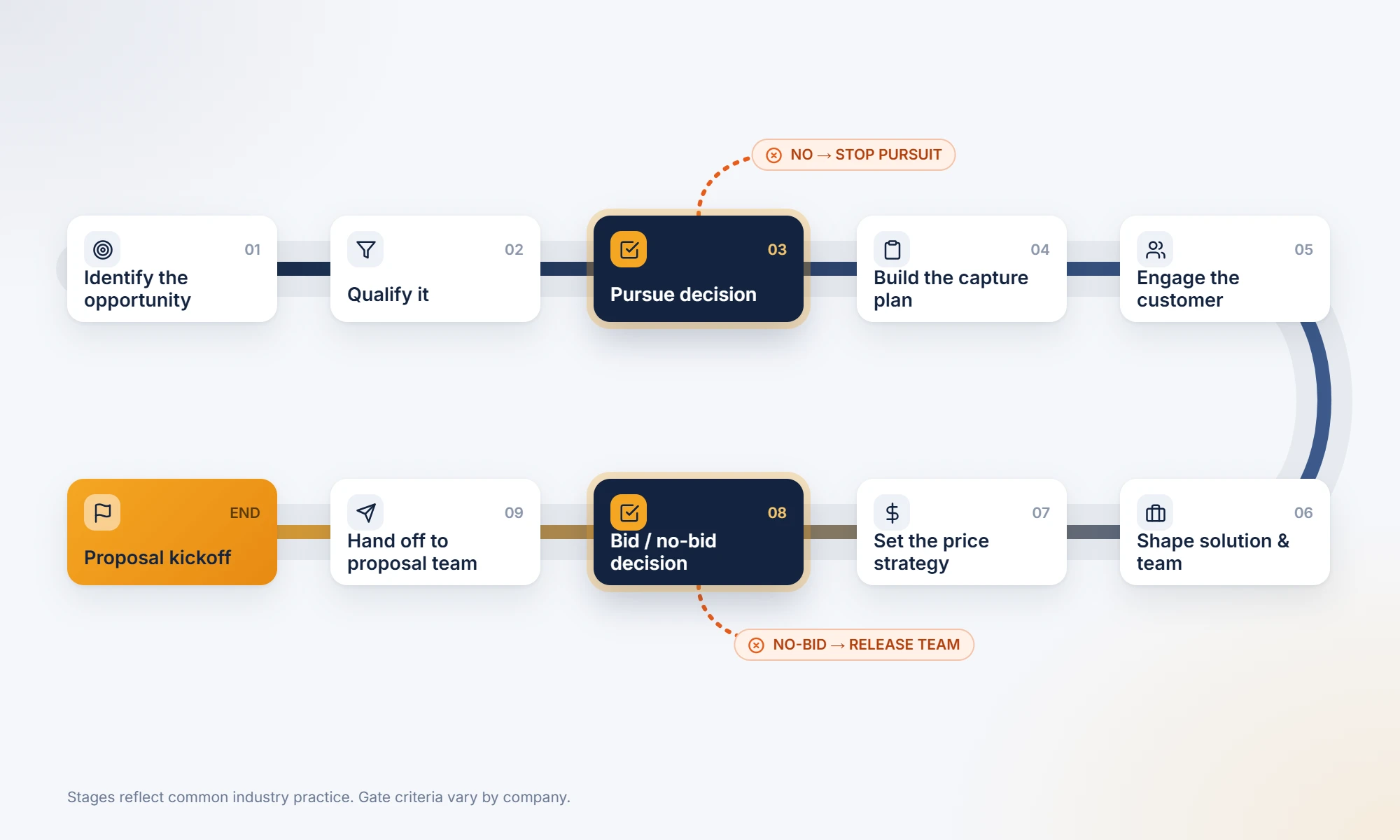
There is no regulation that defines capture stages. The process below reflects common industry practice, and most capture teams run some version of it. What changes from company to company is the number of gates and who signs off at each one.
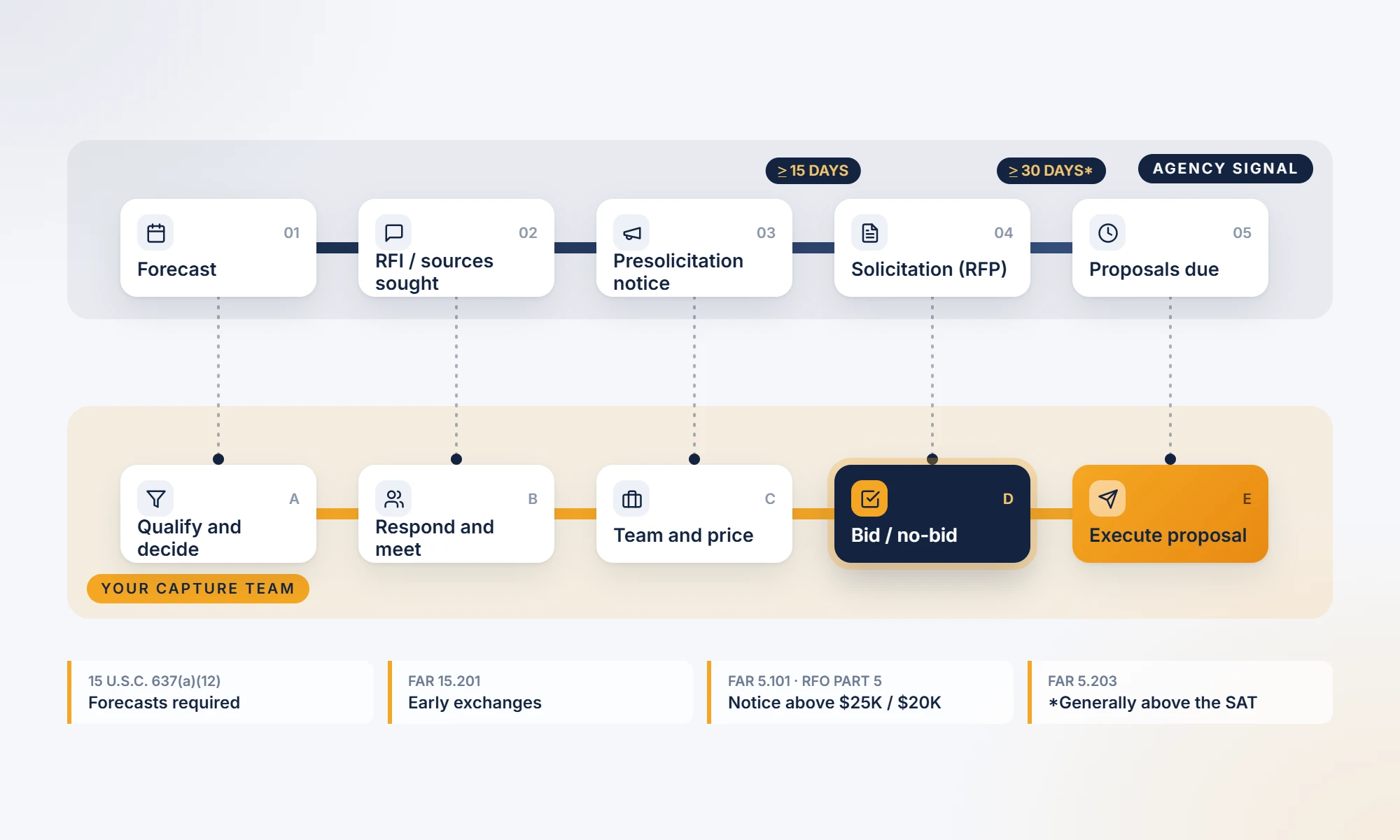
- Identify the opportunity. Find the requirement in agency forecasts, presolicitation notices, RFIs, recompete schedules and customer conversations as early as you can see it.
- Qualify it. Check fit against your capabilities, past performance, contract vehicles, set-aside status and capacity. Most opportunities should die here.
- Make the pursue decision. Commit capture resources, or walk away. This is the first gate, and it should be documented.
- Build the capture plan. Write down the customer’s needs, the competitive field, your win strategy, teaming needs and the price range you must hit.
- Engage the customer. Use industry days, one-on-one meetings, RFI responses and draft RFP comments to understand the requirement and, where appropriate, shape it.
- Shape the solution and team. Close gaps in capability or past performance with teaming partners and refine the technical approach.
- Set the price strategy. Estimate where the winning price will land and build a cost position that can get there.
- Make the bid/no-bid decision. Before the RFP drops, confirm the win probability justifies the proposal cost.
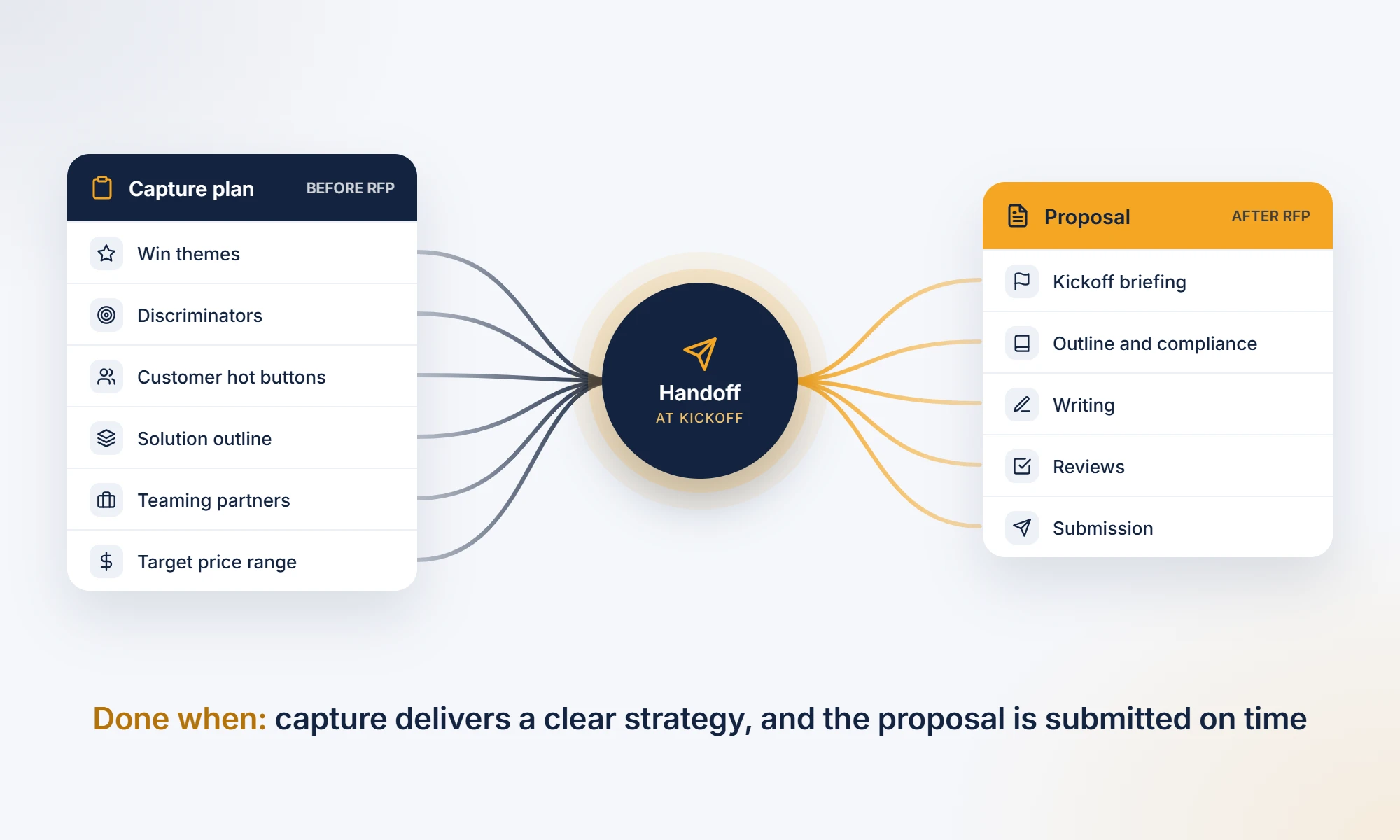
- Hand off to the proposal team. Deliver win themes, discriminators, customer hot buttons and the solution outline so the proposal starts on day one, not week two.
The stages overlap in practice. Customer engagement continues until the RFP is released, and the capture plan is a living document, not a one-time deliverable.
Where Capture Teams Find Opportunities Early
Capture only works if you see the opportunity before your competitors start positioning. Four sources do most of the work.
Agency Procurement Forecasts
Federal law requires larger agencies to publish forecasts. Under 15 U.S.C. 637(a)(12), each executive agency above the statute’s contracting threshold “shall prepare a forecast of expected contract opportunities or classes of contract opportunities” for the next and succeeding fiscal years, and “such forecasts shall be available to small business concerns.” Forecasts must be periodically revised.
GSA’s Forecast of Contracting Opportunities tool is “a governmentwide planning tool that shows upcoming federal contract opportunities,” with “a centralized view of forecasts from participating agencies.” Registration is not required to use it. Forecasts are for planning only and do not commit an agency to buy.
SAM.gov Contract Opportunities
Under FAR 5.101(a)(1), agencies must synopsize proposed contract actions “expected to exceed $25,000” in the Governmentwide Point of Entry, which is SAM.gov. Agencies operating under the FAR overhaul’s Part 5 deviation use a $20,000 presolicitation notice threshold instead. FAR 5.203(a) requires the notice to be published “at least 15 days before issuance of a solicitation,” with exceptions such as commercial acquisitions, and FAR 5.203(c) generally allows at least 30 days to respond above the simplified acquisition threshold.
Read those timelines from the capture side: if the first time you see a requirement is the presolicitation notice, you have roughly six weeks to do work that should take months.
RFIs and Sources Sought Notices
Agencies use requests for information as market research. FAR 10.002(b)(2) lists “publishing formal requests for information” and “contacting knowledgeable individuals in Government and industry regarding market capabilities” among market research techniques. Many agencies post these as sources sought notices. An RFI is often the first public sign that a requirement exists. Our RFP vs RFQ vs RFI guide explains where each notice sits in the acquisition timeline.
Small Business Offices and APEX Accelerators
SBA advises small businesses to review agency procurement forecasts and contact each agency’s small business office. DoD’s APEX Accelerators are “a nationwide network of procurement professionals” that serve as “a critical front door for industry,” with services provided “at no cost to you.”
What Goes Into a Capture Plan
A capture plan is the written strategy for one pursuit. APMP’s practitioner guidance describes structured capture plans that include “external analysis, internal analysis, strategy development.” In practice, a useful capture plan answers these questions:
The core sections of a capture plan and the question each one answers.
| Section | The question it answers |
|---|---|
| Opportunity summary | What is being bought, by whom, through which vehicle, and when? |
| Customer analysis | What does the customer need, what worries them, and who decides? |
| Competitive assessment | Who else is bidding, who is the incumbent, and what are their strengths? |
| Win strategy | Why should the customer choose you, and what are your discriminators? |
| Teaming plan | Which gaps need a partner, and under what arrangement? |
| Price strategy | Where will the winning price land, and can you get there? |
| Action plan and gates | Who does what by when, and when is the next bid decision? |
Teaming Is a Capture Decision
Teaming usually happens during capture, not during the proposal. FAR 9.601 defines a contractor team arrangement as one where “two or more companies form a partnership or joint venture to act as a potential prime contractor,” or where “a potential prime contractor agrees with one or more other companies to have them act as its subcontractors.” Our guide to prime contractor vs subcontractor covers how to decide which side of that arrangement you belong on.
Price Strategy Starts in Capture
If the capture team does not set a target price range, the proposal team will build a price nobody tested against the competition. Our guides to pricing federal bids and ROM, BOE and G&A cover the building blocks.
What Is a Capture Manager?
A capture manager is the person accountable for winning a specific pursuit. They own the capture plan, lead customer engagement, assemble the team, drive the bid decision and hand a ready strategy to the proposal manager.
Typical capture manager responsibilities include:
- Qualifying opportunities and recommending pursue or no-pursue decisions
- Building and updating the capture plan
- Leading customer meetings, industry day attendance and RFI responses
- Analyzing competitors and the incumbent
- Identifying and negotiating teaming partners
- Working with pricing on a target price range
- Presenting the bid/no-bid recommendation to leadership
- Briefing the proposal team on win themes and customer priorities
Capture Manager vs Proposal Manager
How the two roles divide the work on a single pursuit.
| Capture manager | Proposal manager | |
|---|---|---|
| Main question | Can we win this, and how? | Is our response compliant and compelling? |
| Starts | Months before the RFP | When the draft or final RFP is released |
| Owns | Capture plan, win strategy, teaming, bid decision | Proposal schedule, outline, compliance, writing and reviews |
| Works with | Customer, partners, leadership, pricing | Writers, subject matter experts, reviewers, pricing |
| Done when | The proposal team has a clear strategy | The proposal is submitted on time |
The handoff between the two is where many pursuits break. If win themes and discriminators are not written down before the proposal kickoff, the proposal team will write generic content under deadline pressure.
Why Past Performance Belongs in Capture
Past performance is not something you fix during the proposal. FAR 15.304(c)(3)(i) states that past performance “shall be evaluated in all source selections for negotiated competitive acquisitions expected to exceed the simplified acquisition threshold,” with limited exceptions. The FAR overhaul’s Part 15 text keeps the rule: past performance “must be evaluated in every competitive source selection” unless the contracting officer documents why it is not appropriate.
That makes past performance a capture question. If your relevant references are thin, the fix is a teaming partner, a different role on the team or a decision not to bid, and all three have to happen before the RFP. Our government contract types guide also explains how contract type changes the risk you are taking on.
Common Capture Management Mistakes
Capture teams rarely lose because they did nothing. They lose because they did the right things too late or on the wrong pursuits.
- Starting at the RFP. Under the FAR’s 15-day notice and 30-day response minimums, a team that starts at the presolicitation notice has weeks to do months of work.
- Pursuing everything. A pipeline with no qualification gate burns proposal budget on low-probability bids.
- Writing no capture plan. Strategy that lives in one person’s head cannot be handed to a proposal team.
- Teaming late. The strongest partners are committed early. Late teaming means taking whoever is left.
- Skipping the price conversation. A technically strong proposal at the wrong price still loses.
- Losing track of dates across pursuits. Forecast updates, RFI deadlines, industry days and draft RFP comment windows arrive on different schedules for every opportunity.
Most of these come down to visibility: knowing which pursuits are live, what stage each one is in and what is due next.
GovFind finds the opportunity. GovOps360 wins it.
See Where GovOps360 Fits Your Pipeline
Bring an opportunity you are tracking now. We will walk through how your team runs capture today and where GovOps360 fits.
Frequently Asked Questions
1. What is capture management in one sentence?
2. What does a capture manager do?
3. What is the difference between capture management and proposal management?
4. When should capture management start?
5. What is a capture plan?
6. Where do capture teams find opportunities early?
7. Is capture management required by the FAR?
8. Do small businesses need a capture manager?
References and Sources
All sources were checked on November 20, 2026.
- FAR 15.201, Exchanges with industry before receipt of proposals
- FAR Overhaul: Part 15 model deviation
- FAR Part 10, Market Research
- FAR 5.101, Methods of disseminating information
- FAR Subpart 5.2, Synopses of Proposed Contract Actions
- FAR Overhaul: Part 5 model deviation
- FAR 9.601, Definitions (contractor team arrangements)
- FAR 15.304, Evaluation factors and significant subfactors
- 15 U.S.C. 637(a)(12), Agency procurement forecasts
- GSA: Forecast of Contracting Opportunities
- SBA: How to win contracts
- DoD Office of Small Business Programs: APEX Accelerators (PDF)
- APMP: Winning Business Ecosystem
Related reading: GovCon glossary · IDIQ contracts explained

Alaa Negeda
Senior Solution Architect with 23 years of experience in different Technology sectors. Diligent, forward-thinking, and adaptable to dynamic company, customer, and project needs.
Related Articles
Nov 18,2026 GSA Schedule: What It Is and How to Get On One
Sep 30,2026 RFP vs RFQ vs RFI: Which Solicitation You Are Looking At and What to Do
Sep 28,2026
By Alaa Negeda