



 By Alaa Negeda
What Is an IDIQ Contract?
An IDIQ contract is a contract that buys you the right to compete. It does not buy you work. The government awards it, often to a dozen or more companies at once, and then runs a separate competition every time it actually wants something. Winning the contract and winning revenue are two different events, sometimes years apart, and plenty of companies only ever manage the first.
That gap is the whole subject. The rules that create it sit in FAR subpart 16.5: a minimum the government is genuinely obligated to buy, a ceiling that promises nothing, a competition standard for orders called fair opportunity with seven statutory exceptions, and a protest bar that closes off most of the remedies you would expect.
This guide covers what an IDIQ is, what the minimum and the ceiling commit each side to, how orders are competed, how you get on a vehicle, whether you can join later, how long the ordering period can run, and why so many awardees never convert a seat into a dollar. Two figures in it are current as of 2026 and wrong on almost every other page on this subject, and both are flagged where they appear.
An IDIQ contract is an indefinite-delivery, indefinite-quantity contract: an agreement to supply an indefinite quantity of supplies or services, within stated minimum and maximum limits, over a fixed period. The government places individual orders against it as requirements come up. FAR 16.504(a) puts it plainly: the contract provides for an indefinite quantity, within stated limits, of supplies or services during a fixed period, and the government places orders for individual requirements.
Two consequences follow, and they explain most of what confuses people later.
- The quantity is unknown at award. The contract fixes the rules, the scope and the price structure, then leaves the volume open.
- The award is frequently made to several companies at once. FAR 16.504(c)(1)(i) requires contracting officers, to the maximum extent practicable, to prefer multiple awards under a single solicitation. The normal case is that you share the vehicle with competitors.
What Does IDIQ Stand For?
IDIQ stands for indefinite delivery, indefinite quantity, and the two halves describe two separate unknowns. Indefinite delivery means the timing of deliveries is not fixed at award. Indefinite quantity means the amount is not fixed either, beyond a stated minimum and maximum. The FAR itself does not use the acronym; it calls the instrument an indefinite-quantity contract, one of three indefinite-delivery contract types.
One thing IDIQ does not describe is contract type in the FAR Part 16 sense. FAR 16.501-2(c) allows an indefinite-delivery contract to use any appropriate cost or pricing arrangement, so a single IDIQ can carry firm-fixed-price, cost-reimbursement and time-and-materials orders, and many do.
Which FAR Subpart Governs IDIQ Contracts?
FAR subpart 16.5, Indefinite-Delivery Contracts. FAR 16.504 covers the indefinite-quantity contract itself and FAR 16.505 covers ordering. The underlying authority is statutory: 10 U.S.C. 3401 and 41 U.S.C. 4101 define the instrument, 10 U.S.C. 3403 and 41 U.S.C. 4103 authorize the award, and 10 U.S.C. 3406 and 41 U.S.C. 4106 govern ordering and protests.
One boundary matters immediately. FAR 16.500(c) states that GSA regulations and the Federal Supply Schedule coverage in subpart 8.4 and Part 38 take precedence over this subpart. Orders under a GSA Schedule are therefore not governed by the fair opportunity rules in this article. They follow FAR 8.405 instead, and FAR 8.404(a) treats them as issued using full and open competition.
Defense agencies also layer DFARS subpart 216.5 on top of this subpart, so a DoD vehicle carries both rulebooks. FAR vs DFARS covers how the two stack and how to tell a supplemental clause from a FAR one.
The Three Indefinite-Delivery Contract Types
FAR 16.501-2(a) lists three, and only one of them is an IDIQ.
- Definite-quantity contract. A fixed quantity, delivered at times to be determined. The amount is known; only the schedule is open.
- Requirements contract. The government buys all of its actual requirements for the covered supplies or services from one contractor. The quantity is unknown, but the share is total.
- Indefinite-quantity contract. The IDIQ. Quantity unknown between a stated minimum and maximum, and no promise of exclusivity.
FAR 16.501-2(b)(3) draws the line that matters for a bidder: an indefinite-quantity contract limits the Government’s obligation to the minimum quantity specified in the contract. A requirements contract does not work that way. If you are told you have won a vehicle, the first question is which of the three it is.
Task Order vs Delivery Order
The distinction is supplies against services, and nothing else. FAR 16.501-1 defines a delivery-order contract as a contract for supplies that does not procure or specify a firm quantity other than a minimum or maximum, and a task-order contract as the same instrument for services. Orders placed under them are delivery orders and task orders respectively.
So a services IDIQ issues task orders and a supplies IDIQ issues delivery orders. Nothing about the competition rules, the minimum, the ceiling or the protest bar changes between them, which is why the FAR almost always writes the pair together as “task or delivery order”.
A more useful distinction is between the contract and the order. The contract is your seat. The order is what has money on it. Scope, period and maximum value are set at the contract level, and FAR 16.505(a)(2) requires every order to be within the scope, issued within the period of performance, and within the maximum value of the contract. An order that breaks any of the three is the one category of order decision that stays fully protestable, as covered below.
The Guaranteed Minimum and the Ceiling
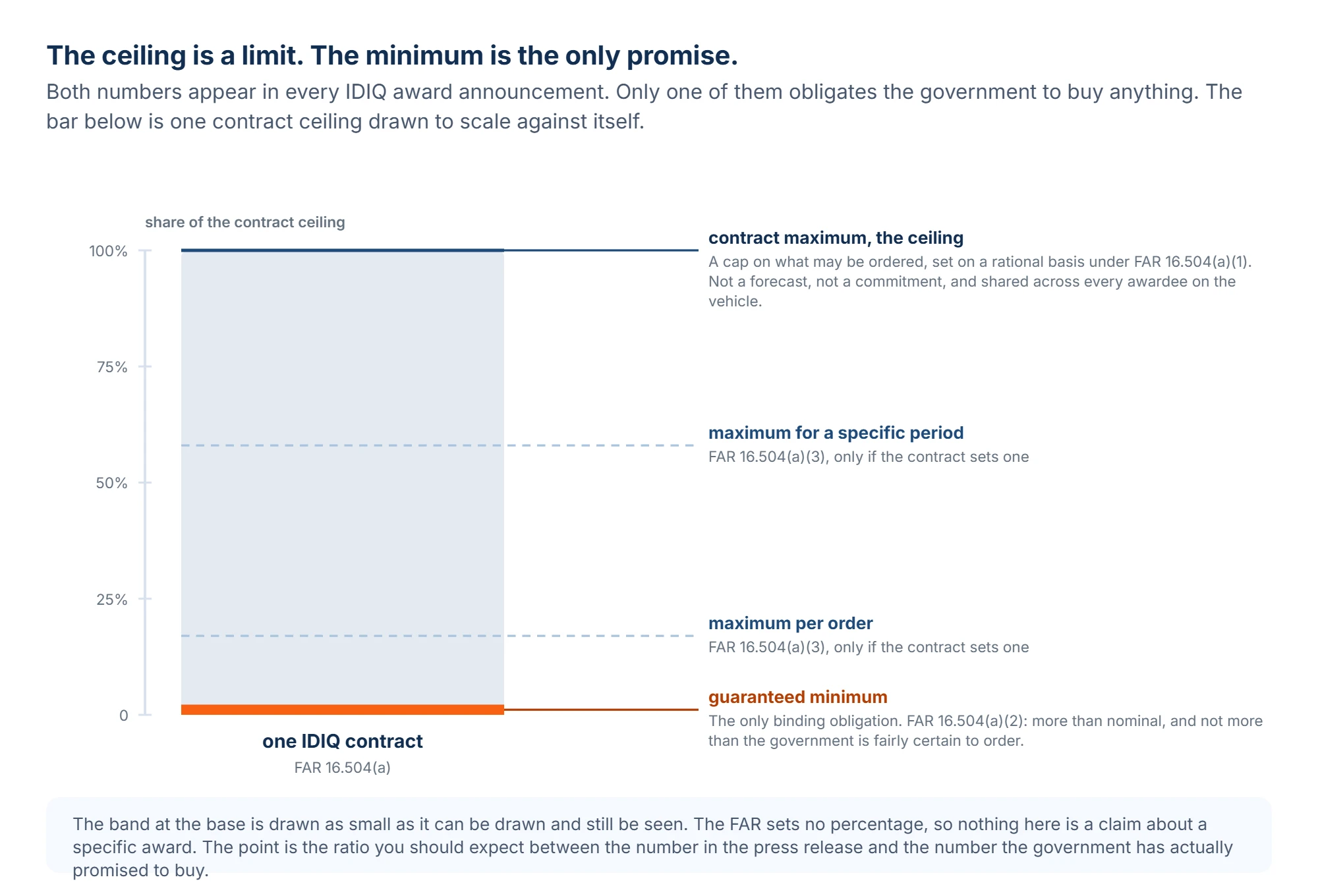
These two numbers appear side by side in every IDIQ announcement and they carry completely different weight. One is an obligation. The other is a limit.
FAR 16.504(a)(1) requires the contract to oblige the government to order, and the contractor to furnish, at least a stated minimum quantity. That is real consideration and it is what makes the contract binding. FAR 16.504(a)(2) then constrains it from both directions: the minimum must be more than a nominal quantity, but it should not exceed the amount that the Government is fairly certain to order.
Read that with a bidder’s eye. The government must promise more than a token and is advised not to promise more than it is confident it will need, which lands the guaranteed minimum on a large multiple-award vehicle somewhere between trivial and small. It is frequently satisfied by a single order to a single awardee, and FAR 16.505(b)(2)(i)(D) makes that explicit by listing “necessary to place an order to satisfy a minimum guarantee” as a standing exception to competing the order at all.
The maximum runs the other way. FAR 16.504(a)(1) tells the contracting officer to set it on a rational basis such as market research or recent comparable contracts. It is a cap on what may be ordered, not a forecast and not a commitment, and it is shared across every awardee on the vehicle. The headline number in a press release is almost always this one.
FAR 16.504(a)(3) adds a third layer that gets missed: the contract may also set maximum or minimum quantities per order and a maximum for any specific period. Those caps are often where the practical constraint actually sits.
IDIQ vs GWAC vs BPA vs GSA Schedule
These four are routinely used as synonyms for “contract vehicle” and they are not interchangeable. Two are IDIQs, one carries no obligation to buy anything, and one is governed by a different part of the FAR entirely. Short definitions for each are in the GovCon glossary.
| Vehicle | What it actually is | Who can place orders | Which rules govern ordering | Guaranteed minimum |
|---|---|---|---|---|
| Agency IDIQ | An indefinite-quantity contract under FAR 16.504 | The awarding agency, and any activity the contract authorizes | FAR 16.505, including fair opportunity if multiple award | Yes. FAR 16.504(a)(1) requires a stated minimum |
| GWAC | An IDIQ for information technology, established by one agency for governmentwide use under an OMB executive agent designation | Any federal agency, through the executive agent | FAR 16.505, the same as any other IDIQ | Yes. It is an IDIQ |
| BPA | A simplified method of filling repetitive needs by establishing charge accounts, under FAR 13.303 | The establishing activity and any activity named in the BPA | FAR 13.303, or FAR 8.405-3 if established under a Schedule | No. FAR 13.303-3(a)(2) obligates the government only to the extent of purchases actually made |
| GSA Schedule | A long-term GSA contract for commercial products and services under FAR subpart 8.4 and Part 38 | Any ordering activity authorized to use the Schedules | FAR 8.405. FAR 16.500(c) gives subpart 8.4 precedence over subpart 16.5 | No minimum flows to you from Schedule status |
FAR 2.101 defines a governmentwide acquisition contract as a task-order or delivery-order contract for information technology, established by one agency for governmentwide use and operated by an executive agent designated by OMB under 40 U.S.C. 11302(e). A GWAC is therefore an IDIQ with an extra layer of authority on top, and the IT restriction is part of the definition. A multi-agency contract is the broader relative: the same instrument, open to other agencies under the Economy Act, without the IT limitation.
A BPA is the odd one out. FAR 13.303-1(a) calls it a simplified method of filling anticipated repetitive needs by establishing charge accounts with qualified sources, and FAR 13.303-3(a)(2) requires a statement that the government is obligated only to the extent of authorized purchases actually made. There is no minimum, and under FAR 13.303-5(b) individual purchases generally may not exceed the simplified acquisition threshold. Schedule BPAs are their own case: FAR 8.405-3(d) caps a single-award Schedule BPA at one year with up to four one-year options, while multiple-award Schedule BPAs generally should not exceed five years.
How Task Orders Are Competed Under an IDIQ
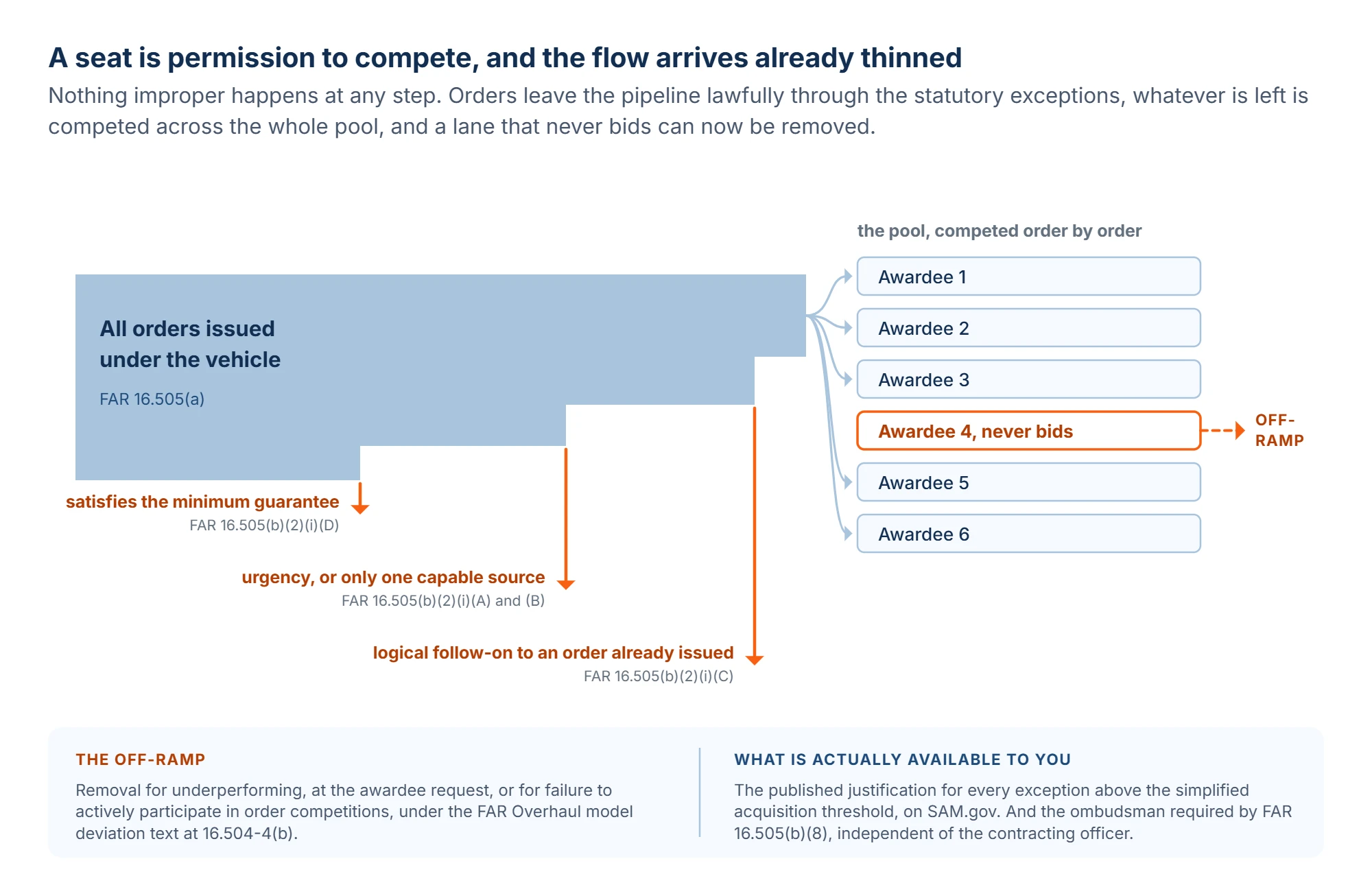
On a multiple-award IDIQ, the competition you won gets you into a pool. Every order after that is competed inside the pool under FAR 16.505(b), and the effort scales with the value of the order.
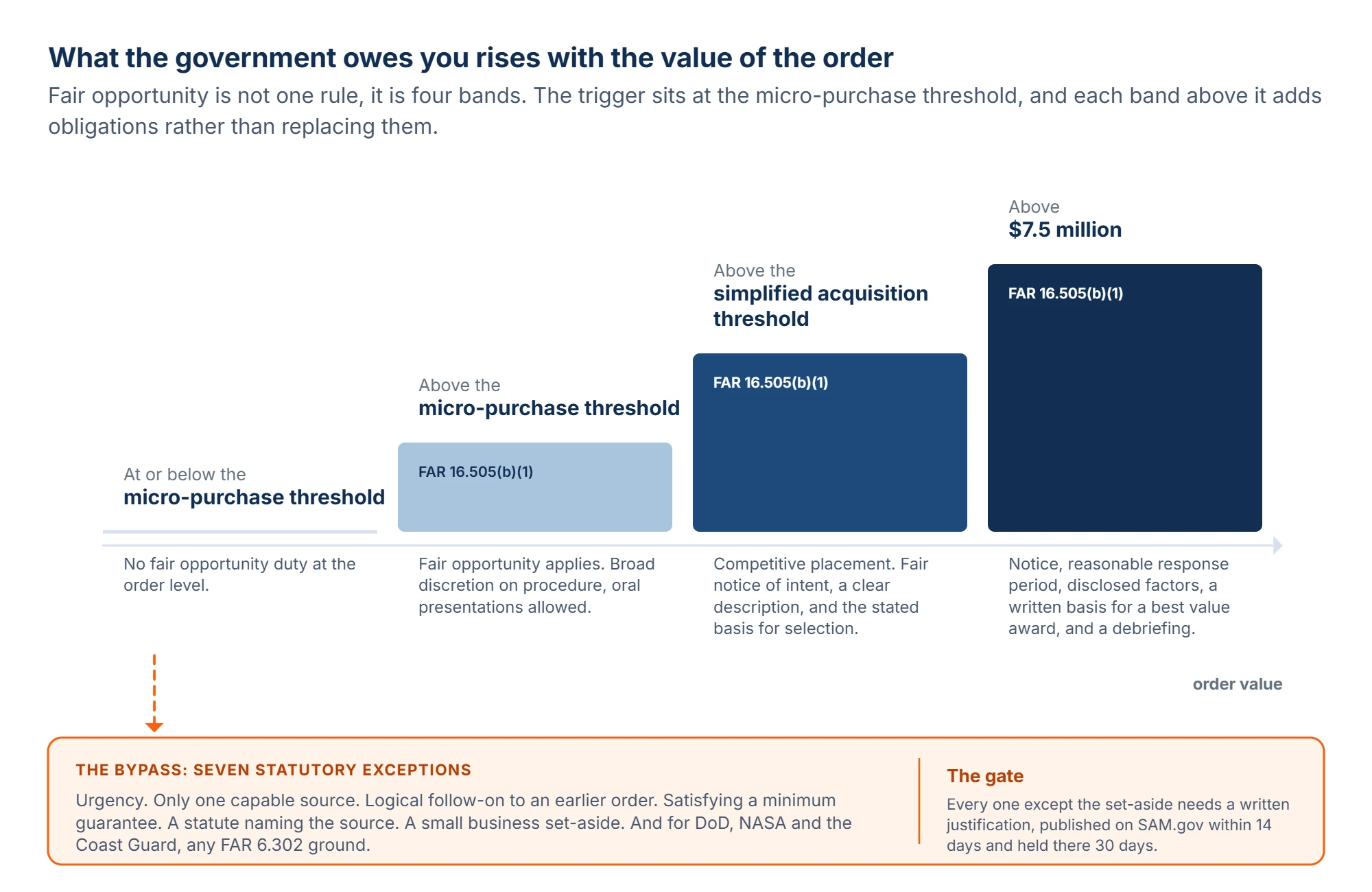
FAR 16.505(b)(1)(i) sets the trigger low: the contracting officer must give each awardee a fair opportunity to be considered for each order exceeding the micro-purchase threshold. Above that, three tiers apply.
- Above the micro-purchase threshold. Fair opportunity applies. The contracting officer has broad discretion over procedure, should keep submission requirements to a minimum, and may use streamlined methods including oral presentations. Part 6 and subpart 15.3 do not apply to the ordering process.
- Above the simplified acquisition threshold. FAR 16.505(b)(1)(iii) requires competitive placement, with fair notice of the intent to purchase, a clear description of the work, the basis on which selection will be made, and a fair opportunity for every responding contractor to have its offer fairly considered.
- Above $7.5 million. FAR 16.505(b)(1)(iv) adds five mandatory elements: a notice stating the requirement clearly, a reasonable response period, disclosure of the significant factors and subfactors including cost or price and their relative importance, a written statement documenting the basis for a best value award, and an opportunity for a postaward debriefing.
Two details matter to a bidder. FAR 16.505(b)(1)(ii)(E) makes price or cost a mandatory factor in every order selection, and FAR 16.505(b)(1)(ii)(B) forbids any method, such as allocating work or designating a preferred awardee, that would not give fair consideration to all awardees before each order. Rotation schemes are not permitted.
The Seven Exceptions to Fair Opportunity
FAR 16.505(b)(2)(i) lists the statutory grounds on which an order can go to one awardee without competition inside the pool.
- Urgency. The need is so urgent that providing a fair opportunity would cause unacceptable delays.
- Only one capable source. Only one awardee can provide the supplies or services at the level of quality required, because they are unique or highly specialized.
- Logical follow-on. The order follows on from an order already issued under the contract, in the interest of economy and efficiency, provided all awardees had a fair opportunity on the original order.
- Minimum guarantee. The order is necessary to satisfy a minimum guarantee.
- Statutory source. Above the simplified acquisition threshold, a statute expressly authorizes or requires purchase from a specified source.
- Small business set-aside. Under 15 U.S.C. 644(r), the contracting officer may set an order aside for small business concerns. This is the one exception that needs no written justification.
- DoD, NASA and Coast Guard. The order meets one of the FAR 6.302 exceptions to full and open competition, under 10 U.S.C. 3406(c)(5).
Each of these except the set-aside requires a written justification, and FAR 16.505(b)(2)(ii)(D) requires it to be published on SAM.gov within 14 days of placing an order above the simplified acquisition threshold, or 30 days for an urgency order, and to stay posted for at least 30 days. If a task order you expected to compete for was awarded without competition, that public justification is where the reason is written down.
Can You Protest a Task Order?
Mostly not. FAR 16.505(a)(10)(i) bars protests in connection with the issuance of an order under a task-order or delivery-order contract, with two exceptions: a protest that the order increases the scope, period, or maximum value of the contract, which is available at any dollar value, and a protest of an order above a dollar threshold, which may only be filed at the Government Accountability Office.
Here is the first of the two currency corrections. Almost every page on this topic, including the FAR text itself, gives the defense threshold as $25 million. It is now $35 million. Public Law 118-159, enacted 23 December 2024, substituted $35,000,000 for $25,000,000 in 10 U.S.C. 3406(f)(1)(B). The civilian threshold at 41 U.S.C. 4106(f) remains $10 million. The FAR text at 16.505(a)(10)(i)(B)(2) still reads $25 million and has not caught up; the Revolutionary FAR Overhaul model deviation text, at its renumbered 16.508(a)(2)(ii), reads $35 million. The statute governs.
How Do You Get On an IDIQ?
You compete for it, in a single full proposal, usually long before any work exists. The award is a normal competitive acquisition: synopsized, solicited, evaluated and awarded under the ordinary rules. What is different is that you are evaluated on capability against a scope description rather than on a solution to a defined requirement.
FAR 16.504(a)(4) sets out what the solicitation has to give you, and it doubles as the checklist for reading one.
- The period, and the options. The number of options and the period covered by each.
- The total minimum and maximum. The quantities the government will acquire across the whole contract.
- A scope description. A statement of work, specification or other description reasonably describing the general scope, nature, complexity and purpose, in a manner that will enable a prospective offeror to decide whether to submit an offer.
- The ordering procedures. Including the ordering media, and, where multiple awards may be made, the procedures and selection criteria that will be used to give awardees fair opportunity on each order.
- Who can order. A description of the activities authorized to issue orders.
The fourth item is the one to read first and the one most bidders read last. It tells you, before you spend anything, how orders will be competed on this vehicle. One where every order runs a full technical evaluation is a different business proposition from one where orders are priced against pre-negotiated labor rates, and the difference decides whether your bid and proposal budget survives the ordering phase.
One structural point affects whether you should bid at all. FAR 16.504(c)(1)(ii)(A) directs the contracting officer to avoid a pool where awardees specialize exclusively in one or a few areas of the statement of work, because that produces sole-source orders. If your capability is narrow and the scope is broad, you are being evaluated against that intent.
Can You Join an IDIQ After Award?
Only if the contract was built to let you. The mechanism is called an on-ramp, and until recently the FAR did not mention it at all. Where on-ramps exist, they exist because the original solicitation created them, so the answer for any specific vehicle sits in that vehicle’s terms rather than in a general rule.
This is the second currency correction, and it is a genuine change. The Revolutionary FAR Overhaul model deviation text for Part 16 adds a section that has no counterpart in the current FAR: 16.504-4, On-ramps and off-ramps. It states that to maintain a current, competitive and innovative pool of vendors on a multiple-award contract, the solicitation and contract may provide for adding a new contractor and increasing the maximum quantity during open seasons, and for removing a contractor for underperforming, for failure to actively participate in order competitions, or at the awardee’s own request.
Two readings follow. On-ramps now have a named place in model regulatory text, which makes them easier to ask for during industry engagement on a draft solicitation and easier for a contracting officer to justify including. And the off-ramp is aimed squarely at the awardee who holds a seat and never bids: sitting on a vehicle is now a listed ground for removal.
One caution. Model deviation text is not the FAR. It binds a given acquisition only where the agency has issued a class deviation adopting it, and agencies have been adopting Part 16 deviations at different speeds, so check the deviation guide on acquisition.gov and the solicitation itself before relying on it. If neither provides for on-ramping, the practical route onto a closed vehicle is subcontracting or teaming with a prime who already holds a seat, and neither gives you a seat of your own.
How Long Can an IDIQ Ordering Period Run?
The five-year figure everyone quotes is real, but it does not come from where people think and it is not a general limit on IDIQ contracts. Three separate rules are being blurred together.
- Defense agencies: five years, extendable to ten. 10 U.S.C. 3403(f) allows a task or delivery order contract to cover a period up to five years, extendable by option or modification, with the total not exceeding ten years unless the agency head determines in writing that exceptional circumstances require longer.
- Options generally: five years for services. FAR 17.204(e) provides that, unless otherwise approved under agency procedures, the total of the basic and option periods shall not exceed five years for services. It carries an exception that explains a great deal about the IT vehicle landscape: these limitations do not apply to information technology contracts.
- Advisory and assistance services: five years, with one six-month extension. FAR 16.505(c) limits the ordering period of a task-order contract for advisory and assistance services, including all options and modifications, to five years, unless a statute authorizes longer or the advisory services are incidental. FAR 16.505(c)(3) permits one sole-source extension of up to six months where the follow-on award is delayed by circumstances that were not reasonably foreseeable.
For civilian agencies the picture is looser than most summaries admit. 41 U.S.C. 4103 requires the solicitation to state the period and the options but sets no overall cap of its own, which is why long civilian IT vehicles are routine and a ten-year ordering period is a normal shape rather than an exception.
What an IDIQ Seat Actually Costs to Chase
There is no published federal figure for this, and the numbers circulating on vendor pages are unsourced. What can be said accurately is where the cost falls, and it is not all at the front.
The vehicle proposal is one full bid and proposal cycle for a contract that may return nothing. The ordering phase is then a repeating cost for the life of the vehicle, because every order above the micro-purchase threshold is another competition and every order above $7.5 million triggers the full FAR 16.505(b)(1)(iv) treatment. Each of those orders is priced from the same rate structure and basis of estimate discipline as any other bid. A ten-year vehicle with monthly order competitions is a decade-long standing commitment of capture and proposal capacity, and that recurring number, not the seat, is what should drive a bid or no-bid decision.
Why IDIQ Holders Win a Seat and Never Win a Task Order
The industry nickname for an IDIQ seat is a hunting license, and it is accurate. The vehicle grants permission to hunt and guarantees nothing about the hunting. The failure is common enough that the government has now written a removal mechanism for it, and the mechanics are more useful than any statistic.
Four things happen, usually together.
- The pool is larger than the order flow. The multiple-award preference at FAR 16.504(c)(1)(i) pushes toward more awardees, and the factors at (c)(1)(ii)(A) include maintaining competition among awardees throughout the period of performance. A pool sized for competition is, by design, one where most awardees lose most orders.
- The exceptions absorb the early orders. The logical follow-on exception at FAR 16.505(b)(2)(i)(C) means that whoever wins the first order in a work area has a defensible path to the next one. Early orders compound.
- The bid and proposal budget runs out before the order flow starts. A vehicle awarded in year one may see its first substantial orders in year two or three, and companies that spent their capture capacity winning the seat often cannot fund the order competitions when they arrive.
- There is almost no remedy. The protest bar at FAR 16.505(a)(10) closes off the normal correction mechanism for orders below the threshold. Losing repeatedly is not, by itself, something you can challenge.
Two levers exist and both are underused. FAR 16.505(b)(8) requires the head of each agency to designate a task-order and delivery-order ombudsman who must review complaints from contractors and ensure they are given a fair opportunity to be considered, consistent with the contract procedures. The ombudsman must be a senior official independent of the contracting officer. That is a named, non-protest channel for the specific complaint that the ordering procedures are not being followed, and most awardees never use it.
The second is the public record. Every exception to fair opportunity above the simplified acquisition threshold has a published justification on SAM.gov under FAR 16.505(b)(2)(ii)(D). If orders on your vehicle keep going to one awardee, the reasons are written down and readable, and whether the pattern is a logical follow-on chain, a recurring urgency claim or a series of set-asides changes what you should do about it.
A dormant seat is also no longer a safe asset to hold: under the model deviation text at 16.504-4(b), failure to actively participate in order competitions is a listed ground for removal.
The FAR Overhaul Renumbers All of This
Everything above cites the FAR as published, currently FAC 2026-01, effective 13 March 2026. The Revolutionary FAR Overhaul has separately published model deviation text for Part 16 that restructures subpart 16.5. Where an agency has adopted it by class deviation, the citations in its solicitation will not match this article or any other source written against the published FAR.
The changes that matter for IDIQ work are structural rather than cosmetic.
- 16.504 is subdivided. Description, Application, Multiple award preference, On-ramps and off-ramps, and Required content become 16.504-1 through 16.504-5.
- On-ramps and off-ramps are new. 16.504-4 has no counterpart in the published FAR.
- Ordering moves out of 16.505. In the model text, 16.505 becomes solicitation provisions and contract clauses. Ordering procedures move to 16.506 and 16.507, with fair opportunity at 16.507-2 and the exceptions at 16.507-6, organized by value band.
- Protests get their own section. 16.508, carrying the corrected $35 million defense threshold.
The practical rule is simple: read the solicitation for which text applies, and never assume a paragraph number from a blog post, including this one, matches the document in front of you.
How to Track Task Order Flow Across Multiple IDIQs
Holding one vehicle is a capture problem. Holding four is an operations problem, and it fails in ways that have nothing to do with the quality of your proposals.
- Orders are not synopsized. FAR 16.505(a)(1) states that the contracting officer generally does not synopsize orders under indefinite-delivery contracts. Notices arrive through whatever ordering medium the contract specified, to whatever address is on file, and not where you watch for opportunities.
- Response periods are short and start without warning. Above $7.5 million a reasonable response period is required. Below it the contracting officer has broad discretion, so a notice that sits unread for four days can be most of the window.
- The pattern is invisible one order at a time. Whether you are losing on price, losing on past performance or not being solicited at all only shows up across a run of orders, and across vehicles. Meanwhile each vehicle runs down its own ceiling, its per-order caps under FAR 16.504(a)(3) and its ordering period, and nobody sends a reminder.
That gives four questions any company holding more than one vehicle should be able to answer without a meeting:
- Which orders have come out on each vehicle this quarter, which did we bid, and which did we miss entirely?
- Where an order was awarded without competition, is the published justification on file and read?
- On each vehicle, what is our bid rate, our win rate, and the trend of both?
- Which ordering periods and ceilings are within twelve months of running out?
GovOps360 keeps the vehicle, its orders, what was bid, what was won and the dates in one record, so the pattern across a portfolio of IDIQs is visible without assembling it by hand each quarter. GovFind finds the opportunity. GovOps360 wins it.
See Where GovOps360 Fits Your Pipeline
Bring the vehicles you hold and the last three task orders you did not bid. We will walk through how the flow would be tracked and tell you where another tool is the better fit.
Frequently Asked Questions
1. What is the difference between a single-award and a multiple-award IDIQ?
2. Is an IDIQ a contract type?
3. What is an IDIQ ceiling breach?
4. Is a GWAC an IDIQ?
5. What is the difference between an IDIQ and a BPA?
6. Can a task order be set aside for small business?
7. How long can an IDIQ contract last?
8. Can you protest the award of a task order?
References and Sources
Every FAR citation was read on acquisition.gov against FAC 2026-01, effective 13 March 2026, and every statutory citation against the current United States Code, on 5 September 2026. The Revolutionary FAR Overhaul model deviation text for Part 16 was read on the same day.
- FAR subpart 16.5, Indefinite-Delivery Contracts, including 16.500(c), 16.501-1, 16.501-2, 16.504 and 16.505
- FAR 2.101, definitions of governmentwide acquisition contract and multi-agency contract
- FAR subpart 8.4, Federal Supply Schedules, including 8.404(a) and 8.405-3(d)
- FAR subpart 13.3, including 13.303-1(a), 13.303-3(a)(2) and 13.303-5(b) on blanket purchase agreements
- FAR 17.204(e), the five-year limit on basic and option periods and the information technology exception
- Revolutionary FAR Overhaul, model deviation text for Part 16, including 16.504-4 on-ramps and off-ramps and 16.508 protests
- 10 U.S.C. 3403, task and delivery order contracts, including the contract period rule at (f) and the single-source threshold at (d)(3)
- 10 U.S.C. 3406(f), the task order protest threshold, raised to $35,000,000 by Public Law 118-159
- 41 U.S.C. 4103, the civilian award authority, which sets no overall cap on the contract period
Related reading: government contract types covers what type your task orders will actually be, ROM, BOE and G&A covers pricing them, and FAR vs DFARS covers which rulebook applies to the vehicle.

Alaa Negeda
Senior Solution Architect with 23 years of experience in different Technology sectors. Diligent, forward-thinking, and adaptable to dynamic company, customer, and project needs.
Related Articles

 Sep 30,2026
 RFP vs RFQ vs RFI: Which Solicitation You Are Looking At and What to Do
 Sep 28,2026
 DDQ Meaning: What a Due Diligence Questionnaire Asks and How to Answer It
 Sep 25,2026