



 By Alaa Negeda
Before the Math: What “Price” Means on a Federal Bid
Learning how to price federal bids is not one skill. It is two, and most guides only teach the first. The first is arithmetic: turn a wage into a fully burdened price without dropping anything. The second is anticipation: know what the government will do to that number after you submit it, and price so it survives.
Deltek and acquisition.gov explain the arithmetic well enough. What almost nobody does is run one contract from a wage to a submitted price with real figures, then show you the four things the government does to it next. That is what this article does.
The four gates every federal price passes through
Once your price leaves your building, it runs a gauntlet. Knowing the order matters, because each gate has a different failure mode:
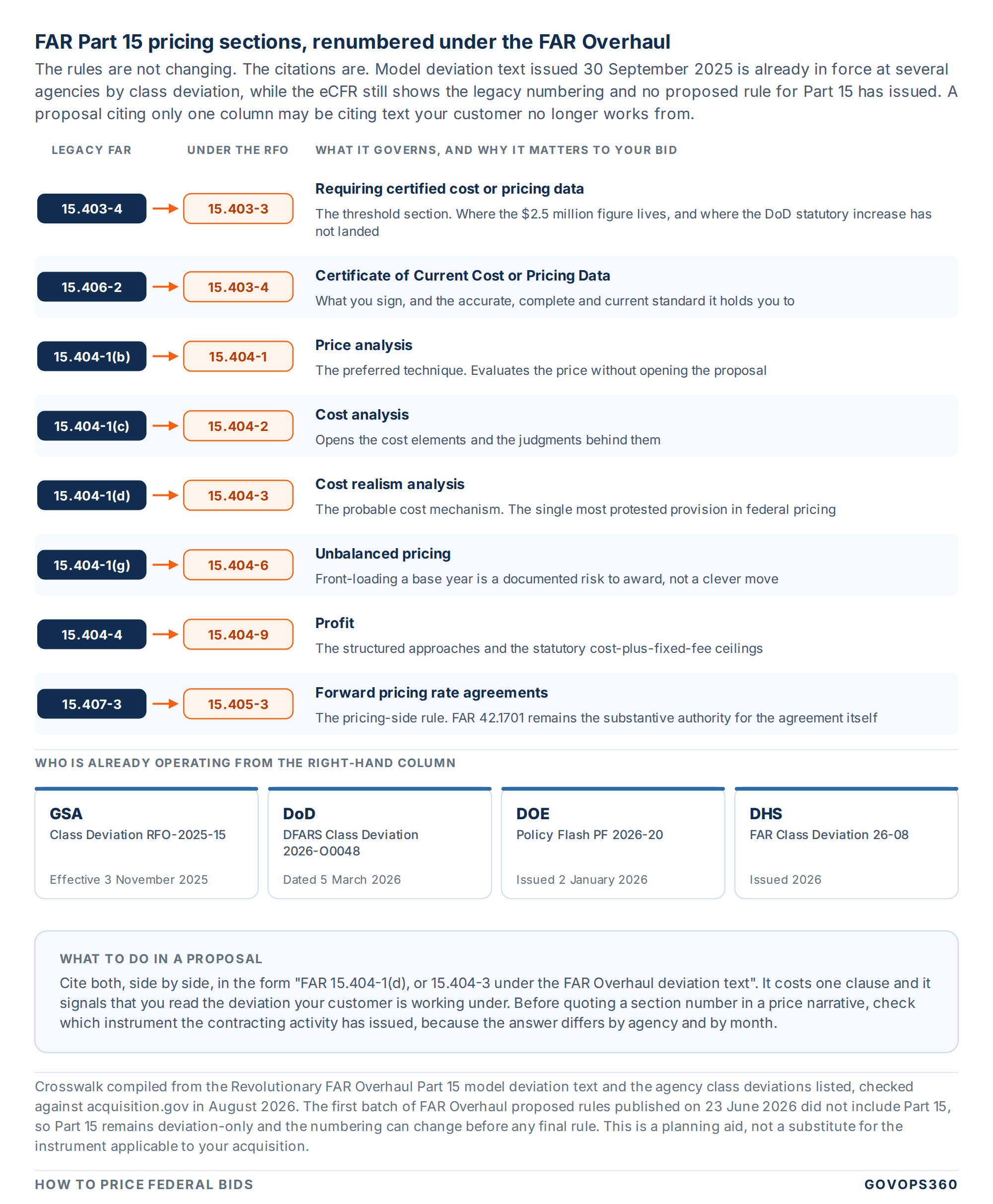
- Price analysis or cost analysis. Which one the contracting officer performs depends on what information they can require from you, and that turns on the TINA threshold. FAR 15.404-1(b) and (c).
- Cost realism analysis. Mandatory on cost-reimbursement work, discretionary on some fixed-price work, and the gate where a low price stops helping you. FAR 15.404-1(d).
- Profit or fee analysis. Structured, and on DoD work usually the weighted guidelines. FAR 15.404-4 and DFARS 215.404-4.
- Certification, and afterwards, audit. If you crossed the threshold you signed a certificate, and that certificate has a long tail. FAR 15.406-2 and 15.407-1.
The rest of this guide walks the build-up first, because you cannot pass a gate you cannot compute. Then it takes the gates one at a time.
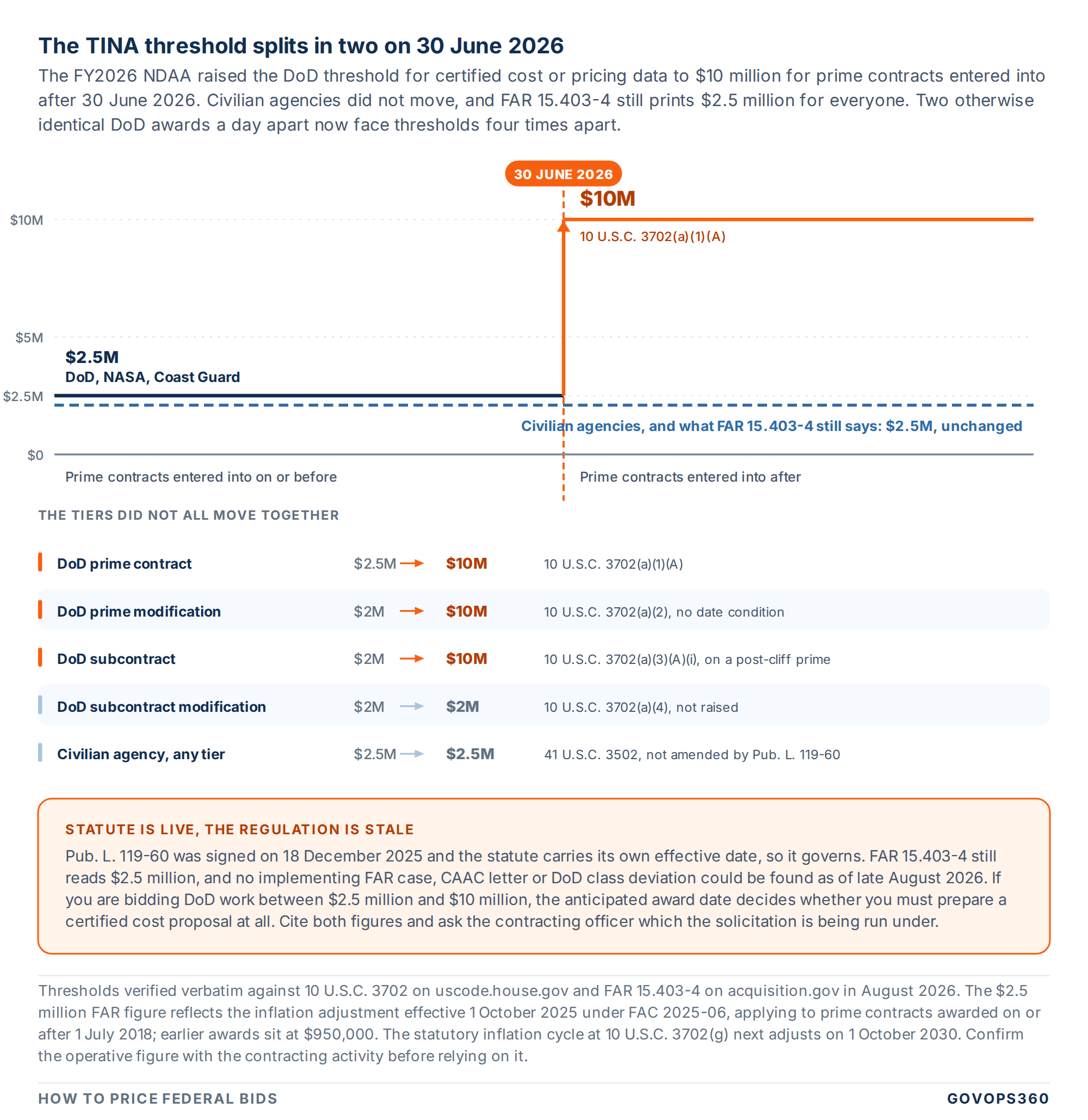
$10,000,000
The DoD threshold for certified cost or pricing data on prime contracts entered into after 30 June 2026, up from $2 million. FAR 15.403-4 still prints $2.5 million
$2,500,000
The threshold the FAR actually states today, for prime contracts awarded on or after 1 July 2018. Civilian agencies did not move at all
4 of 4
GAO cost realism sustains in 2025 that turned on the agency's comparison method or documentation, not on a bidder pricing too low
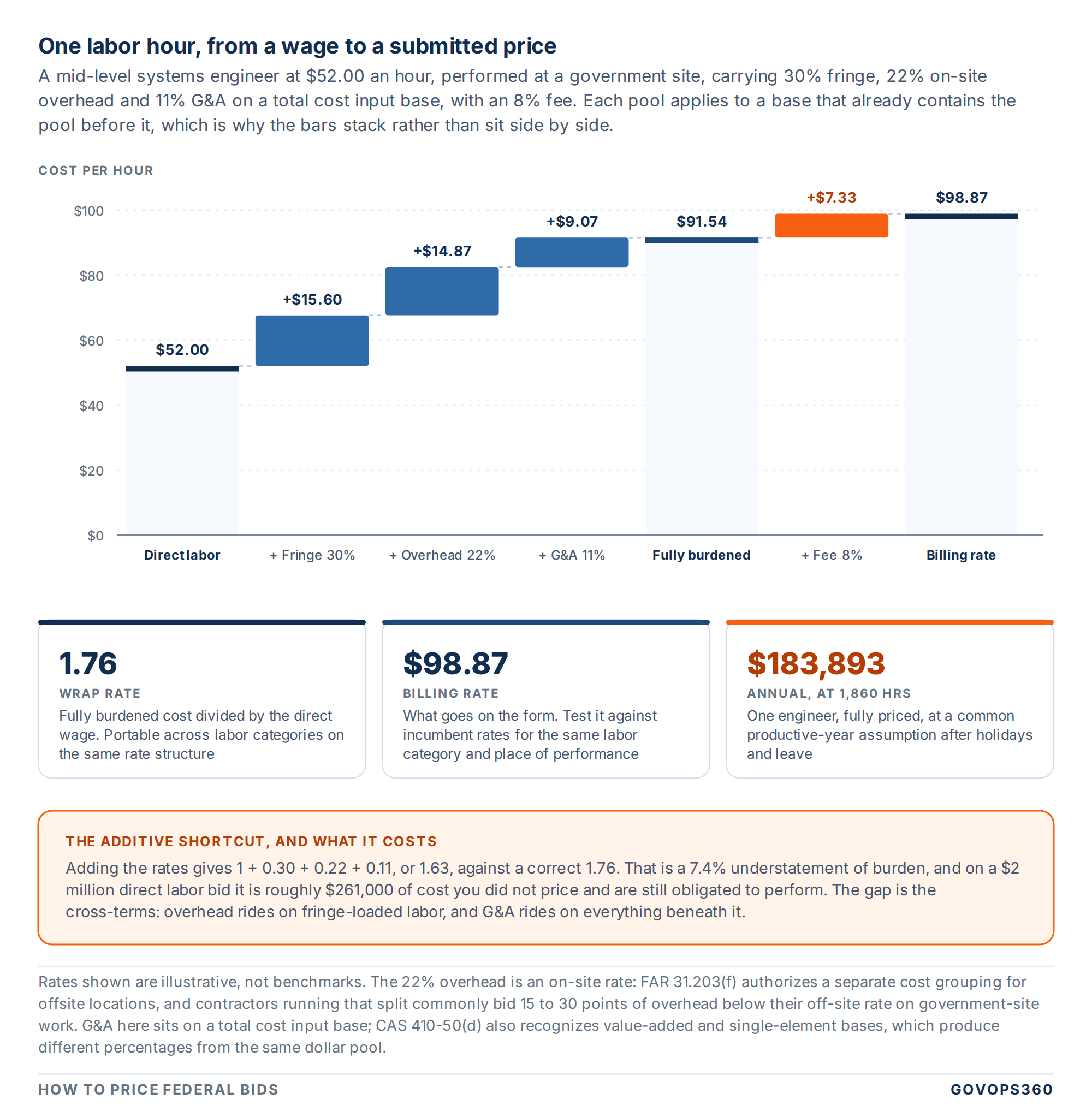
Step by Step: How to Price Federal Bids From a Wage to a Submitted Price
Everything downstream depends on getting this cascade right, and the cascade has exactly one rule: every pool applies to a base that already contains the pool before it. Rates compound. They do not add.
We will price one labor category on a five-year time-and-materials task order. A mid-level systems engineer at $52.00 an hour, performed at a government site, with 30% fringe, 22% on-site overhead, 11% G&A on a total cost input base, and an 8% fee.
Step 1. Fix the direct labor rate, and escalate it
Start with the unburdened wage. $52.00. If the vehicle runs five years, price five years: a base priced at year-one wages loses margin every year by construction. Take your escalation from your own history, not a national average, and apply it to the pools that move with labor as well as to the wage itself.
Step 2. Apply fringe to direct labor
$52.00 times 1.30 equals $67.60. Fringe is payroll taxes, leave, health, retirement. If the work is covered by the Service Contract Act, the health and welfare determination sets a floor here that has nothing to do with your corporate benefit design, so check the wage determination before you model.
Step 3. Apply overhead to labor plus fringe, not to bare labor
$67.60 times 1.22 equals $82.47. Note the base. Overhead applied to the unburdened wage understates the pool and leaves part of your fringe permanently unrecovered. And note the rate: 22% is an on-site rate. FAR 31.203(f) authorizes a separate cost grouping for offsite locations, and a contractor running that split routinely bids 15 to 30 points of overhead below their off-site rate on government-site work. Our wrap rate guide covers the pool structure in full.
Step 4. Apply G&A to total cost input
$82.47 times 1.11 equals $91.54. This is fully burdened cost. The base matters as much as the rate: CAS 410-50(d) recognizes total cost input, value-added, and single element, and the same dollar pool produces a very different percentage depending on which you use. You cannot switch bases opportunistically, because consistency is the requirement.
Step 5. Add fee, as a separate line
$91.54 times 1.08 equals $98.87. That is your billing rate. Keep cost and fee on separate lines in your own model from the first keystroke, because federal solicitations require them shown separately and because you will be asked to defend them separately.
Step 6. Extend, and sanity-check the total
At 1,860 productive hours, one engineer is $183,893 a year fully priced. Multiply out your staffing plan, add materials and subcontracts with their own handling treatment, and you have a proposal. The wrap rate here is $91.54 divided by $52.00, or 1.76, which sits inside the 1.6 to 2.2 band commonly cited for federal services work.
Federal Bid Price Calculator
The cascade above is the whole of how to price federal bids arithmetically. Run your own labor category through it. The calculator applies the pools in the correct order, shows every intermediate figure, and reports the fully burdened cost, the billing rate and the implied wrap rate. It also shows what the additive shortcut would have produced, so you can see the size of the error in your own numbers.
Nothing is transmitted or stored. The calculation runs entirely in your browser.
Federal Bid Price Calculator
Applies fringe, overhead and G&A in the correct cascading order, then adds fee, and shows every intermediate figure. Runs entirely in your browser, nothing is sent or stored.
Fully burdened multiplier
2.0020
Break-even multiplier, no fee
Bid multiplier
2.1622
What you bid, fee included. Times the wage gives your billing rate
| Direct labor | $50.00 |
|---|---|
| + Fringe | $15.00 |
| = Labor + fringe | $65.00 |
| + Overhead | $26.00 |
| = Total cost input | $91.00 |
| + G&A | $9.10 |
| Fully burdened cost | $100.10 |
| + Fee | $8.01 |
| Billing rate | $108.11 |
| Annual fully burdened cost | $186,186 |
Assumes the standard cascade: fringe on direct labor, overhead on labor plus fringe, G&A on total cost input (CAS 410). If your G&A uses a value-added or single-element base, or you carry separate on-site and off-site overhead pools, enter the rate that applies to this labor category and place of performance.
How to read the result
- Fully burdened cost is your break-even on that hour. Any price below it loses money before fee.
- Billing rate is what goes on the form. Test it against incumbent rates on GSA Advantage price lists and against public award data for the same labor category and place of performance.
- Implied wrap rate is the portable number. It travels across labor categories that share a rate structure, which makes it the right thing to compare against your own win history.
- The additive comparison is a diagnostic. If your own pricing spreadsheet produces the smaller figure, you have found a live problem.
Use provisional billing rates for in-year bidding and your most recent negotiated final rates for anything that will be audited. Where the two have drifted apart, the gap surfaces later as a year-end adjustment.
Choosing Your Fee, and the Ceilings You Cannot Exceed
Fee is the one number in the build-up that is genuinely a decision rather than a calculation. It is also the one most often used as a shock absorber when a price target is missed, which is how a bid closes at a loss the first time an assumption moves.
Two constraints bound the decision. One is statutory and hard. The other is procedural and shapes what the contracting officer expects to see.
The statutory ceilings on cost-plus-fixed-fee work
FAR 15.404-4(c)(4)(i) caps the fee on a cost-plus-fixed-fee contract, and the cap depends on the work:
- 15% of estimated cost excluding fee, for experimental, developmental or research work.
- 10% of estimated cost excluding fee, for other cost-plus-fixed-fee contracts.
- 6% of the estimated cost of construction excluding fees, for architect-engineer services for public works or utilities.
These are ceilings, not targets. Nothing entitles you to them.
When a structured approach is required
Under FAR 15.404-4(b)(1), an agency making noncompetitive awards above the simplified acquisition threshold totaling $50 million or more a year must use a structured approach to set its profit objective in any acquisition requiring cost analysis. FAR 15.404-4(d)(1) lists the six factors that approach weighs: contractor effort, contract cost risk, Federal socioeconomic programs, capital investments, cost-control and other past accomplishments, and independent development.
On DoD work, DFARS 215.404-4 requires a structured approach whenever certified cost or pricing data is obtained, and the default is the weighted guidelines method recorded on DD Form 1547.
What the weighted guidelines actually reward
The contract type risk values at DFARS 215.404-71-3 are the clearest statement in federal acquisition of how the government prices risk transfer. They are worth internalizing, because they tell you where fee is available:
Firm-fixed-price, no financing
Normal value 5%, range 4 to 6%. The highest contract type risk value available, because you carry the performance risk outright
Firm-fixed-price, progress payments
Normal 3%, range 2 to 4%. Government financing reduces your risk, so it reduces the fee the guidelines support
Cost-plus-incentive-fee
Normal 1%, range 0 to 2%. Cost risk has largely moved back to the government
Cost-plus-fixed-fee, and T&M
Normal 0.5%, range 0 to 1%. Neither receives the working capital adjustment. The government is carrying the cost risk and prices accordingly
Read the pattern rather than the numbers. Fee tracks risk transfer. If you want a defensible higher fee, take on risk the government would otherwise carry, and say so in the proposal. Asking for firm-fixed-price fee on a cost-reimbursement structure is asking to be adjusted downward.
Cost and Price Analysis in Government Contracts: What Happens to Your Number
Cost and price analysis in government contracts are not two names for the same review. They are different techniques, applied to different information, and which one you face changes what you have to hand over.
FAR 15.404-1 sets the structure. Price analysis at (b) evaluates the price as a whole, without looking inside it. Cost analysis at (c) opens the proposal up and examines the individual elements and the judgments behind them. Cost realism at (d) is a further step again, covered in the next section. Technical analysis at (e) checks the quantities and types of labor and material against what the work actually needs.
Price analysis, and the comparison that decides it
Price analysis is the default and the preferred technique. The contracting officer compares your price against other offers received, against published price lists, against prices previously paid, against an independent government estimate, or against a parametric estimate. Your job on a price-analysis buy is to be comparable: use the labor category names the solicitation uses, price the place of performance the solicitation states, and do not force the evaluator to reconstruct your basis.
Cost analysis, and when it reaches you
Cost analysis becomes necessary when price analysis alone cannot establish reasonableness, which in practice means sole source work, cost-reimbursement work, and anything above the certified data threshold. Here the contracting officer verifies your cost data, evaluates the effect of your estimating methods, compares your proposed costs against your actuals, and checks your indirect rates against any forward pricing rate agreement.
Forward pricing rate agreements, and what they buy you
If you have an FPRA, the rates in it are the basis for pricing every contract action performed during the period it covers, under FAR 15.407-3(b). That is a real advantage: the rate argument is already settled before the bid. FAR 42.1701 governs the agreement itself, and it requires the agreement to name an expiration date, to be cancellable at the option of either party, and to require you to notify the government of significant changes in your cost or pricing data. Where no valid FPRA exists, the administrative contracting officer issues a forward pricing rate recommendation instead, and DCMA-MAN 2201-01 directs monitoring at least quarterly.
One caution on FPRAs, because published guidance is loose about it: no regulation prescribes how long an FPRA runs. FAR 42.1701 requires that it state an expiration date, and DCMA policy leaves the term to the administrative contracting officer on the facts. The commonly repeated “one to two years” is industry practice, not a rule.
Unbalanced pricing, the quiet disqualifier
FAR 15.404-1(g) requires the contracting officer to analyze offers for unbalanced pricing, where one line item or contract period is significantly overstated or understated even though the total looks fine. Front-loading a base year to improve cash flow is the classic version, and it is a documented risk to award, not a clever move.
Cost Realism Analysis, and Why a Low Price Can Lose
Cost realism is the gate that reverses the intuition every commercial bidder brings to federal work. Below a certain point, lowering your price stops helping you and starts scoring against you.
FAR 15.404-1(d)(1) defines cost realism analysis as the process of independently reviewing and evaluating specific elements of each offeror’s proposed cost estimate to determine whether the proposed cost elements are realistic for the work to be performed, reflect a clear understanding of the requirements, and are consistent with the unique methods of performance and materials described in the offeror’s technical proposal.
The fixed-price hook most bidders miss
Cost realism is not only a cost-reimbursement problem. FAR 15.404-1(d)(3) permits realism analysis on competitive fixed-price incentive contracts and, in exceptional cases, on other competitive fixed-price contracts where new requirements may not be fully understood, where there are quality concerns, or where past experience indicates that proposed costs have produced quality or service shortfalls. The results feed performance risk assessments and responsibility determinations. The offered prices are not adjusted, but your risk rating can be.
What actually got sustained in 2025
Here is the finding that changes how you should read this gate. Across the 2025 GAO decisions, the sustains did not turn on a bidder pricing too low. They turned on the agency comparing the wrong things or failing to document what it did:
- SMS Data Products Group, B-423197, decided 4 March 2025. Sustained. The Air Force applied an 8% discount benchmark to professional compensation with no documented rationale tied to the concerns in FAR 52.222-46, and ran a supplier risk report instead of the price risk report that DFARS 252.204-7024 requires.
- MicroTechnologies, B-423197.2, decided 4 March 2025. Sustained. The agency compared proposed labor rates including fringe against incumbent labor rates alone, which GAO described as converting an apples-to-apples comparison into an apples-to-oranges one.
- Owl International, B-423281, decided 25 April 2025. Sustained in part. The solicitation incorporated FAR 52.222-46 and the Navy collected compensation worksheets, then failed to assess the information the offerors had provided.
- Markon, B-423767, decided 12 December 2025. Sustained. The agency found costs unrealistic by relying on oral instructions given at pre-bid meetings that were never incorporated into the solicitation.
What that means for your proposal
Two things follow, and both are actionable. First, if your professional compensation is being questioned, the burden on the agency is documentary, so give it something to document: name your rates, tie them to your actuals, and address employee availability and program continuity in the terms FAR 52.222-46 uses. Second, if you are bidding DoD services, the DFARS 252.204-7024 price risk report is now an independent protest ground and it appears in almost no published pricing guidance. Knowing it exists is a genuine edge.
The TINA Threshold and Certified Cost or Pricing Data in 2026
This is the section where most published guidance on how to price federal bids is now simply wrong, and the error is large enough to change how you prepare a bid.
The TINA threshold is the value above which the contracting officer must require certified cost or pricing data: a full cost breakdown, submitted under a certificate, opened to audit. Below it you may still be asked for data other than certified cost or pricing data, which is a materially lighter obligation. Crossing the line changes the cost of bidding.
| Who is buying, and when | Certified cost or pricing data threshold | Where the number comes from |
|---|---|---|
| Civilian agency, any date | $2,500,000 for prime contracts awarded on or after 1 July 2018 | FAR 15.403-4(a)(1). Statutory base of $2 million at 41 U.S.C. 3502, inflation-adjusted to $2.5 million effective 1 October 2025 by FAC 2025-06 |
| Civilian agency, legacy awards | $950,000 for prime contracts awarded before 1 July 2018 | FAR 15.403-4(a)(1), raised from $750,000 effective 1 October 2025 |
| DoD, NASA or Coast Guard prime entered into on or before 30 June 2026 | $2,500,000 as the FAR states it | FAR 15.403-4(a)(1). The statutory increase does not reach these awards |
| DoD, NASA or Coast Guard prime entered into after 30 June 2026 | $10,000,000 | 10 U.S.C. 3702(a)(1)(A) as amended by Pub. L. 119-60 section 1804(c)(1), signed 18 December 2025. FAR 15.403-4 has not been updated and still reads $2.5 million |
| DoD modification to a prime contract | $10,000,000 price adjustment | 10 U.S.C. 3702(a)(2) as amended. No award-date condition appears in the text |
| DoD subcontract under a post-30 June 2026 prime | $10,000,000 | 10 U.S.C. 3702(a)(3)(A)(i) as amended, flowing down where the prime and each higher tier were required to submit data |
| DoD subcontract modification | $2,000,000, unchanged | 10 U.S.C. 3702(a)(4). This tier was not raised |
| Any agency, below the threshold | Certified data may still be required case by case | FAR 15.403-4(a)(2). Requires the head of the contracting activity, without power of delegation, and a written justification, and only above the simplified acquisition threshold |
The 30 June 2026 cliff, and why it matters right now
Read the fourth row again. Two otherwise identical DoD prime contracts, one entered into on 30 June 2026 and one on 1 July 2026, face thresholds four times apart. If you are bidding DoD work of between $2.5 million and $10 million, the anticipated award date changes whether you must prepare a certified cost proposal at all. That is a bid and proposal budget question, not a footnote.
It is also a divergence, not a settled position. The statute is in force and its own effective date governs. FAR 15.403-4 still prints $2.5 million, and no implementing FAR case, CAAC letter or DoD class deviation could be found as of late August 2026. So the honest answer to “what is the threshold” is: cite both, and ask the contracting officer which one the solicitation is being run under.
The exceptions, and there are five of them
Certified cost or pricing data is not required where one of the exceptions at FAR 15.403-1(b) applies, and the contracting officer must conclude that none applies before requiring certified data at all. Published lists routinely give four and drop the last:
- Prices agreed upon are based on adequate price competition.
- Prices agreed upon are based on prices set by law or regulation.
- A commercial product or commercial service is being acquired.
- A waiver has been granted.
- The action is a modification of a contract or subcontract for commercial products or commercial services.
Adequate price competition, and a reversal worth knowing
Between 2018 and 2025, the DoD version of the adequate price competition exception was narrowed by statute to require at least two responsive and viable competing bids, which made the exception considerably harder to satisfy. Pub. L. 119-60 section 812(a)(7), signed 18 December 2025, repealed that language: 10 U.S.C. 3703(a)(1)(A) now reads simply “price competition.” Meanwhile FAR 15.403-1(c)(1)(ii), which allows a single-offer pathway supported by market research, still excludes DoD, NASA and the Coast Guard. Statute and regulation are out of alignment here too, and every guide written in that seven-year window describes the narrowed rule as current law.
What the certificate commits you to
If you cross the threshold you will execute a Certificate of Current Cost or Pricing Data under FAR 15.406-2, certifying that the data submitted are accurate, complete and current as of the date of agreement on price. Two features of that certificate deserve attention before you sign it. It addresses the accuracy of factual data rather than your judgment about future costs. And your obligation is not discharged by what the government’s negotiators happened to know: you remain responsible for reasonably available information showing the negotiated price was not based on accurate, complete and current data.
The tail is long. Under FAR 15.407-1(b)(1), the government is entitled to a price adjustment, including profit or fee, for any significant amount by which the price was increased because of defective data, enforced through the clauses at FAR 52.215-10 and 52.215-11. Sole source status does not defeat that right, nor does a lump-sum agreement, nor the absence of an executed certificate. Offsets for understated data from the same pricing action are allowed, but not where the understatement was knowing. Interest runs on overpayments, and knowing submission of defective data carries a penalty equal to the overpayment.
Running a Price-to-Win Check Before You Submit
Everything so far produces a defensible price. Knowing how to price federal bids defensibly is the baseline. A price-to-win check asks a different question: is a defensible price a winning one on this particular pursuit? The two are not the same, and the gap between them is where most bid decisions actually get made.
Price to win is not a discount exercise. Done properly it is an evidence exercise, and it happens before you finalize the fee, not after.
1. Against the incumbent, using public data
Public award data and GSA Advantage price lists give you real rates for the same labor categories. If you are materially above the incumbent on a price-sensitive recompete, the rate structure is the problem, not the proposal narrative. Look at the incumbent’s place of performance too: an on-site incumbent carrying an on-site overhead pool is a different competitor from an off-site one.
2. Against your own win history
Sort your recent bids by wrap rate and mark the wins. The band where you actually win is your real competitive range, and it is usually narrower than anyone in the room expects. This is the single most useful pricing artifact a small contractor can build, and it costs nothing but discipline.
3. Against the evaluation method in Section M
Price weighting changes the answer entirely. On lowest price technically acceptable, price is the decision. On best value tradeoff, a higher price can win and often should. On a cost-reimbursement best value buy, remember that your proposed cost is not the number being scored, so pricing below realistic cost moves you backwards under FAR 15.404-1(d)(2).
4. Against absorption
A rate is only competitive if it is achievable at your projected volume. Rates built on an optimistic revenue plan collapse the moment the volume does not arrive, and then every other bid priced off those rates is underwater too. Recompute your pools monthly against actuals rather than annually against a plan.
Where the pricing decision lives
The reason price-to-win work so often happens too late is that the evidence lives in four different places: the pipeline, the rate model, the past-bid history and the incumbent research. Keeping them in one place, against a named pursuit, is a capture problem before it is a pricing problem. Our guides to GovCon CRM platforms and contract management software cover the tooling side of that.
Price Your Next Bid Against What the Work Actually Costs
Rate structures drift, provisional rates go stale, and the win band lives in a spreadsheet nobody opens. See how GovOps360 keeps live rates against a named pursuit, or start with GovOps360 plans if you would rather see the pipeline side first.
Frequently Asked Questions
1. What is the TINA threshold in 2026?
It depends on who is buying and when the contract is entered into. FAR 15.403-4(a)(1) states $2,500,000 for prime contracts awarded on or after 1 July 2018, following the inflation adjustment effective 1 October 2025, and $950,000 for earlier awards. For DoD, NASA and the Coast Guard, 10 U.S.C. 3702(a)(1)(A) as amended by Pub. L. 119-60 raises the threshold to $10,000,000 for prime contracts entered into after 30 June 2026. Civilian agency thresholds were not changed by that statute. FAR 15.403-4 has not been updated to reflect the DoD figure, so cite both and confirm with the contracting officer which applies to your solicitation.
2. What is certified cost or pricing data?
Certified cost or pricing data is a complete breakdown of the cost elements behind your proposed price, submitted with a Certificate of Current Cost or Pricing Data under FAR 15.406-2 attesting that the data are accurate, complete and current as of the date of agreement on price. It is required above the TINA threshold unless one of the five exceptions at FAR 15.403-1(b) applies. It is distinct from data other than certified cost or pricing data, which is a lighter obligation without the certificate and without the same audit exposure. The certificate covers factual data rather than your judgment about future costs, and defective data exposes you to a price reduction, interest, and a penalty equal to the overpayment where the submission was knowing.
3. What is cost realism analysis?
Cost realism analysis is defined at FAR 15.404-1(d)(1) as independently reviewing and evaluating elements of an offeror's proposed cost estimate to determine whether they are realistic for the work, reflect a clear understanding of the requirements, and are consistent with the offeror's technical proposal. It is mandatory on cost-reimbursement contracts, where FAR 15.404-1(d)(2) requires the agency to determine a probable cost for each offeror and to evaluate on that figure rather than the proposed cost. It may also be applied to competitive fixed-price incentive contracts and, in exceptional cases, other fixed-price work, where the prices are not adjusted but the risk assessment can be.
4. What is the difference between cost analysis and price analysis?
Price analysis under FAR 15.404-1(b) evaluates the proposed price as a whole without examining the individual cost elements, typically by comparing it against other offers, published price lists, prices previously paid, or an independent government estimate. Cost analysis under FAR 15.404-1(c) opens the proposal and reviews the separate cost elements and the judgments applied to them, including your estimating methods and your indirect rates. Price analysis is the preferred technique. Cost analysis becomes necessary when price analysis alone cannot establish that the price is fair and reasonable, which in practice means sole source work, cost-reimbursement work, and acquisitions above the certified data threshold.
5. How do you calculate a federal bid price step by step?
Start with the unburdened direct labor rate and escalate it across the period of performance. Multiply by one plus your fringe rate to get labor plus fringe. Multiply that by one plus your overhead rate, applied to labor plus fringe rather than to bare labor. Multiply that by one plus your G&A rate on your accepted allocation base to reach fully burdened cost. Multiply once more by one plus your fee to reach the billing rate. Extend across your staffing plan and add materials and subcontracts with their own handling treatment. The rates must be compounded rather than added, because each pool applies to a base that already contains the pool before it.
6. Does the lowest price win a federal contract?
Only where the solicitation says so. On lowest price technically acceptable procurements price decides among acceptable proposals. On best value tradeoff procurements a higher price can and often should win. On cost-reimbursement work a low price can actively hurt you, because FAR 15.404-1(d)(2) requires the agency to evaluate you at its own probable cost rather than your proposed cost, so you are scored on the adjusted figure while remaining bound to your own. Read Section M before you set the fee, because the evaluation method changes what a winning price looks like.
7. What is a price to win analysis?
A price to win analysis estimates the price at which you would win a specific pursuit, then tests whether that price is achievable at your real cost structure. Four checks make it useful: comparison against the incumbent using public award data and GSA Advantage price lists for the same labor categories and place of performance; comparison against your own win history sorted by wrap rate; alignment with the evaluation method in Section M; and a check that the rates are absorbable at your projected volume. It is an evidence exercise rather than a discount exercise, and it belongs before the fee decision rather than after it.
References and Sources
- FAR 15.403-1, Prohibition on obtaining certified cost or pricing data, and the exceptions at (b)
- FAR 15.403-4, Requiring certified cost or pricing data, and the current thresholds
- FAR 15.404-1, Proposal analysis techniques, including cost realism at (d) and unbalanced pricing at (g)
- FAR 15.404-4, Profit, including the statutory fee ceilings at (c)(4)(i)
- FAR 15.406-2, Certificate of Current Cost or Pricing Data
- FAR 15.407-1, Defective certified cost or pricing data
- FAR 15.407-3, Forward pricing rate agreements
- FAR Subpart 42.17, Forward pricing rate agreements, the substantive authority
- FAR 31.203, Indirect costs, including the offsite cost grouping at (f)
- FAR 52.222-46, Evaluation of Compensation for Professional Employees
- DFARS 215.404-4, Profit, and the requirement to use a structured approach
- DFARS 215.404-71-3, Contract type risk and working capital adjustment values
- 10 U.S.C. 3702, Required cost or pricing data and certification, as amended
- 10 U.S.C. 3703, Exceptions to required submission, as amended
- 41 U.S.C. 3502, Required cost or pricing data for civilian agencies
- 48 CFR Part 9904, Cost Accounting Standards, including CAS 410
- Inflation Adjustment of Acquisition-Related Thresholds, 90 FR 41872, 27 August 2025
- Revolutionary FAR Overhaul, Part 15 model deviation text and status
- GSA Class Deviation RFO-2025-15, adopting the RFO Part 15 text
- DoD DFARS Revolutionary FAR Overhaul class deviations
- GAO, SMS Data Products Group, B-423197, 4 March 2025
- GAO, MicroTechnologies LLC, B-423197.2, 4 March 2025
- GAO, Markon LLC, B-423767, 12 December 2025
- DCMA-MAN 2201-01, Forward Pricing Rates
- DCAA Audit Program 23000, Forward Pricing Rate Proposal Audits
- Increase of Monetary Thresholds Related to the Cost Accounting Standards Program, proposed rule, 20 March 2026
Citations were verified against the current text on acquisition.gov, ecfr.gov, uscode.house.gov and gao.gov in August 2026. Dollar thresholds reflect the inflation adjustment effective 1 October 2025 under FAC 2025-06, and the statutory amendments in Pub. L. 119-60 signed 18 December 2025. The DoD threshold of $10,000,000 at 10 U.S.C. 3702(a)(1)(A) applies to prime contracts entered into after 30 June 2026 and had no implementing FAR change or class deviation at the time of writing, so the FAR and the statute currently state different figures. FAR Part 15 is being renumbered under the Revolutionary FAR Overhaul: model deviation text was issued on 30 September 2025 and is in force at several agencies by class deviation, but no proposed rule for Part 15 had been published, so section numbering can differ by agency. The increase in Cost Accounting Standards thresholds was proposed on 20 March 2026 and is not final. Fee ranges and wrap rate bands cited are practitioner figures rather than published government statistics. This article is not legal or accounting advice. Pricing decisions with audit or protest exposure should be taken with counsel and your accounting firm.

Alaa Negeda
Senior Solution Architect with 23 years of experience in different Technology sectors. Diligent, forward-thinking, and adaptable to dynamic company, customer, and project needs.
Related Articles

 Sep 30,2026
 RFP vs RFQ vs RFI: Which Solicitation You Are Looking At and What to Do
 Sep 28,2026
 DDQ Meaning: What a Due Diligence Questionnaire Asks and How to Answer It
 Sep 25,2026