



 By Alaa Negeda
The Deadline That Decides This Purchase
Most buyers start looking at subcontractor tracking software in the second week of October. That is not a coincidence. It is the point at which someone realizes the Summary Subcontract Report is due on 30 October, that it has to reconcile with twelve months of subcontract awards nobody classified as they went, and that the classification cannot be reconstructed from memory.
That is the actual buying trigger in this category, and almost no vendor page addresses it. Feature lists talk about visibility, collaboration and centralized documents. The reader has a filing deadline, six socioeconomic categories to allocate dollars across, and a contracting officer who will read the result.
So this guide starts with the reporting obligation rather than the feature list. If your contracts carry a subcontracting plan, the reports below are the thing your subcontractor tracking software has to produce. Everything else is secondary.
Why the reports carry more weight than they used to
Late or reduced payment to a small business subcontractor is not just a commercial dispute. FAR 42.1503(b)(2)(v) lists “small business subcontracting, including reduced or untimely payments to small business subcontractors” among the minimum factors a contracting officer must evaluate in past performance, which means it lands in your CPARS record alongside technical performance and cost control.
That single subparagraph changes the economics of this purchase. Tracking subcontractor payment dates stops being an accounts payable nicety and becomes a past performance risk, which is the one thing that follows a prime into every future competition. If you are still building your pricing on assumptions rather than verified rates, our wrap rate guide and calculator covers the other half of that exposure.
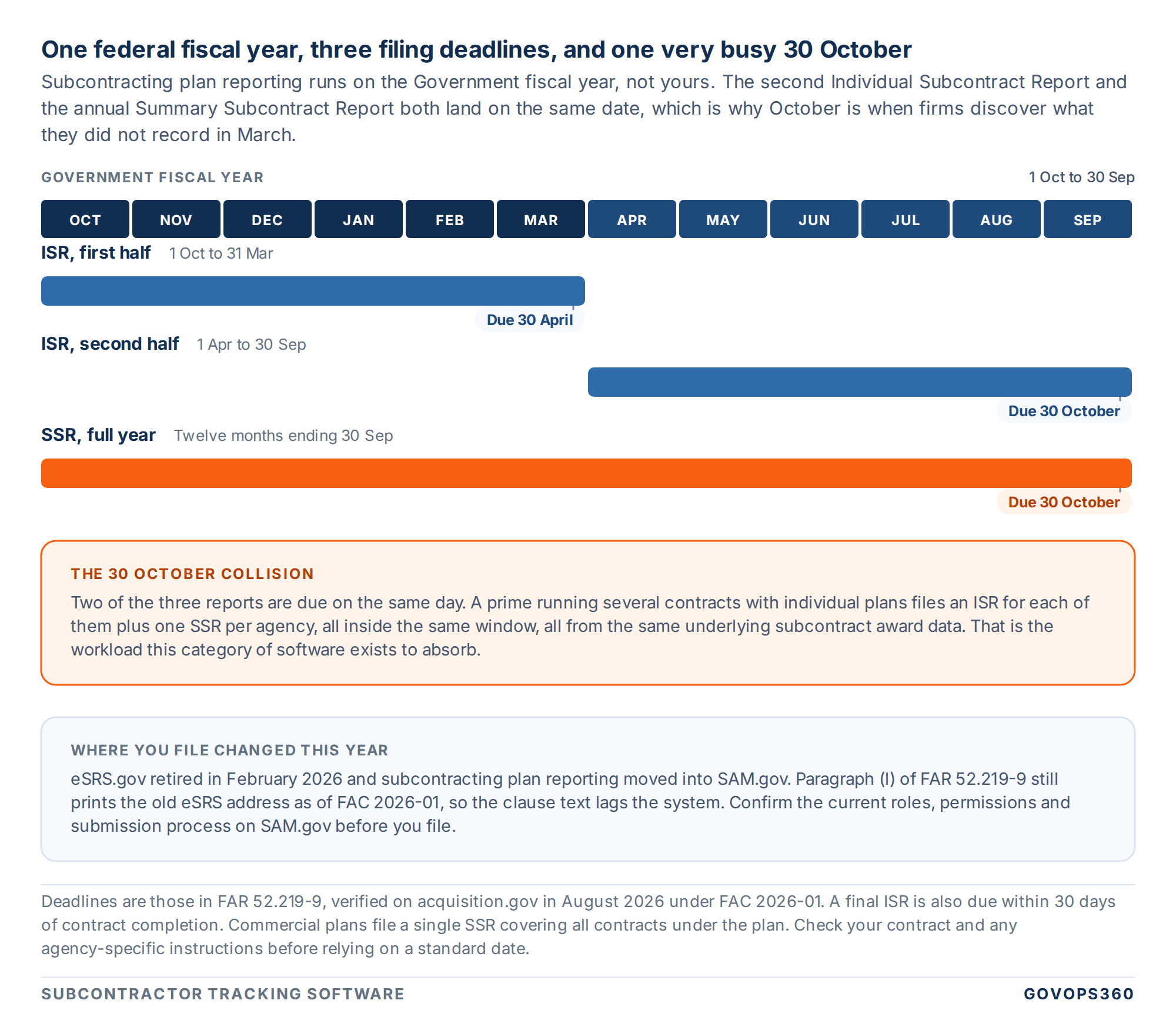
30 October
Annual Summary Subcontract Report deadline, covering the twelve-month period ending 30 September. The single date that drives demand in this category
30 Apr and 30 Oct
Individual Subcontract Report deadlines, due 30 days after each semiannual period ending 31 March and 30 September
$900,000
Current subcontracting plan threshold under FAR 19.702, up from $750,000 effective 1 October 2025. Construction rose from $1.5 million to $2 million
The Subcontracting Report Checklist
Here is the complete filing picture for a prime operating under an individual or commercial subcontracting plan. Any subcontractor tracking software you consider has to produce these, in this format, on these dates. Every date, authority and destination below comes from FAR 52.219-9 and FAR 52.242-5, linked in the references.
| Report | What it covers | Period | Due | Filed in |
|---|---|---|---|---|
| Individual Subcontract Report (ISR) | Subcontract awards under one contract, allocated across the six socioeconomic goal categories, against the goals in your accepted plan | Semiannual, periods ending 31 March and 30 September | 30 April and 30 October, 30 days after each period closes | SAM.gov subcontracting plan reporting, formerly eSRS |
| Final ISR | The same content, covering the period from the last report through contract completion | From the close of the last reporting period to contract completion | Within 30 days of contract completion | SAM.gov subcontracting plan reporting |
| Summary Subcontract Report (SSR) | All subcontract awards across every contract with the agency, or across all contracts under a commercial plan | Twelve months ending 30 September | 30 October, annually | SAM.gov subcontracting plan reporting |
| Reduced or untimely payment notice | Written notification to the contracting officer identifying the small business subcontractor and the reason for the reduced or late payment | On occurrence. FAR 52.242-5 treats a payment more than 90 days past due as untimely | Within 14 days of the reduced or untimely payment | Direct to the contracting officer, not a portal |
| Accelerated payment pass-through | Not a report, but a tracked obligation. On receiving an accelerated payment from the Government, pass it to small business subcontractors | On occurrence | Within 15 days of receiving the accelerated payment, after a proper invoice | No filing. FAR 52.232-40 requires the substance of the clause in all subcontracts with small business concerns |
Getting into the SAM.gov reporting workflow
The filing dates are the easy half. The harder half is that the system changed underneath them, and access does not carry over automatically. Work through this before the period closes, not after.
- Confirm who can actually file. The people responsible for reporting need the SAM.gov roles that cover entity reporting and subcontracting plan reporting. Check the current role names on SAM.gov rather than assuming your old eSRS access transferred.
- Bring your entities across. Add the entities your team reported for under eSRS to the SAM.gov account so the reporting relationships are available in the current system.
- Check eligibility before you prepare anything. Confirm in the workspace which prime contracts and subcontracting plans are actually available for reporting. A contract that does not appear is a problem to solve in September, not on 29 October.
- Assign the filing as a named task. Reporting ownership tends to drift between contracts, finance and program staff. Give it an owner and a due date.
- Keep the underlying record yourself. The portal is where you submit, not where your evidence lives. Retain the subcontract award data, the goals and actuals used, approvals and a copy of what was submitted.
- Check for agency-specific instructions and any extension on the current SAM.gov reporting page before you rely on a standard deadline. Validation rules and instructions can differ by agency.
The six categories every dollar has to land in
FAR 52.219-9(d)(1) requires goals expressed both in total dollars subcontracted and as a percentage of total planned subcontracting dollars, across exactly six categories: small business, veteran-owned small business, service-disabled veteran-owned small business, HUBZone small business, small disadvantaged business, and women-owned small business.
A subcontractor can sit in several of these at once, which is where reconstruction after the fact breaks down. Socioeconomic status is also a point-in-time fact rather than a permanent attribute. A firm certified as HUBZone in November may not be in July, and the classification that matters is the one in force on the award date. If your record does not capture status as at award, the report is a guess.
What happens when a filing is missed
There is no automatic monetary penalty for a late ISR or SSR, which is why the risk gets underestimated. The consequences are slower and more expensive than a fine. A missing report is visible to the contracting officer and feeds the past performance evaluation under FAR 42.1503(b)(2)(v). Failure to make a good faith effort to comply with a subcontracting plan is a material breach under the clause. And on a set-aside contract, an inability to demonstrate compliance with the limitations on subcontracting is the kind of finding that attracts a size protest or worse.
Use the checklist below to establish whether you are in scope at all, and what you owe if you are.
Subcontracting Plan Readiness
Check every statement that is true of your firm today, not the version of your firm you intend to be by October.
0 of 10
Check the statements above to see where you stand.
What a Prime Actually Has to Track
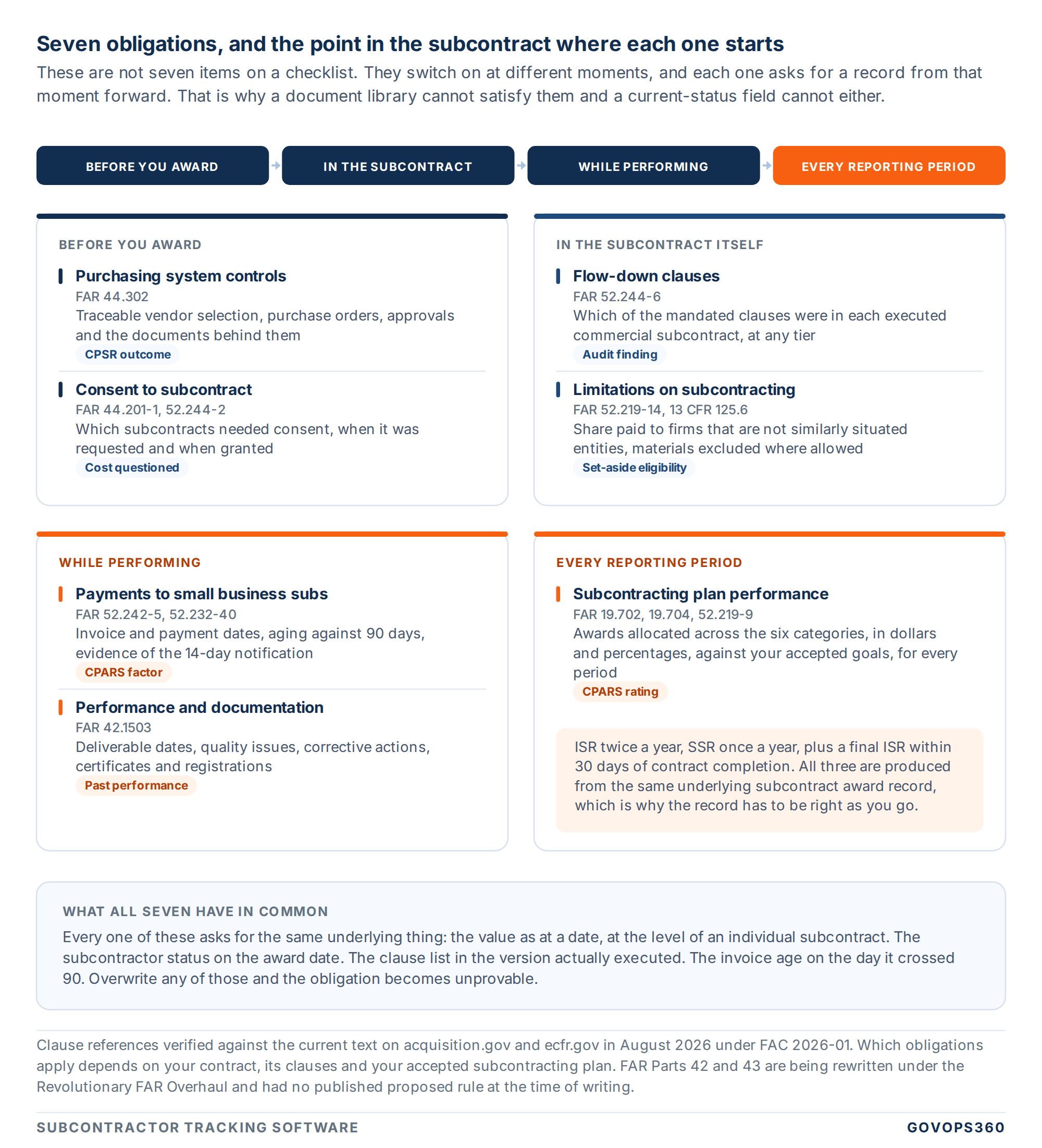
Reporting is the deadline, but it is not the whole obligation. A prime managing subcontractors under a federal contract carries six distinct compliance duties, each with its own authority, its own data requirement and its own failure mode. Confusing them is how firms end up with a well-organized document library that still cannot answer the contracting officer’s question.
- Subcontracting plan performance. FAR 19.702, 19.704 and 52.219-9. Awards allocated across the six categories, in dollars and percentages, against your accepted goals, per reporting period. Failure to make a good faith effort is a material breach, and the result feeds your CPARS rating.
- Limitations on subcontracting. FAR 52.219-14 and 13 CFR 125.6. The percentage of the contract amount paid to firms that are not similarly situated entities, excluding the cost of materials where the clause allows. Exposure runs to set-aside eligibility, size protests, and in serious cases False Claims Act risk.
- Consent to subcontract. FAR 44.201-1 and 52.244-2. Which subcontracts required consent, when it was requested, what the notification package contained and when consent was granted. Costs incurred without required consent can be questioned.
- Purchasing system controls. FAR 44.302. Traceable vendor selection, purchase orders, approvals and the documentation behind them. The contracting officer decides whether a Contractor Purchasing System Review is needed based on subcontract volume, complexity, dollar value and past performance, and a failed review restricts how you buy.
- Flow-down clauses. FAR 52.244-6. For each commercial subcontract at any tier, which of the mandated clauses were included in the executed agreement. The clause names a finite list, which is what makes this auditable rather than a matter of judgment.
- Payments to small business subcontractors. FAR 52.242-5 and 52.232-40. Invoice receipt and payment dates per subcontractor, aging against the 90-day untimely threshold, and evidence of the 14-day notification where applicable. This is a direct CPARS factor under FAR 42.1503(b)(2)(v) and the most under-tracked obligation on this list.
- Subcontractor performance and documentation. FAR 42.1503 plus your own contract terms. Deliverable dates, quality issues, corrective actions, insurance certificates and current registrations. This is your own past performance rating, and your ability to defend a subcontractor selection later.
Notice what the third column is asking for. In every row it is a record over time, tied to a date, at the level of an individual subcontract. Not a document, and not a current status. That distinction is the whole reason subcontractor tracking software exists as a category, and it is the test to apply to any system you are shown.
Flow-Down, Consent and the Limits
Three of the six obligations trip primes more often than the rest, because each one has a condition attached that changes what you owe. They are worth taking individually. Our guide to prime contractor versus subcontractor roles covers the strategic side of these clauses. What follows is only what they demand of your records.
Flow-down is a finite list, not a general principle
For commercial products and commercial services, FAR 52.244-6 does not ask you to flow down everything. It names the specific clauses that apply to subcontracts at any tier, and the list runs to roughly two dozen, covering contractor code of business ethics, whistleblower rights, basic safeguarding of covered contractor information systems, prohibitions on certain telecommunications equipment, small business utilization, the labor and equal opportunity clauses, combating trafficking in persons, and accelerated payments to small business subcontractors.
The practical consequence is that “did we flow down correctly” is a per-subcontract, per-clause question with a definite answer. It is auditable, which means it is also trackable, and a system that stores your subcontract as a PDF and stops there cannot answer it.
Consent depends on your purchasing system, not the dollar value alone
Under FAR 44.201-1, a contractor with an approved purchasing system needs consent only for the subcontracts the contracting officer has specifically identified in the contract. Without an approved system, consent is required for all cost-reimbursement, time-and-materials and labor-hour subcontracts, and for fixed-price subcontracts above the simplified acquisition threshold or a stated percentage of total estimated contract cost.
That is a single conditional branch, and it is the one most spreadsheets get wrong, because the sheet was built when the answer was one thing and never revisited when it became the other. The status of your purchasing system is a field, not an assumption.
The limits themselves, and the threshold nobody reconciles
FAR 52.219-14(e) sets the ceilings: 50 percent for services, 50 percent for supplies excluding the cost of materials, 85 percent for general construction and 75 percent for special trade construction. The same percentages appear at 13 CFR 125.6(a). In both, the limit is measured against amounts paid to firms that are not similarly situated entities.
There is one live inconsistency worth knowing about before your next plan submission. FAR 19.702 now sets the subcontracting plan threshold at $900,000, and $2 million for construction, effective 1 October 2025. SBA’s own regulation at 13 CFR 125.3(c)(1), last amended in December 2024, still reads $750,000 and $1,500,000. The FAR governs the contract in front of you, but if a contracting officer or a template cites the lower figure, that is where the discrepancy comes from. Check the current FAR text rather than relying on either number from memory.
Why Spreadsheets Fail at This Specific Job
Spreadsheets are not a bad tool. They fail here for four structural reasons, and it is worth being precise about them, because three of the four are not solved by buying software either.
They store status, not history
A cell holds one value. The obligation requires the value as at a date: the subcontractor's certified status on the award date, the invoice age on the day it crossed 90 days, the clause list in the version of the agreement that was actually executed. Overwriting is the default behavior of a spreadsheet and the failure mode of this obligation
The record lives in four places at once
Award data sits in the contracts file, payment dates in accounting, socioeconomic status in a registration record, and performance notes in someone's email. No single sheet is authoritative, so every report becomes a reconciliation exercise performed under deadline
Nobody notices the deadline until it arrives
A spreadsheet cannot tell you that an invoice is at day 83, or that a certification lapsed last month, or that a period closed nine days ago. Every obligation in this category has a date attached, and dates need something that watches them
The person who built it moves on
The formula that allocated dollars across six categories was correct when it was written and is now undocumented. This is the risk that survives every software purchase, which is why the data model matters more than the interface
The record does not exist anywhere else
It is tempting to assume the government holds this information centrally and a report is just a retrieval exercise. It does not. A December 2014 review by the Government Accountability Office, Federal Subcontracting: Linking Small Business Subcontractors to Prime Contracts Is Not Feasible Using Current Systems, examined the relevant federal reporting systems and found that none was designed to link small business subcontractors to specific prime contracts. Coverage of subcontracting plans, lower-tier subcontractors and small business status varied between systems, and plans covering multiple contracts did not identify which contracts they applied to.
That report is now over a decade old and the systems have changed around it, including the 2026 move of subcontracting reporting into SAM.gov. The structural point has not changed. The prime is the only party that holds the complete record, which means the quality of your reporting is a direct function of the quality of your own tracking. There is no upstream source to fall back on.
What to Look For in Subcontractor Tracking Software
Map the obligations first, then evaluate against them. The eight capabilities below are the ones that follow directly from sections 2 and 3, and each has a demo test attached, because the difference between a platform that handles this and one that stores documents about it is not visible in a feature list.
- Report generation in the current filing format. The reports are the deliverable, and a system that holds the data but cannot output it has moved the work rather than removed it. Ask them to generate an ISR and an SSR from sample data in the format SAM.gov now expects, and ask directly whether submission is manual and whether they have updated since eSRS.gov retired.
- Six-category classification with effective dates. Socioeconomic status is a point-in-time fact, and the classification that matters is the one in force on the award date. Add a subcontractor, set a HUBZone certification with an expiry, award before and after that date, and check that each award is allocated to the status in force at the time.
- Payment aging against the 90-day threshold. FAR 52.242-5 treats payment more than 90 days past due as untimely, and untimely payment is a CPARS factor. Ask to see the aging view for small business subcontractors specifically, and what the system does at day 75. If the answer is a report you have to run, it will not be run.
- The 14-day notification as a workflow. The obligation is not to notice the late payment, it is to notify the contracting officer in writing within 14 days. Ask what happens the moment a payment crosses the threshold. You want an assigned action with a due date, not an alert.
- Flow-down clause matrix per subcontract. FAR 52.244-6 names a finite list for commercial subcontracts at any tier, so compliance is a per-subcontract, per-clause fact. Ask to see which clauses are recorded against one subcontract and whether the list differs by subcontract type. A single yes or no field is not tracking.
- Consent tracking tied to purchasing system status. FAR 44.201-1 branches on whether your purchasing system is approved, so the field has to branch too. Change the setting and confirm the consent requirements change with it. Many systems hard-code one branch.
- Similarly situated calculation. For set-aside work, 13 CFR 125.6(c) excludes work a similarly situated subcontractor performs with its own employees, and without that split the percentage is wrong. Enter a set-aside contract with a mix and ask for the limitations calculation.
- Audit trail and version history. Every obligation here is evidenced by what the record said at a point in time, and an overwritten field is an unprovable claim. Change a value, ask to see the previous one with who changed it and when, then ask how long that history is retained.
Three questions worth asking that vendors rarely volunteer
Does anything submit for you? Reporting moved into SAM.gov in February 2026. Confirm with any vendor whether their integration writes to the current system, exports a file you upload, or produces a document a person retypes. All three are legitimate answers. Only one of them saves the time you are buying.
Does the accounting data flow, or get typed? Payment dates live in your accounting system. A tracking tool that requires manual entry of payment dates will drift within one quarter, and the payment obligation is the one with a direct CPARS consequence.
What is the data model, not the interface? A subcontractor with several statuses, several subcontracts, several clause sets and several invoices is a relational problem. If the underlying structure is one row per subcontractor, you will hit the ceiling in the first reporting cycle.
If you are evaluating this alongside a broader pipeline or capture purchase, our comparison of the best CRM for government contractors covers the platforms that handle pre-award pursuit, which is a different problem with a different shortlist.
Where GovOps360 Fits, and Where a Point Solution Wins
We are building GovOps360 as a lifecycle platform, covering pursuit through contract administration and into finance, rather than a dedicated subcontractor tracking software product. That shapes both what it is good for and what it is not, and the honest version of that is more useful to you than a feature list.
One disclosure first, because it changes how you should read everything in this section. GovOps360 is pre-launch. Pricing is not finalized and there is no published customer base. We are not going to describe roadmap capability as shipping capability, and we are not going to quote adoption metrics we do not have.
The seam we are built around
Subcontract compliance data is worth very little in isolation. The reports have to reconcile with accounts payable, the payment aging depends on invoice records, and the limitations calculation depends on contract values. Most small and mid-size primes handle those joins in spreadsheets sitting between a CRM, a contracts folder and an accountant. GovOps360 is designed to hold pursuit, contract administration and finance in one data model so those joins are not manual. That is the specific problem we think is worth solving.
Where a dedicated point solution is the better answer
- You have a filing deadline in the next two quarters. Buy something generally available, implemented and supported today. This is not a close call.
- Subcontract compliance is the entire problem. If your CRM and accounting stack is settled and working, a focused tool will go deeper on clause libraries, consent workflows and report generation than a lifecycle platform reasonably can, and it will do it without a migration. Named options worth a look, each described from its own public pages: Unanet Enterprise SubK for subcontractor management with FAR and DFARS flow-down tracking and invoice automation, Deltek Costpoint Capture and Contracts Management for automated clause flow-down to subcontractors inside a GovCon ERP, TechnoMile Contracts Suite for clause, CLIN and subcontract tracking with auditor data calls in mind, Unison CLM for prime and subcontract lifecycle with clause extraction, and the Icertis government contractors edition for obligation and deliverable tracking with automatic mandatory clause flow-down. Our guide to government contract management software compares the post-award side of these platforms properly.
- You are a large prime with an approved purchasing system and an established ERP. Your compliance module probably belongs inside that ERP, close to the payment data, rather than in a separate platform that has to integrate with it.
- You need documented, audited compliance posture right now. Ask any vendor, including us, for their current security position in writing. If a specific certification is a procurement gate for you, verify it before it becomes a factor in your own compliance story.
Where we think we are worth a conversation
Firms in the roughly 20 to 300 employee band who are outgrowing spreadsheets on both sides at once, pipeline and subcontract administration, and who do not want to buy and integrate three systems to get there. If that is you, the conversation is worth having now, while the product is still being shaped.
A 90-Day Plan to Get Reporting Under Control
The sequence matters more than the tool. Firms that automate before they clean up produce faster wrong answers. This ordering puts the data first, and it works whether you end up buying anything or not.
Days 1 to 30
Establish the baseline. List every active contract carrying a subcontracting plan, its plan type, its goals in both dollars and percentages, and every subcontract under it. Capture socioeconomic status as at each award date, not today. Done means one authoritative list, reconciled to accounts payable for the current period.
Days 31 to 60
Close the gaps the baseline exposed: missing certifications, undocumented consent, unrecorded flow-down clauses, invoices already past 60 days. Draft the reduced or untimely payment notification template now, before you need it. Done means every gap has an owner and a due date, and nothing sits past 90 days unfiled.
Days 61 to 90
Only now consider tooling. Run the eight demo tests from section 6 against your own cleaned data rather than vendor samples, then dry-run a full ISR and SSR cycle against the current SAM.gov process. Done means a complete report produced and reconciled once, under no time pressure, with a documented process someone else can follow.
The one thing to do this week
Pull your small business subcontractor invoices and sort by age. Anything past 60 days is heading toward the 90-day untimely threshold in FAR 52.242-5, and anything already past 90 needs a written notification to the contracting officer within 14 days. That is the obligation with the shortest clock and the most direct line to your past performance record, and it takes an afternoon to check.
The firms that struggle with subcontractor tracking software are rarely the ones that bought the wrong platform. They are the ones who treated a reporting obligation as an administrative task until the week the report was due, and discovered that the twelve months of classification decisions behind it were never recorded in the first place.
See How GovOps360 Handles Subcontract Compliance
Bring one contract with a subcontracting plan and last period’s ISR. We will walk the data model with you, and if a dedicated compliance tool is the better fit for your situation we will say so.
Frequently Asked Questions
1. What is subcontractor tracking software?
It is software a prime contractor uses to record and report on its subcontracts under a federal contract. The core function is maintaining an auditable record over time: subcontract awards allocated across the six socioeconomic categories required by FAR 52.219-9, each subcontractor's certified status as at the award date, flow-down clauses included per subcontract under FAR 52.244-6, consent status under FAR 44.201-1, and payment dates measured against the 90-day untimely threshold in FAR 52.242-5. Document storage is the easy part. The reporting and the point-in-time history are the reason a dedicated tool exists.
2. When are the ISR and SSR due?
The Individual Subcontract Report is semiannual, covering periods ending 31 March and 30 September, and is due 30 days after each period closes, so 30 April and 30 October. A final ISR is due within 30 days of contract completion. The Summary Subcontract Report is annual, due 30 October, covering the twelve months ending 30 September. Under a commercial plan, a single SSR covers all contracts under that plan and is due within 30 days of the end of the Government fiscal year.
3. Is eSRS still the filing system?
No. eSRS.gov retired in February 2026 and subcontracting plan reporting now happens inside SAM.gov, with esrs.gov redirecting there. Worth knowing: paragraph (l) of FAR 52.219-9 still prints the eSRS.gov address as of FAC 2026-01, so the clause text has not caught up with the migration. If your internal procedures or a vendor's documentation still describe eSRS.gov as the destination, they need updating.
4. When is a subcontracting plan required?
Under FAR 19.702, when a contract or modification is expected to exceed $900,000, or $2 million for construction, and has subcontracting possibilities. FAR 19.704 then governs what the plan itself has to contain, including the goals and the reporting assurances. Those thresholds rose from $750,000 and $1.5 million effective 1 October 2025. One inconsistency to be aware of: SBA's regulation at 13 CFR 125.3(c)(1) still carries the older figures, so a template or a contracting officer citing $750,000 is working from the SBA text. Check the current FAR rather than relying on a remembered number. Note also that the software can track plan performance. It cannot determine whether a plan is required, which is a contract-by-contract determination.
5. How long can a prime take to pay a small business subcontractor?
There is no general FAR clause setting a 30-day prime-to-subcontractor payment deadline. The 30-day Prompt Payment rule runs from the Government to the prime. What binds the prime is narrower and often missed. FAR 52.242-5 defines an untimely payment as one more than 90 days past due and requires written notification to the contracting officer within 14 days of a reduced or untimely payment. FAR 52.232-40 requires the prime, on receiving an accelerated payment from the Government, to pass it to small business subcontractors within 15 days, with no fee charged for doing so. And FAR 42.1503(b)(2)(v) makes reduced or untimely payments to small business subcontractors an evaluation factor in past performance.
6. What are the limitations on subcontracting percentages?
FAR 52.219-14(e) and 13 CFR 125.6(a) set the same limits: 50 percent for services, 50 percent for supplies excluding the cost of materials, 85 percent for general construction excluding materials, and 75 percent for special trade construction excluding materials. The limit is measured against amounts paid to firms that are not similarly situated entities. Under 13 CFR 125.6(c), work performed by a similarly situated subcontractor with its own employees does not count as subcontracted, which is why tracking has to record subcontractor status and self-performed scope, not just the dollar amount.
7. Do I need subcontractor tracking software, or will a spreadsheet do?
For a single contract with a handful of subcontracts, often yes. It stops working for a specific reason rather than a general one: a spreadsheet cell stores a current value, and every obligation here requires the value as at a date. The subcontractor's certified status on the award date, the invoice age on the day it crossed 90 days, the clause list in the version of the agreement actually executed. Overwriting is what spreadsheets do by default, and an overwritten field is an unprovable claim in an audit. The second reason is that the underlying data lives in four places, so every report becomes a reconciliation performed under deadline. Those two limits, not the size of the spreadsheet, are what subcontractor tracking software is bought to fix.
References and Sources
- FAR 19.702, Statutory requirements for subcontracting plans and current thresholds
- FAR 52.219-9, Small Business Subcontracting Plan, including ISR and SSR filing and the six goal categories
- FAR 52.219-14, Limitations on Subcontracting
- FAR 44.201-1, Consent and advance notification requirements
- FAR 52.244-2, Subcontracts
- FAR 52.244-6, Subcontracts for Commercial Products and Commercial Services, and the mandated flow-down clauses
- FAR 52.242-5, Payments to Small Business Subcontractors, including the 90-day and 14-day provisions
- FAR 52.232-40, Providing Accelerated Payments to Small Business Subcontractors
- FAR 42.1503, Past performance evaluation factors, including small business subcontracting
- FAR 19.704, Subcontracting plan requirements
- FAR 44.302, Requirements for a Contractor Purchasing System Review
- 13 CFR 125.6, Prime contractor performance requirements and similarly situated entities
- 13 CFR 125.3, SBA subcontracting assistance regulation and plan thresholds
- SAM.gov, Subcontracting Plan Reporting, the system that replaced eSRS in February 2026
- GAO-15-116, Federal Subcontracting: Linking Small Business Subcontractors to Prime Contracts Is Not Feasible Using Current Systems, December 2014
- SBA prime and subcontracting guidance
- SBA SUBNet subcontracting opportunities
- Unanet Enterprise SubK, subcontractor management
- Deltek Costpoint Capture and Contracts Management
- TechnoMile Contracts Suite
- Unison CLM, contract lifecycle management
- Icertis pre-configured solution for government contractors
Regulatory citations were verified against the current text on acquisition.gov and ecfr.gov in August 2026, under FAC 2026-01. FAR thresholds are subject to periodic inflation adjustment, and the FAR text and SBA regulation currently carry different subcontracting plan thresholds, so confirm the figure in the FAR provision applicable to your contract rather than relying on a remembered number. The retirement of eSRS.gov and the migration of subcontracting plan reporting into SAM.gov is stated on SAM.gov; confirm the current submission process, the current role and permission names, and any agency-specific instructions or filing extension there before you file. Vendor capabilities named in section 7 were taken from each vendor’s own public product pages in August 2026 and are recorded as published claims rather than independent verification. GovOps360 is pre-launch at the time of writing, pricing is not finalized, and nothing in this article describes roadmap capability as generally available. This article is not legal advice. Compliance determinations under a subcontracting plan should be made with your contracts and legal function.

Alaa Negeda
Senior Solution Architect with 23 years of experience in different Technology sectors. Diligent, forward-thinking, and adaptable to dynamic company, customer, and project needs.
Related Articles
 Sep 30,2026
 RFP vs RFQ vs RFI: Which Solicitation You Are Looking At and What to Do
 Sep 28,2026
 DDQ Meaning: What a Due Diligence Questionnaire Asks and How to Answer It
 Sep 25,2026