



 By Alaa Negeda
Two Different Products Share One Name
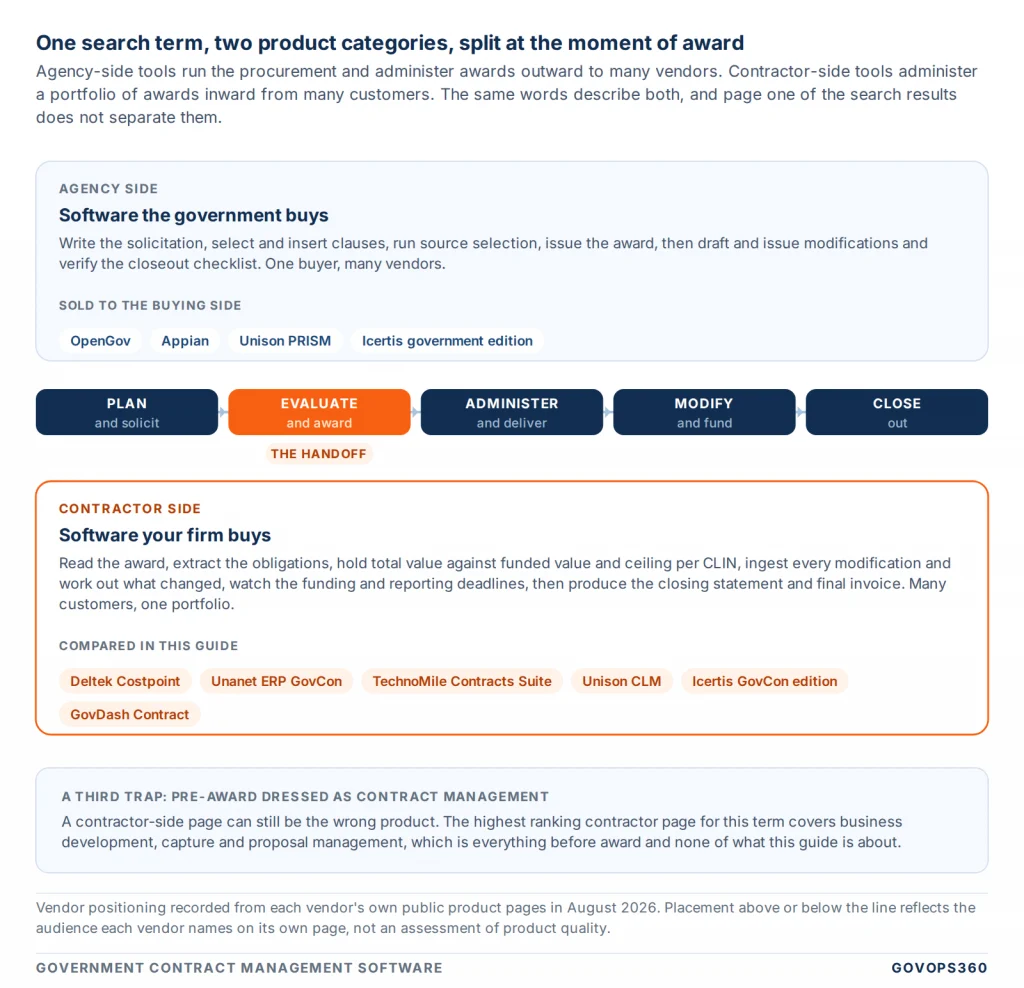
Search for government contract management software and you get two entirely different product categories in one result set, presented as though they were the same thing. One is bought by agencies to run procurements and administer the contracts they award. The other is bought by companies to administer the contracts they have won. They sit on opposite sides of the same transaction, they solve opposite problems, and almost nothing carries over between them.
This is not a subtle distinction that only matters to specialists. It decides whether the software you buy can track a contract modification against your funded value, or whether it was designed to write that modification in the first place. Buy the wrong side and you have purchased a tool that models your customer’s workflow rather than your own.
Nothing on the first page of results says so. We checked.
This guide is about the post-award half of the lifecycle. Pre-award capture, pipeline and proposal software is a separate category with separate vendors, and we compare eight of them in our CRM for government contractors guide.
What a search for government contract management software actually returns
As of August 2026, the results for this term mix both sides without comment, and an AI Overview sits above them citing ten sources drawn from both categories in a single answer. OpenGov’s ranking page is procurement and contract management for state and local government. Appian’s is contract management for state and local departments and agencies. Unison’s is PRISM, which the page describes as designed for federal contracting professionals and which carries a FedRAMP authorization and a DISA impact level 5 rating. Those are agency products, correctly described, ranking for a query most contractors type.
The highest-ranking contractor-side product page is worse for the reader, not better. Salesforce sits near the top with a government contractor software page covering business development, capture, proposal management and gate reviews. That is genuinely contractor-side, and it is entirely pre-award. A contractor who searches this term, clicks the top product result and assumes it addresses contract administration has landed in the wrong category twice in one click.
The paid data says the same thing
If the head term delivered contractor intent, advertisers would bid it up. They have not. The broad term runs around $0.80 a click. The contractor-qualified variant, contract management software for government contractors, carries roughly a quarter of the volume at about $20.00 a click. Buyers are paying twenty five times more per click to reach the intent the main term fails to deliver, which is the clearest available signal that the two audiences are not interchangeable and that the market knows it.
25x
The cost-per-click premium on the contractor-qualified search term over the broad one. Advertisers pay far more to reach the intent the head term does not resolve
0 of 10
Page-one results that distinguish agency-side from contractor-side tools. The AI Overview merges both into one answer
5
Contractor-side platforms with genuine published post-award depth that do not appear on page one at all, for the query that describes exactly what they do
Agency-Side vs Contractor-Side: The Capability Matrix
Use this to place any government contract management software you are shown on the correct side before you look at a single feature. Here is the split, capability by capability. The right-hand column is the part that matters, because it explains why a feature that sounds identical on two vendor pages is doing a different job in each product.
| Capability | Agency-side tool | Contractor-side tool | Why they diverge |
|---|---|---|---|
| Core job | Run a procurement and administer awards to many vendors | Administer a portfolio of awards from many customers | One is one-to-many outward, the other is one-to-many inward. The data model is inverted |
| Contract writing | Assemble the document, select and insert clauses, issue the award | Read the document, extract the obligations, comply | Agencies author. Contractors interpret. A contractor never needs a clause-selection engine |
| Clause handling | Choose which clauses apply and build them into the solicitation | Identify which clauses were imposed, which flow down, and what each one obligates you to do by when | The contractor problem is extraction and obligation tracking, not assembly |
| Modifications | Draft and issue the modification | Ingest the modification, work out what changed in funding, dates and scope, and assert any adjustment claim in time | The contractor has a 30-day clock under FAR 52.243-1(c) that the agency side has no equivalent of |
| CLINs, SLINs and funding | Obligate funds against line items and track the obligation | Track total value, funded value and ceiling separately, per line item, and know when funded value is about to run out | Contractors perform against funded value, not total value. Confusing them is how a firm works unfunded |
| Cost and funding limits | Not applicable. The agency allots the funds | Notify the contracting officer when the next 60 days of cost will exceed 75 percent of estimated cost or allotted funds, per FAR 52.232-20 and 52.232-22 | This is a pure contractor obligation with a hard trigger, and it exists in no agency-side tool |
| Deliverables | Receive, inspect and accept | Track every CDRL line, its submission dates, its approval code and its resubmission consequences, separately from the end item | CDRL dates are distinct deliverables. Agencies see them arrive. Contractors have to make them arrive |
| Invoicing | Receive and pay, subject to Prompt Payment | Build a compliant invoice by contract type, submit through the required electronic route, reconcile against funded value | Contract-type-aware billing is a contractor problem. Cost type, T&M, FFP and milestone all invoice differently |
| Past performance | Write the CPARS evaluation | Respond to it inside 14 calendar days under FAR 42.1503(d), knowing it reaches source selection officials 14 days after notification either way | Same record, opposite roles, and only one side is on a clock |
| Closeout | Verify the 15 items at FAR 4.804-5(a) and issue the completion statement | Produce the closing statement and final invoice that two of those 15 items depend on | The agency owns the checklist. The contractor owns two line items on it and gets blamed for the delay |
| Subcontract flow-down | Not applicable | Determine which clauses flow down, record them per subcontract, and evidence it | Entirely contractor-side, and the obligation runs to every tier |
| Authoritative record | The contract file is the agency's record of what it bought | Your record is the only complete account of what you owe and what you are owed | No upstream system holds the contractor view. This is why the tooling is not optional at scale |
How to use this before you take a single demo
Take any product page for government contract management software and read it against the middle two columns. If the capabilities described belong in the second column, you are looking at an agency product, no matter how the page is titled or which query it ranks for. That test resolves most of the shortlist in about ten minutes and costs nothing.
Two products deserve a note because they legitimately appear in both columns. CobbleStone markets to agencies and contractors on the same page, and its government page carries a FAR and DFARS clause library alongside SAM.gov entity validation, which is contractor-relevant. Unison runs PRISM for agencies and a separate CLM product for contractors, described on its own page as purpose-built for the government contract lifecycle. Straddling is legitimate. Not telling you which half you are being sold is not.
What Post-Award Contract Administration Actually Involves
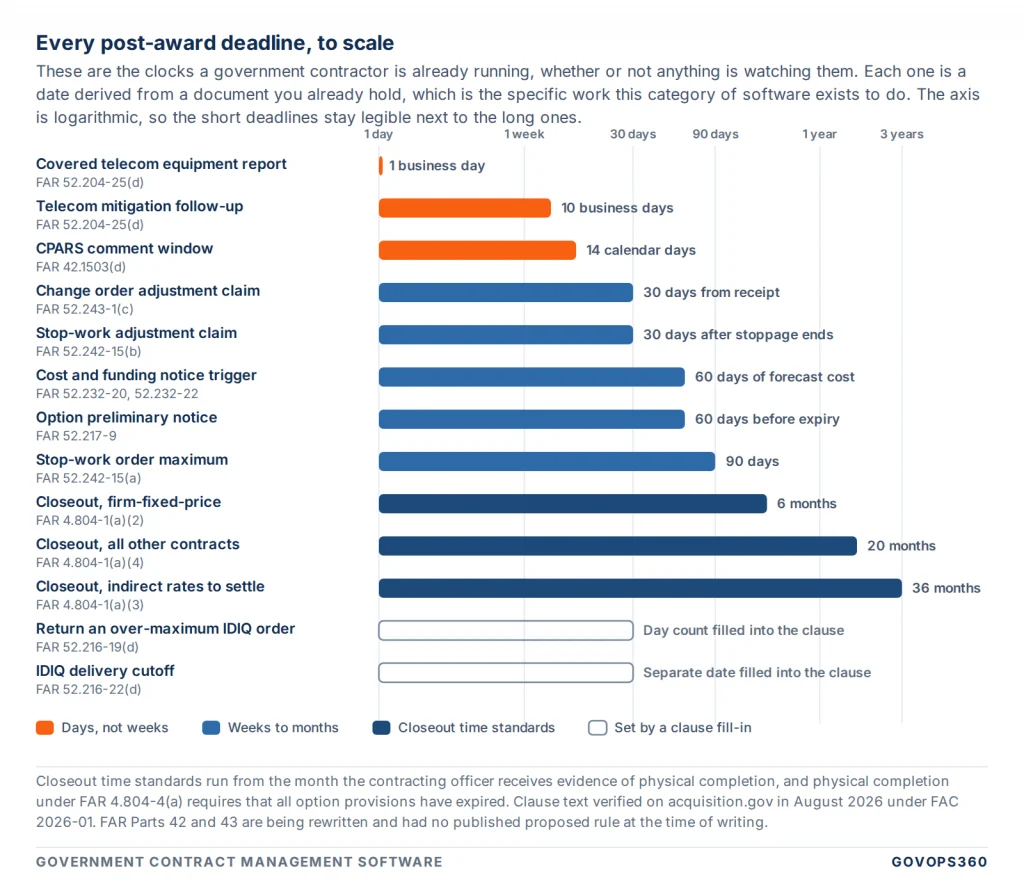
Vendor pages describe this work as visibility, collaboration and a single source of truth. The work is actually a set of obligations with dates attached, most of them written into your contract as FAR clauses, several of them with clocks that start without anyone telling you. Those clocks are the specification. If a platform cannot watch them, it is a document repository with a search box.
The three that catch people out
- The 30-day assertion clocks. Under FAR 52.243-1(c) you must assert your right to an equitable adjustment within 30 days of receiving a written change order, and under FAR 52.242-15(b) within 30 days after a work stoppage ends. In both cases the contracting officer may accept a later proposal before final payment, but that is discretion rather than a right, and it is not something to plan around.
- The 75 percent funding trigger. FAR 52.232-20(b) and 52.232-22(c) require written notice when costs expected in the next 60 days, added to costs already incurred, will exceed 75 percent of the estimated cost or the amount currently allotted. This is a forward-looking obligation, which is why it needs a forecast rather than a monthly report, and the notice itself has to carry a revised estimate or a figure for the additional funds required.
- The one-business-day telecom report. FAR 52.204-25(d) gives you a single business day to report covered telecommunications equipment discovered during performance, then 10 business days for further mitigation detail. No monthly review cycle can satisfy that, which makes it the clearest test of whether a system is watching or just storing.
The other six are the IDIQ order limits and performance tail under FAR 52.216-19(d) and 52.216-22(d), the option exercise notice under FAR 52.217-9, the 14-day CPARS comment window under FAR 42.1503(d), and closeout. Every one is a date derived from a document you already hold, which is exactly the kind of work software should be doing and spreadsheets cannot.
And then there is closeout
Closeout is the obligation everyone underestimates, because the deadline belongs to somebody else. FAR 4.804-1(a) sets the time standards, measured from the month the contracting officer receives evidence of physical completion: 6 months for firm-fixed-price contracts, 20 months for all other contracts, and 36 months where indirect cost rates have to be settled. Physical completion itself is defined at FAR 4.804-4(a), and it includes a detail that catches people out, which is that all option provisions must have expired.
The administering office then works the 15-item checklist at FAR 4.804-5(a). Two of those items are yours: the contractor’s closing statement and the contractor’s final invoice. A third, settlement of subcontracts by the prime, is also yours in substance. So a closeout that stalls for years often stalls on three items a contractor could have produced at any point.
It stalls often. In GAO-17-738, published 28 September 2017, the Government Accountability Office found that none of the five agencies reviewed had agency-wide elements that would let them track and oversee contract closeout, meaning no reliable count of contracts awaiting closeout and no performance metrics. On the audit side, DCAA had halved its backlog of incurred-cost proposals awaiting audit to 14,208, but averaged 885 days from receiving an adequate proposal to completing the audit, of which only 138 days was actual audit work.
The Clause Library Question Nobody Is Asking
Nearly every government contract management software product advertises a FAR and DFARS clause library, clause automation, or automated clause flow-down. In August 2026 that claim deserves a question it has not been getting, because the FAR is currently being rewritten and the rewrite is not finished.
The two parts you care about most are the least settled
FAR Part 43 governs contract modifications. FAR Part 42 governs contract administration and includes the CPARS provisions. Those are the two parts that most directly define post-award contract management work, and both sit in rulemaking cases with no published proposed rule yet. The regulation your administration software is built to track is, in precisely the areas that matter most to it, mid-revision.
That is not a reason to delay a purchase. It is a reason to ask a specific question, and to distrust a vague answer.
What we found when we checked the vendors
We read the public clause-library and clause-automation pages for CobbleStone, Unanet, Deltek, TechnoMile, Unison CLM and Icertis. As of August 2026, none of those pages mentions the FAR overhaul, model deviation text, or agency class deviations. That is a statement about published marketing pages rather than about what any of these products does internally, and several of them may well be handling it perfectly well. But a buyer reading those pages has no way to tell, and the pages are what buyers read.
We will hold ourselves to the same standard. GovOps360 is pre-launch, our own clause handling is described in section 7 with that label attached, and if you ask us this question we will answer it in writing.
Ask which source
Is the clause library built from codified FAR text, from the FAR Council model deviation text, or from specific agency class deviations? These can differ right now, and "the FAR" is not an answer
Ask which agencies
Deviations are issued agency by agency. If you sell to DoD, GSA and HHS, ask whether all three are covered and how divergence is handled
Ask the revision date
What is the as-of date on the library, what is the update cadence, and who decides when something changes. A library with no visible revision date is a document, not a service
Ask what happens on change
When a clause changes, does the platform flag affected active contracts and subcontracts, or does it only apply the new text going forward? The second one leaves your existing portfolio untouched
One related correction worth making, because it appears in a lot of secondary coverage. Wide Area WorkFlow has not been renamed in regulation. DFARS 252.232-7003 still requires electronic payment requests and receiving reports through WAWF, and the DFARS text still cites the legacy address. PIEE is the portal you sign in through, not a replacement for the clause. If a vendor tells you the clause now says PIEE, they are describing the login page.
Contractor-Side Government Contract Management Software Compared
Six platforms with genuine published post-award contract administration for government contractors. Every entry below is drawn from the vendor’s own public product pages in August 2026 and is recorded as a published claim rather than independent verification. Where a vendor has not stated something, the cell says so instead of guessing, which is why this table has more blanks than most.
Note what is not here. This is not a capture or pipeline comparison. If you are choosing a pre-award system, our guide to the best CRM for government contractors covers eight platforms on that basis, and several vendors appear in both articles with different products.
Deltek Costpoint, Capture and Contracts Management. A GovCon ERP with contract administration as a named add-on module, and Deltek states that 84 percent of the top 25 government contractors use Costpoint. The module covers pre-award to closeout in one lifecycle, contract modifications, automated FAR and DFARS clause flow-down to subcontractors, contract value and funding tracking, closeout activities and OCI disclosures. CLINs, SLINs and CDRLs are not named on the page. Costpoint GCCM is stated to meet FedRAMP Moderate Equivalency, with DCAA, CMMC and CAS also referenced. Pricing is not published.
Unanet ERP GovCon, Contract Management. A module inside the ERP rather than a standalone product, and the most explicit mod-level description of the six. Unanet states it captures every mod including funding changes, period-of-performance changes, CLIN and SLIN updates and administrative changes, and that it tracks total value, funded value and ceiling on every contract with configurable threshold alerts. It also assigns FAR, DFARS and agency-specific clauses and flows the relevant ones to subcontractor purchase orders. DCAA audit readiness and FAR and DFARS compliance are referenced; SOC 2, CMMC and CUI are not claimed on the module page. Pricing is not published.
TechnoMile Contracts Suite. A distinct product from TechnoMile Growth Suite rather than a feature of it, positioned for GovCon, aerospace and defense and other federal contractors. The page describes a cradle-to-grave lifecycle with tracking of clauses, changes to available funding based on CLINs and SLINs, modifications, subcontracts and deliverables, plus responding to data calls and demonstrating compliance to auditors. The security position is not publicly stated, and the security and compliance page returned a 404 at the time of writing, so confirm that directly. Pricing is not published.
Unison CLM. A contractor-side product from a vendor better known for the agency-side PRISM, described on its own page as purpose-built for the government contract lifecycle. Coverage spans creation, negotiation, modification tracking, renewal and closeout for prime contracts and subcontracts, with FAR clause extraction and flow-down and audit readiness for DCAA and DCMA. Invoicing is not confirmed. FedRAMP is claimed for PRISM, not for CLM, and nothing else is stated on the CLM pages. Pricing is not published.
Icertis, government contractors edition. A pre-configured edition of an enterprise CLM platform, sitting alongside the separate agency edition discussed in section 1. It claims tracking of obligations, deliverables and modifications in real time, automatic mandatory clause flow-down to subcontractors, subcontractor compliance monitoring with alerts, automated clause updates and compliance checks, and closeout checklists with records archived per federal retention requirements. CLINs are not mentioned. FedRAMP appears as an unanswered heading on the page, so treat it as not stated and confirm. Pricing is not published.
GovDash Contract module. One of five modules alongside Discover, Capture, Pricer and Proposal, narrower than the ERPs and honest about it. Upload a mod and the platform extracts changes to funding, dates and tasks for review, with approve or reject per change, plus a full award history repository updated as mods arrive. CLINs, options, CDRLs, invoicing and closeout are not mentioned. Its published security position is the strongest of the six: FedRAMP Moderate Equivalent and Ready, NIST SP 800-53 aligned controls, DFARS 252.204-7012 for CUI, US-based personnel and a self-hosted option. Pricing is not published, though the model is described as per-module subscriptions plus workspace credits.
Two products that are commonly mistaken for this category
PROCAS is GovCon project accounting, with modules for accounting, timekeeping, expense reporting and management reporting. It publishes a SOC 2 report and a CMMC 2.0 Level 1 assessment, which is a stronger disclosed position than several platforms above. It does not offer a contract administration module, and its pages do not claim to. Good accounting software is not contract management software, and firms that buy it expecting the second are surprised.
Procurement Sciences describes itself as an end-to-end automation system for capture, proposal and business development. Its only post-award-adjacent feature is task order management. It is a serious platform on the pre-award side and belongs in that comparison rather than this one.
And Deltek Vantagepoint is not the GovCon product. It is built for architecture, engineering and consulting firms. Costpoint is the government contracting ERP. This pair gets conflated frequently enough to be worth stating plainly.
Where the ERPs End and the Point Tools Start
The six platforms above split into two shapes, and the choice between them is mostly a question about your accounting system rather than about contract management features.
The ERP module route
Deltek Costpoint and Unanet ERP GovCon put contract administration next to the general ledger. Funded value, billing and indirect rates live in the same database as the contract record, which is exactly where the funding-limit and invoicing obligations want to be. The cost is that you are buying or already running the ERP, and the contract module is not sold as a standalone answer
The dedicated CLM route
TechnoMile Contracts Suite, Unison CLM and Icertis go deeper on clauses, obligations and flow-down, and do not require you to move your accounting. The cost is an integration to your finance system for anything that touches money, and that integration is where the effort lands
The lightweight route
GovDash Contract handles mod ingestion and an award repository well and does not claim more. For a firm with a handful of contracts and no CLIN complexity, that may be the whole requirement. It will not carry funding limits or closeout
The honest third option
A firm with fewer than roughly ten active contracts, no cost-reimbursement work and no IDIQ vehicles can run this on a disciplined spreadsheet plus calendar reminders for the nine clocks in section 3. Saying otherwise would be selling you something. The threshold is not company size, it is contract-type complexity
The question that actually decides it
Where does your funded value live today, and who reconciles it? If the answer is a spreadsheet maintained by one person between your accounting system and your contracts folder, that spreadsheet is the thing being replaced, and the platform that can absorb it without a manual re-entry step is the right shape. If your funded value already lives in an ERP and is reconciled automatically, you are shopping for clause and obligation depth, which points the other way.
Contract type is the second determinant. Cost-reimbursement and incrementally funded work brings FAR 52.232-20 and 52.232-22 into play, which means a 60-day forward cost forecast is a compliance obligation rather than a management report. Firm-fixed-price-only firms can defer that entirely. If you are unsure how your indirect rates roll into any of this, our wrap rate guide and calculator is the place to start, because no contract management system will fix a rate structure you have not verified.
If a meaningful share of your work flows to subcontractors, the flow-down and reporting side becomes its own selection driver, and our guide to subcontractor tracking software for primes covers those obligations in detail.
Where GovOps360 Fits, and Where It Does Not
One disclosure before anything else, because it changes how you should read this section. GovOps360 is pre-launch. Pricing is not finalized, there is no published customer base, and we are not going to describe roadmap capability as shipping capability or quote adoption figures we do not have.
The seam we are built around
We are building a lifecycle platform covering pursuit, contract administration and finance in a single data model, aimed at small and mid-size contractors. That choice comes directly from the argument in section 6. The obligations that carry the most consequence, funding limits, invoicing and closeout, all sit at the join between the contract record and the accounting record. Most firms in that size band hold that join in a spreadsheet. Closing it is the specific problem we think is worth solving, and it is the reason the platform carries quotes, invoices and a Chart of Accounts alongside contract tracking rather than integrating out to them.
Where another product is the better answer
- You need it working this quarter. Buy something generally available. This is not a close call and we will say so on the call.
- You are already running Costpoint or Unanet ERP. Your contract administration probably belongs in the module that sits next to your general ledger, not in a separate platform that has to integrate back to it.
- Clause and obligation depth is the whole requirement. If your finance stack is settled and what you need is a deep clause library with flow-down automation and audit-ready evidence, a dedicated CLM will go further on that specific axis than a lifecycle platform reasonably can.
- You handle CUI and need a documented position today. Ask us, and ask every vendor, for their current security posture in writing. Where a specific certification is a procurement gate for you, verify it rather than accepting a marketing phrase. Among the six above, GovDash publishes the most detailed position, and we will say that plainly.
Where we are worth a conversation
Firms of roughly 20 to 300 people outgrowing spreadsheets on both sides at once, pre-award pipeline and post-award administration, who do not want to buy, integrate and maintain three systems to get there. If that is you, now is a useful time to talk, because the product is still being shaped and the FAR overhaul means every clause library in this market is being rebuilt anyway.
How to Run the Evaluation
Resist the scripted demo. Bring one real contract, ideally one that has been modified at least twice and has an option or a task order on it, and ask each vendor to model it. The tests below come straight from the obligations in section 3, and each has a visible pass condition.
- Load a real modification. The most frequent post-award event, and the one carrying a 30-day clock. A pass looks like the system showing what changed in funding, dates and scope, then opening a dated action for the adjustment assertion. Not a notification. An assigned task with a due date.
- Show total, funded and ceiling value separately. Contractors perform against funded value, and a single contract value field is how firms end up working unfunded. A pass is three distinct fields, per CLIN where the contract has them, with a threshold alert you can set yourself.
- Forecast 60 days of cost against the 75 percent trigger. FAR 52.232-20 and 52.232-22 make this a notification obligation, not a management report. A pass is a forward-looking view that fires before the threshold, rather than a report someone has to remember to run.
- Enter an order above the IDIQ maximum. FAR 52.216-19(d) makes an over-maximum order binding unless you return it inside the clause day count. A pass is the system recognizing the breach, including the series-of-orders test, and starting the return clock.
- Store the two IDIQ end dates. The ordering period end and the delivery cutoff in 52.216-22(d) are different dates and are routinely conflated. A pass is two separate fields, with performance obligations driven by the right one.
- Interrogate the clause library. The FAR is mid-rewrite and agency class deviations differ, so ask the four questions in section 4. A pass is a named source, a visible as-of date, a stated update cadence, and a described behavior when a clause changes on a contract you are already performing.
- Produce a closeout pack. Two of the 15 items at FAR 4.804-5(a) are your closing statement and your final invoice. A pass is a reconciled position for a completed contract, generated from the record rather than assembled by hand.
Two things to settle before you sign
Where does the accounting data come from? If payment and cost data has to be typed into the contract system, it will drift within one quarter, and every obligation that depends on money will drift with it. Ask to see the integration working, not described.
Who maintains the clause library, and how would you know if they stopped? This is the question the current FAR rewrite makes urgent, and it is the one most likely to be answered with a reassurance rather than a process. Ask for the as-of date in writing.
The firms that regret their government contract management software are rarely the ones that picked the wrong feature set. They are the ones that bought an agency-side tool because it ranked for the query they typed, or bought a pre-award platform expecting it to close out a contract. Both mistakes are avoidable in ten minutes with the matrix in section 2.
See How GovOps360 Handles Post-Award Administration
Bring one contract with at least two modifications on it. We will model it end to end, show you where the platform helps, and tell you honestly where one of the six above is the better fit today.
Frequently Asked Questions
1. What is government contract management software?
It is software used to administer government contracts, and the term covers two different product categories that are frequently confused. Agency-side tools help a government buyer run a procurement, write the contract, select clauses and administer awards to many vendors. Contractor-side tools help a company administer the contracts it has won: ingesting modifications, tracking total value against funded value and ceiling per CLIN, watching cost and funding limits under FAR 52.232-20 and 52.232-22, managing CDRL deliverables, responding to CPARS evaluations, and producing the closing statement and final invoice that closeout depends on. The two share a name and almost nothing else. Establish which side a product serves before you evaluate its features.
2. Is a CRM the same as government contract management software?
No. A CRM or capture platform handles the pre-award side: finding opportunities, qualifying them, bid or no-bid decisions, teaming and proposal development. Contract management handles what happens after award: modifications, funding, deliverables, invoicing, past performance and closeout. Several vendors sell both as separate products, which is a useful signal that they are separate problems. TechnoMile sells a Growth Suite and a Contracts Suite. GovDash sells Capture and Contract as different modules. Salesforce runs a government contractor page that is entirely pre-award. If you need both, you are making two decisions, not one.
3. What are the contract closeout time standards?
FAR 4.804-1(a) sets them, measured from the month the contracting officer receives evidence of physical completion: 6 months for firm-fixed-price contracts, 20 months for all other contracts, and 36 months for contracts requiring settlement of indirect cost rates. Physical completion is defined at FAR 4.804-4(a) and requires that all supplies have been delivered or services performed and accepted, and that all option provisions have expired. In practice closeout runs long. GAO found in September 2017 that none of five agencies reviewed could reliably count their contracts awaiting closeout, and that DCAA averaged 885 days from receiving an adequate incurred-cost proposal to completing the audit.
4. How does the FAR overhaul affect government contract management software?
The FAR Council is rewriting the Federal Acquisition Regulation on two tracks. Model deviation text has been issued covering Parts 1 through 51 and agencies are expected to adopt it by issuing their own class deviations, ordinarily within 30 days. Formal rulemaking is split into twelve cases and only four have published proposed rules as of August 2026. Two consequences for buyers. First, FAR Part 42 on contract administration and Part 43 on modifications are among the cases with no proposed rule yet, so the parts most relevant to this software are the least settled. Second, because agencies implement through their own deviations, operative clause text can differ by agency right now. Ask any vendor advertising a clause library which source it is built from, which agencies are covered, what its as-of date is, and what happens to active contracts when a clause changes.
5. Is WAWF still required, or has it been replaced by PIEE?
WAWF is still the system named in regulation. DFARS 252.232-7003 requires electronic submission of payment requests and receiving reports through Wide Area WorkFlow, and the DFARS text still cites the legacy WAWF address. PIEE, the Procurement Integrated Enterprise Environment, is the single sign-on portal through which WAWF is now accessed. It is not a replacement for the clause and there has been no DFARS rename. The distinction matters when a vendor describes its invoicing integration, because integrating with a portal and integrating with the WAWF submission methods are different claims.
6. How long do I have to respond to a CPARS evaluation?
FAR 42.1503(d) gives contractors up to 14 calendar days from notification that a past performance evaluation is available to submit comments, rebutting statements or additional information, with a review above the contracting officer available for disagreements. The important detail is in FAR 42.1503(f): the evaluation becomes available to source selection officials no later than 14 days after that notification, whether or not you responded. So the record goes live on a fixed schedule and a missed window is a permanent gap in your past performance file rather than a deferred task.
7. Do small contractors need government contract management software?
Not always, and the honest threshold is contract-type complexity rather than company size. A firm with fewer than roughly ten active contracts, all firm-fixed-price, no IDIQ vehicles and no cost-reimbursement work can run the obligations in this article on a disciplined spreadsheet plus calendar reminders. What changes the answer is any one of the following: cost-reimbursement or incrementally funded work, which brings the 75 percent notification under FAR 52.232-20 or 52.232-22 into play; IDIQ vehicles, which bring order limits and two different end dates; CLIN-level funding; a subcontracting plan; or a closeout backlog that is holding up final payment. Any of those turns manual tracking into an audit risk.
References and Sources
- FAR 4.804-1, Closeout by the office administering the contract, including time standards
- FAR 4.804-4, Physically completed contracts
- FAR 4.804-5, Procedures for closing out contract files and the 15-item checklist
- FAR 52.232-20, Limitation of Cost
- FAR 52.232-22, Limitation of Funds
- FAR 52.216-18, 52.216-19 and 52.216-22, IDIQ ordering, order limitations and indefinite quantity
- FAR 52.217-9, Option to Extend the Term of the Contract
- FAR 52.243-1, Changes, Fixed-Price
- FAR 52.242-15, Stop-Work Order
- FAR 42.1502 and 42.1503, past performance evaluation frequency, thresholds and the 14-day comment window
- FAR 52.204-25, prohibition on covered telecommunications equipment and the reporting timeline
- FAR 52.245-1, Government Property, record and reporting requirements
- DFARS 252.232-7003, Electronic Submission of Payment Requests and Receiving Reports
- Revolutionary FAR Overhaul, official landing page
- FAR Part Deviation Guide, model deviation text by part
- GAO-17-738, Federal Contracting: Additional Management Attention and Action Needed to Close Contracts and Reduce Audit Backlog, September 2017
- Deltek Costpoint Capture and Contracts Management
- Unanet ERP GovCon contract management module
- TechnoMile Contracts Suite
- Unison CLM, contract lifecycle management
- Unison Acquisition and PRISM, agency-side positioning
- Icertis pre-configured solution for government contractors
- Icertis pre-configured solution for government agencies
- GovDash Contract module
- CobbleStone government contract management, agency and contractor positioning
- OpenGov procurement and contract management, agency-side
- Appian government acquisition management suite, agency-side
- Salesforce government contractor software, pre-award positioning
- PROCAS, GovCon project accounting
- GovOps360 plans and tier features
Regulatory citations were verified against the current text on acquisition.gov in August 2026, under FAC 2026-01. Because the Revolutionary FAR Overhaul is in progress, model deviation text and agency class deviations may differ from the codified FAR text cited here, and the position stated in this article is current as of August 2026 rather than permanent. Vendor capabilities, security statements and pricing were taken from each vendor’s own public pages in August 2026 and are recorded as published claims rather than independent verification. Where a vendor has not published a position, this article says so rather than estimating one. The finding that no reviewed vendor page mentions the FAR overhaul is a statement about published marketing pages on the date checked, not about product internals. Pricing is not published by any platform compared here. GovOps360 is pre-launch at the time of writing, pricing is not finalized, and nothing in this article describes roadmap capability as generally available. This article is not legal advice. Compliance determinations under your contracts should be made with your contracts and legal function.

Alaa Negeda
Senior Solution Architect with 23 years of experience in different Technology sectors. Diligent, forward-thinking, and adaptable to dynamic company, customer, and project needs.
Related Articles
 Sep 30,2026
 RFP vs RFQ vs RFI: Which Solicitation You Are Looking At and What to Do
 Sep 28,2026
 DDQ Meaning: What a Due Diligence Questionnaire Asks and How to Answer It
 Sep 25,2026