



 By Alaa Negeda
Prime Contractor vs Subcontractor: The Difference That Actually Matters
A prime contractor holds the contract with the government. A subcontractor holds a contract with the prime contractor. Every other difference between the two paths, margin, risk, past performance, compliance burden and how fast you get paid, follows from that one structural fact.
Here is a detail that says a lot about how the acquisition system is built. FAR 44.101 defines a subcontractor precisely, as “any supplier, distributor, vendor, or firm that furnishes supplies or services to or for a prime contractor or another subcontractor.” Search FAR 2.101 for a matching definition of prime contractor and there is not one. The regulation defines the subordinate role and assumes you already understand the senior one.
That asymmetry is not an accident. The government’s contractual relationship runs to the prime and stops there. The prime is the party that signed, the party that gets paid, the party that is evaluated, and the party that answers for every dollar and every clause below it.
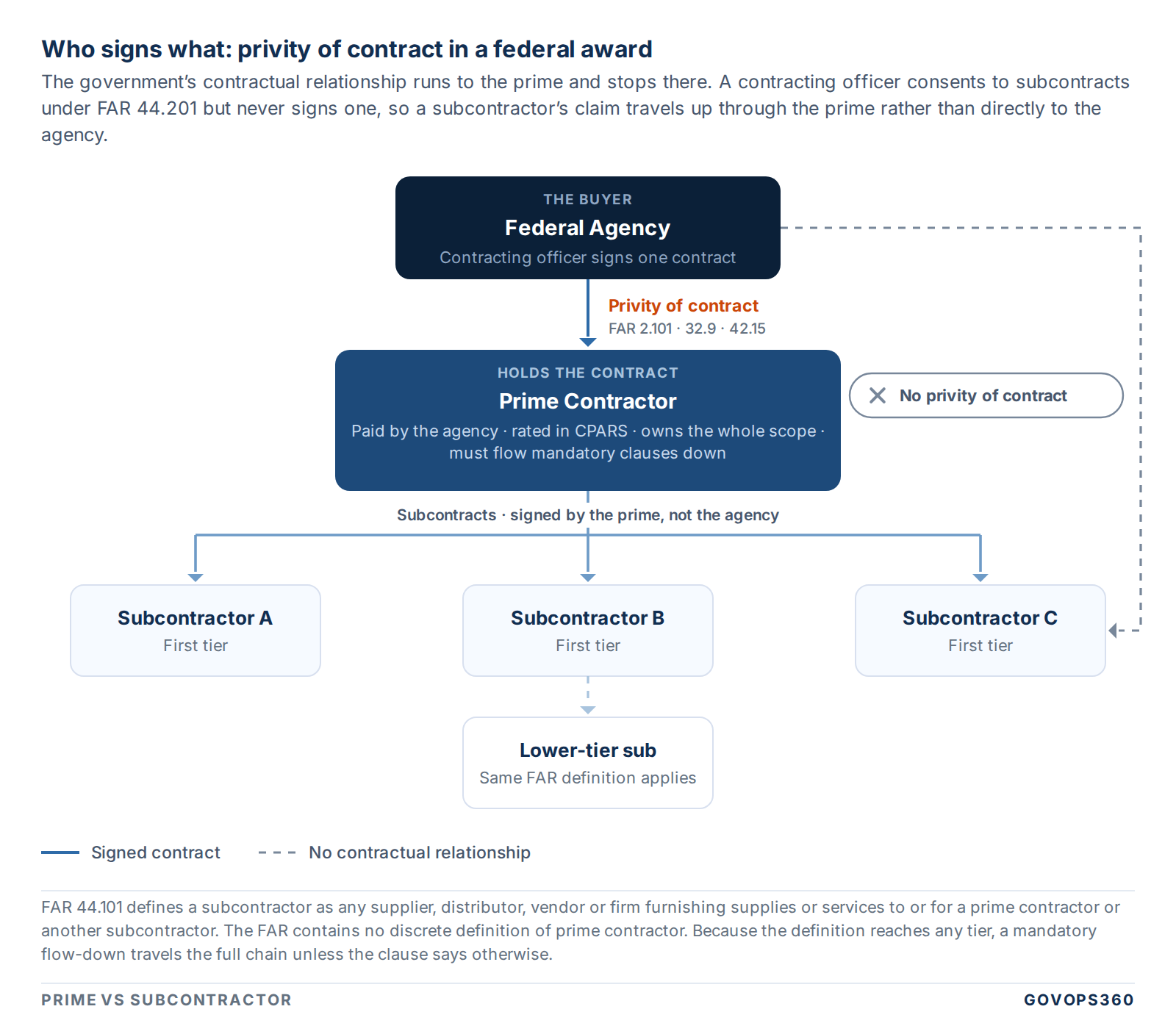
What privity means on a Tuesday
A contracting officer consents to subcontracts under FAR 44.201 but never signs one. A subcontractor with a payment dispute sues the prime contractor, not the Treasury. And a subcontractor’s excellent work is recorded against the prime’s name.
Tiers, and why the FAR does not care about them
Industry talks about first-tier and lower-tier subcontractors. The FAR does not use those labels. Its single definition of subcontractor covers any firm supplying “a prime contractor or another subcontractor,” so the same rules reach down the chain regardless of depth. When a clause flows down, it flows all the way unless the clause says otherwise.
That matters when you are the sub. Being third tier does not exempt you from a mandatory flow-down. It only means the obligation reached you through two intermediaries who each had a duty to pass it on.
50%
The share of a services set-aside a small business prime must keep with itself or similarly situated firms (13 CFR 125.6)
$900K
Contract value above which a large prime must carry a small business subcontracting plan, $2M for construction (FAR 19.702)
Zero
CPARS records a subcontractor earns for subcontract work. The rating attaches to the contract holder
Side by Side: What Actually Changes
Most comparisons of these two roles list adjectives. The table below lists mechanisms, because every difference that matters traces to a specific regulation or a specific cash-flow consequence.
| Dimension | As prime contractor | As subcontractor |
|---|---|---|
| Contractual relationship | Signs with the government and holds privity | Signs with the prime contractor, no privity with the government |
| Who pays you | The agency, 30 days after a proper invoice (FAR 32.904) | The prime, on subcontract terms |
| Past performance | A CPARS record in your own name | No CPARS record of your own |
| Revenue recognized | Full contract value | Your subcontract value only |
| Performance risk | The whole scope, including your subs’ failures | Limited to your scope of work |
| Compliance load | Subcontracting plan, ISR/SSR, CPSR, ICS, flow-down duty | Whatever flowed down to you |
| Set-aside limits | Must keep 50% of services, 15% of general construction | Not directly constrained |
| Bonding | Miller Act bonds over $150,000 on construction | Only if the prime requires it |
| Agency relationship | Direct, and it compounds across recompetes | Mediated by the prime |
How to read that table
Two rows do most of the work in a real decision.
The past performance row is the reason firms outgrow subcontracting. Every year spent as a sub builds capability and revenue, but not the one asset a source selection scores directly.
The compliance load row is the reason firms attempt priming too early. Each item in it is a real system that has to exist before award, not a form you complete afterwards.
The Prime-Readiness Scorecard
Ten questions. Each maps to a specific regulatory threshold or a specific way firms get hurt, not to general readiness. Answer honestly and the total tells you whether to prime this year, team this year, or fix something first.
Prime-Readiness Scorecard
Check every statement that is true of your firm today, not the version of your firm you expect at award.
0 of 10
Check the statements above to see your readiness band.
Reading your score
- 8 to 10. You are built to prime. Pick pursuits where your past performance is genuinely relevant and bid them.
- 5 to 7. Prime selectively, on smaller fixed-price work that does not trigger the systems you are missing. Team on anything cost-reimbursement.
- Below 5. Subcontract deliberately this year and close the gaps. Bidding prime without an adequate accounting system or the working capital to finance a payment lag is how firms win work that then damages them.
Two of the ten are disqualifying rather than scored. Without SAM registration you cannot be awarded a prime contract. And if a single subcontractor would perform the primary and vital work, you have an affiliation problem before you have a pricing problem.
Scoring your firm once is useful. Scoring every pursuit against the vehicles you can realistically prime is what turns this into a habit, and that is the job of capture intelligence across your live pipeline.
Past Performance: The Asymmetry That Decides It
Read that definition closely. The evaluation attaches to the party that performed the contract or order. That party is the prime contractor. A subcontractor can deliver flawlessly for five years across four programs and finish with no CPARS record of its own.
The consequence is more serious than most firms assume. FAR 15.305(a)(2) provides that an offeror without a record of relevant past performance “may not be evaluated favorably or unfavorably on past performance.” Neutral sounds harmless. It is not. In a best-value tradeoff you are being compared against incumbents carrying Exceptional ratings, and neutral is functionally a loss on that factor.
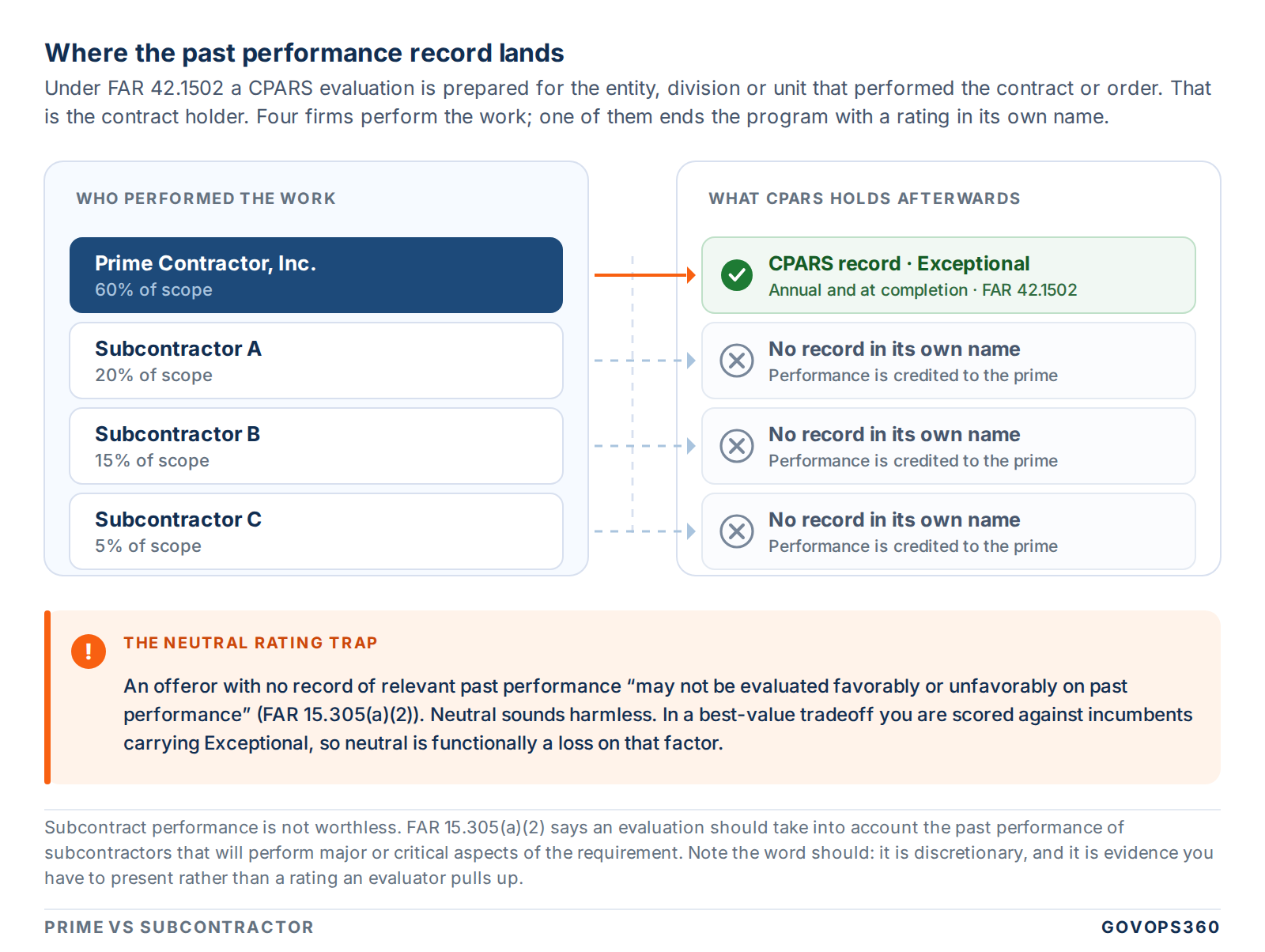
What subcontract experience does buy you
It is not worthless, and the mechanism matters. FAR 15.305(a)(2) also says the evaluation “should take into account past performance information regarding predecessor companies, key personnel who have relevant experience, or subcontractors that will perform major or critical aspects of the requirement.”
Three things follow:
- Note the word should. This is discretionary language, not a mandate. A solicitation can decline to credit it.
- The credit flows when your subcontractor performs major or critical aspects. As a prime you can legitimately draw on a teammate’s record. That is what teaming is for.
- Your own subcontract performance can be offered as relevant experience in a proposal narrative, supported by letters from the prime contractor. It is evidence, not a rating.
Put plainly: subcontracting builds a story you have to tell and defend. Priming builds a record the evaluator pulls up without asking you.
You are also rated on how you treat your subs
FAR 42.1503(b)(2)(v) makes small business subcontracting a CPARS rating factor, “including reduced or untimely payments to small business subcontractors.” Paying your subcontractors late is not just a commercial dispute. It is a documented past performance problem that follows you into the next source selection.
The Small Business Rules That Constrain the Choice
If you hold or are pursuing a set-aside, the prime-or-sub decision is partly made for you by regulation. Two rules dominate, and one of them is where compliant-looking teaming arrangements go to die.
Limitations on Subcontracting
On a services set-aside you may not pay more than 50% of what the government pays you to firms that are not similarly situated (13 CFR 125.6).
Similarly Situated
Amounts subcontracted to a firm holding the same set-aside status do not count against the limit, provided that firm performs with its own employees.
Ostensible Subcontractor
If one sub performs the primary and vital work, or you are unusually reliant on it, SBA can treat you as affiliated and you lose small status for that award (13 CFR 121.103(h)).
Mentor-Protege
A protege and mentor may joint venture as a small business for any prime contract, with the managing partner performing at least 40% of the joint venture’s work (13 CFR 125.9).
The self-performance floors
13 CFR 125.6 expresses the limits as caps on what may go to firms that are not similarly situated:
- Services: no more than 50% to non-similarly-situated firms
- Supplies and products: no more than 50%
- General construction: no more than 85%, so at least 15% stays with you or similarly situated firms
- Specialty trade construction: no more than 75%, so at least 25% stays
These apply to set-asides above the simplified acquisition threshold, including 8(a), SDVOSB, VOSB, HUBZone, WOSB and EDWOSB awards. The similarly situated carve-out is the planning lever: a small business prime can team heavily with other small businesses of the same status without breaching the limit, provided those firms perform with their own employees rather than re-subcontracting the work onward.
The trap that ends protests
The ostensible subcontractor rule is the most common way a technically compliant teaming arrangement collapses. 13 CFR 121.103(h) makes an offeror ineligible as a small business where SBA finds an ostensible subcontractor: a firm that is not similarly situated and either performs the primary and vital requirements of the contract, or is a firm the prime contractor is unusually reliant on.
Read that as a warning about proposal architecture, not just arithmetic. If your technical volume leans on a large partner’s facilities, key personnel and process maturity, you can pass the 50% calculation and still lose on affiliation. Competitors read proposals looking for exactly this, and it is decided after award, when losing is most expensive.
Most of the guides that rank for this topic do not mention this rule at all. If you build a teaming strategy from one of them, you will not see the protest coming.
What Lands on the Prime and Not the Sub
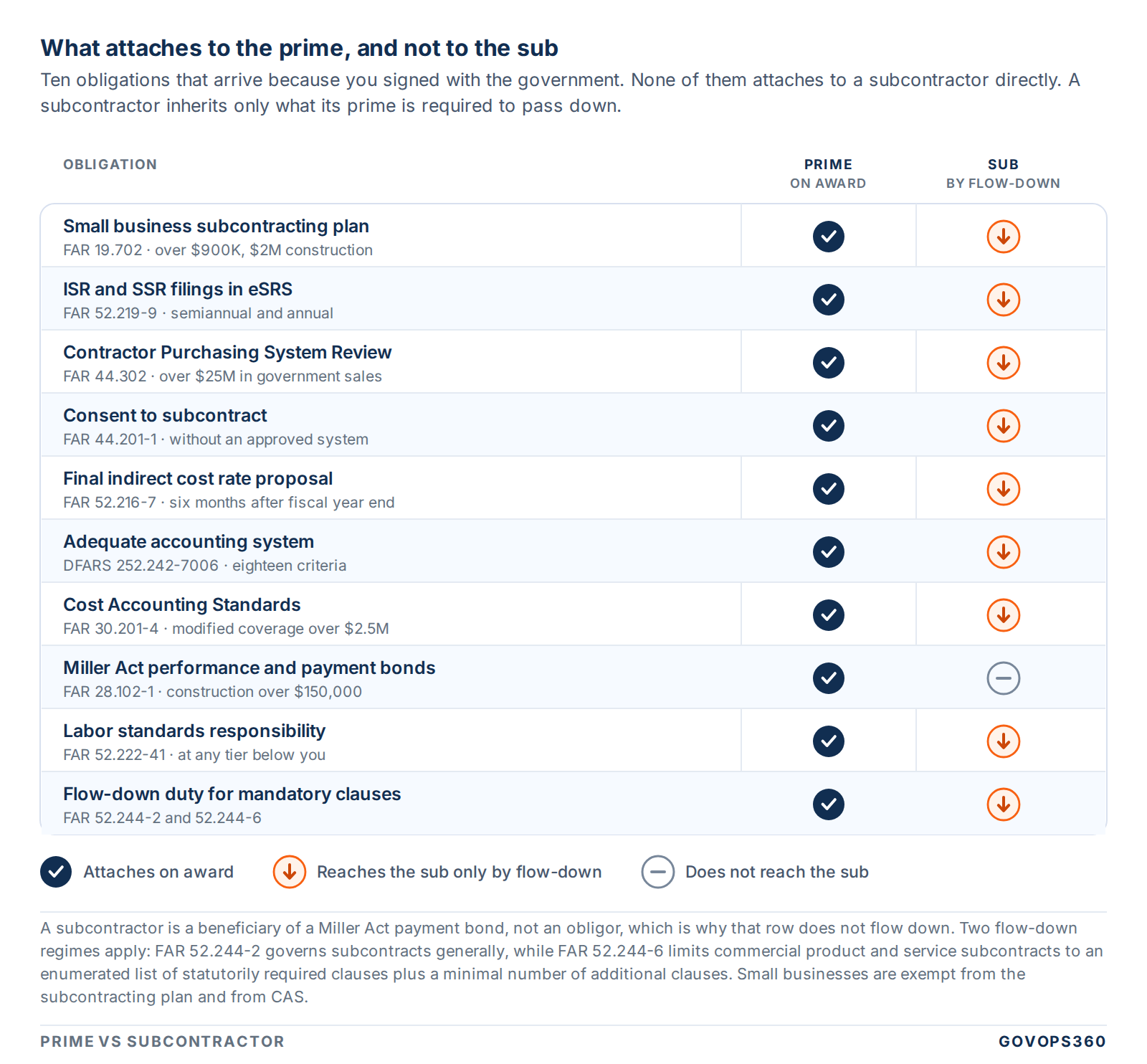
Every item below is a system, a filing or a liability that attaches because you signed with the government. As a subcontractor you inherit only what flows down to you.
- Small business subcontracting plan. Required on negotiated acquisitions expected to exceed $900,000, or $2 million for construction (FAR 19.702). Small businesses are exempt. Failure to make a good faith effort is a material breach and can carry liquidated damages.
- ISR and SSR reporting. Under FAR 52.219-9 the Individual Subcontract Report is semiannual for periods ending 31 March and 30 September, due 30 days after close. The Summary Subcontract Report is annual, due 30 October. Both are filed in eSRS.
- Contractor Purchasing System Review. FAR 44.302(a) requires a review to determine whether a CPSR is needed once government sales, excluding competed fixed-price and commercial items, are expected to exceed $25 million in the next twelve months.
- Consent to subcontract. Without an approved purchasing system, FAR 44.201-1 requires the contracting officer’s consent for cost-reimbursement, time-and-materials and labor-hour subcontracts, and for fixed-price subcontracts above the simplified acquisition threshold or 5% of estimated cost.
- Final indirect cost rate proposal. FAR 52.216-7 requires an adequate submission within the six-month period following each fiscal year end on cost-type work.
- Adequate accounting system. DFARS 252.242-7006 sets eighteen criteria on DoD work, including segregation of direct and indirect costs and timekeeping tied to cost objectives. A material weakness finding starts a 30-day response and 45-day correction clock.
- Cost Accounting Standards. CAS exempts small businesses, commercial item acquisitions and contracts under $7.5 million where the business unit holds no other CAS-covered work. Modified coverage applies on negotiated contracts over $2.5 million but less than $50 million (FAR 30.201-4(b)).
- Bonding. Miller Act performance and payment bonds are required on construction contracts exceeding $150,000 (FAR 28.102-1(a)).
- Labor standards responsibility. FAR 52.222-41 requires the prime contractor to insert the Service Contract Labor Standards clause in covered subcontracts, and the contracting officer may withhold payment for violations at any contractor or subcontractor level.
- Flow-down duty. You are responsible for passing mandatory clauses down. Two regimes apply: FAR 52.244-2 governs subcontracts generally, while FAR 52.244-6 restricts commercial product and service subcontracts to an enumerated list of statutorily required clauses, permitting only “a minimal number of additional clauses.”
One moving part worth checking before you bid
Cybersecurity flow-down is in flux. On 13 July 2026 the Department announced an immediate suspension of CMMC Phase II requirements, which had been scheduled to begin on 10 November 2026, while a comprehensive review proceeds. Phase I self-assessment requirements remain in place. Where the DFARS 252.204-7012 clause applies, paragraph (m) still requires it to be flowed down without alteration to subcontracts involving covered defense information, including subcontracts for commercial products and services.
Confirm the current position before relying on any of this in a bid. This area has moved twice in a year.
Margins, Cash Flow and the Payment Lag
Why prime margins are higher
There is no published federal statistic comparing prime and subcontract margins. DCAA does not release one, SBA does not, and GAO does not. Anyone quoting you a precise differential is quoting a rule of thumb, and you should treat it as one.
The reasons primes earn more are structural, and they are checkable:
- The prime carries performance risk for the entire scope, including work it did not perform itself. Risk is compensated.
- The prime applies G&A, and where it exists a subcontract handling pool, to subcontracted dollars. It earns on volume it passes through.
- The prime holds the customer relationship, which compounds into recompete advantage that a subcontractor cannot bank.
The cash flow trap
Priming changes when money moves, not only how much of it you keep.
The agency owes you payment on the later of 30 days after a proper invoice or 30 days after acceptance (FAR 32.904(b)). On construction progress payments the clock is 14 days.
Your obligations to your subcontractors do not wait for that. On construction contracts the Prompt Payment Act requires the prime contractor to pay subcontractors within seven days of receiving payment from the agency, and retainage may be withheld only where the subcontract permits it, written notice of the deficiency is given, and the government receives a copy of that notice. Separately, where FAR 52.232-40 applies, a prime contractor receiving accelerated payments must pass accelerated payments to its small business subcontractors within 15 days, without charging them a fee, and must flow that obligation down.
So a prime contractor running a subcontractor-heavy program is financing the gap between its own receivables and its payables. That is a working capital requirement, not an accounting detail, and it is the item most commonly missing from a firm’s first prime bid. Getting paid on time starts with a proper invoice, which is why quoting and invoicing discipline is a cash-flow control and not just admin.
Fee is not where you recover a bad structure
On time-and-materials work your rates are fixed at award for the life of the vehicle. On firm-fixed-price work the entire cost risk is yours. Neither gives you a lever to fix an underpriced bid later. If the only way a prime contractor bid closes is by cutting fee, the honest read is that you should be teaming on that pursuit instead.
Building those rates correctly is its own discipline. Our guide to the wrap rate formula and benchmark ranges walks through the cascade and ships a free calculator.
Conclusion
The prime-or-sub question is usually asked as a matter of ambition. It is better treated as a matter of readiness, pursuit by pursuit.
Subcontracting is not a lesser path. It builds capability, revenue and relationships, and for a firm without an adequate accounting system or the working capital to finance a payment lag it is the correct commercial answer. What it does not build is a CPARS record, and that is the asset a source selection reads first.
So the sequence that works is deliberate. Subcontract to build capability. Fix the systems the scorecard exposes. Then prime on pursuits where your past performance is genuinely relevant and your teaming structure survives the ostensible subcontractor test.
Run the scorecard above against your firm as it exists today, not as you intend it to look by the time of award. If you score below five, the most valuable thing you can do this quarter is close a gap rather than submit a bid.
Know Which Pursuits You Can Prime
Frequently Asked Questions
1. What is the difference between a prime contractor and a subcontractor?
2. What is a prime contract?
3. Does subcontracting count as past performance for a prime bid?
4. How much of a contract must a small business prime perform itself?
5. Can a subcontractor get its own CPARS rating?
6. Is it better to be a prime contractor or a subcontractor?
7. Can a small business be treated as large because of who it subcontracts to?
References & Sources
- FAR 2.101 – Definitions
- FAR 15.305 – Proposal evaluation (past performance)
- FAR 19.702 – Statutory requirements (subcontracting plans)
- FAR 28.102-1 – Performance and payment bonds (construction)
- FAR 30.201-4 – Contract clauses (CAS coverage)
- FAR Subpart 32.9 – Prompt payment
- FAR 42.1502 and 42.1503 – Contractor performance information (CPARS)
- FAR 44.101 – Definitions (subcontract, subcontractor, CPSR)
- FAR 44.201-1 – Consent to subcontract
- FAR 44.302 – Requirements (CPSR threshold)
- FAR 52.216-7 – Allowable cost and payment
- FAR 52.219-9 – Small business subcontracting plan
- FAR 52.222-41 – Service Contract Labor Standards
- FAR 52.232-40 – Accelerated payments to small business subcontractors
- FAR 52.244-6 – Subcontracts for commercial products and services
- DFARS 252.242-7006 – Accounting system administration
- 13 CFR 125.6 – Limitations on subcontracting
- 13 CFR 121.103 – Affiliation and the ostensible subcontractor rule
- 13 CFR 125.9 – SBA Mentor-Protege program
- 31 U.S.C. Chapter 39 – Prompt Payment
- DoD CIO – CMMC program status
Regulatory thresholds and clause text were verified against acquisition.gov and eCFR in August 2026. Margin comparisons between prime and subcontract work are practitioner reasoning, not published statistics: no federal agency publishes such a figure. CMMC phasing was suspended in July 2026 and remains under review, so confirm current status before relying on it in a bid.

Alaa Negeda
Senior Solution Architect with 23 years of experience in different Technology sectors. Diligent, forward-thinking, and adaptable to dynamic company, customer, and project needs.
Related Articles

 Sep 30,2026
 RFP vs RFQ vs RFI: Which Solicitation You Are Looking At and What to Do
 Sep 28,2026
 DDQ Meaning: What a Due Diligence Questionnaire Asks and How to Answer It
 Sep 25,2026