



 By Alaa Negeda
What Is a ROM Estimate?
A ROM estimate in federal contracting is a number you give the government before anybody has agreed what the work is. It is not an offer, it is not binding, and it is the single most dangerous number most contractors send, because of what happens to it afterwards.
Three terms travel together on every federal pricing conversation and are constantly confused: the ROM, the basis of estimate that has to stand behind a real proposal, and G&A, the indirect pool that decides what your rate actually is. Two of the three are not defined in the FAR at all, which is exactly why they cause trouble.
This guide defines each one, separates a ROM from a budgetary quote and from a firm offer, sets out the three-pool indirect structure and where G&A sits in it, gives the FAR and CAS rules that actually govern the allocation, and covers what happens when the number in your ROM email comes back as the ceiling you have to bid under.
A ROM estimate in federal contracting is a rough price given early, on limited information, so the government can size a requirement, test whether it is affordable, or decide whether to pursue it at all. It is produced in hours or days rather than weeks, and it carries none of the supporting detail a proposal would.
The first thing to know is that the FAR does not define a ROM. There is no clause, no threshold, no prescribed format. That is not an oversight to be worked around, it is the whole reason the term is risky: an undefined number with no agreed status is a number that can be used for anything.
The government does have a definition, just not in the acquisition regulation. The GAO Cost Estimating and Assessment Guide describes a ROM as developed “when a quick estimate is needed and few details are available,” useful for what-if analysis and examining high-level alternatives, and states the limit plainly: a ROM “should never be considered a budget-quality cost estimate.”
That sentence is worth keeping to hand. It is the most authoritative statement available on what a ROM is for, and it comes from the body that audits how the government estimates cost.
What Is a Rough Order of Magnitude?
Rough order of magnitude is what ROM stands for, and the phrase is doing real work. An order of magnitude is a factor-of-ten judgment: is this a hundred thousand dollar problem or a million dollar one. The term originates in engineering and project management generally, not in federal acquisition, which is why searching it returns construction and IT project material alongside GovCon material.
In a federal context the practical meaning is narrower. A ROM answers whether a requirement is fundable at roughly the level the government has in mind. It does not answer what the work will cost.
What Accuracy Range Is a ROM Expected to Hit?
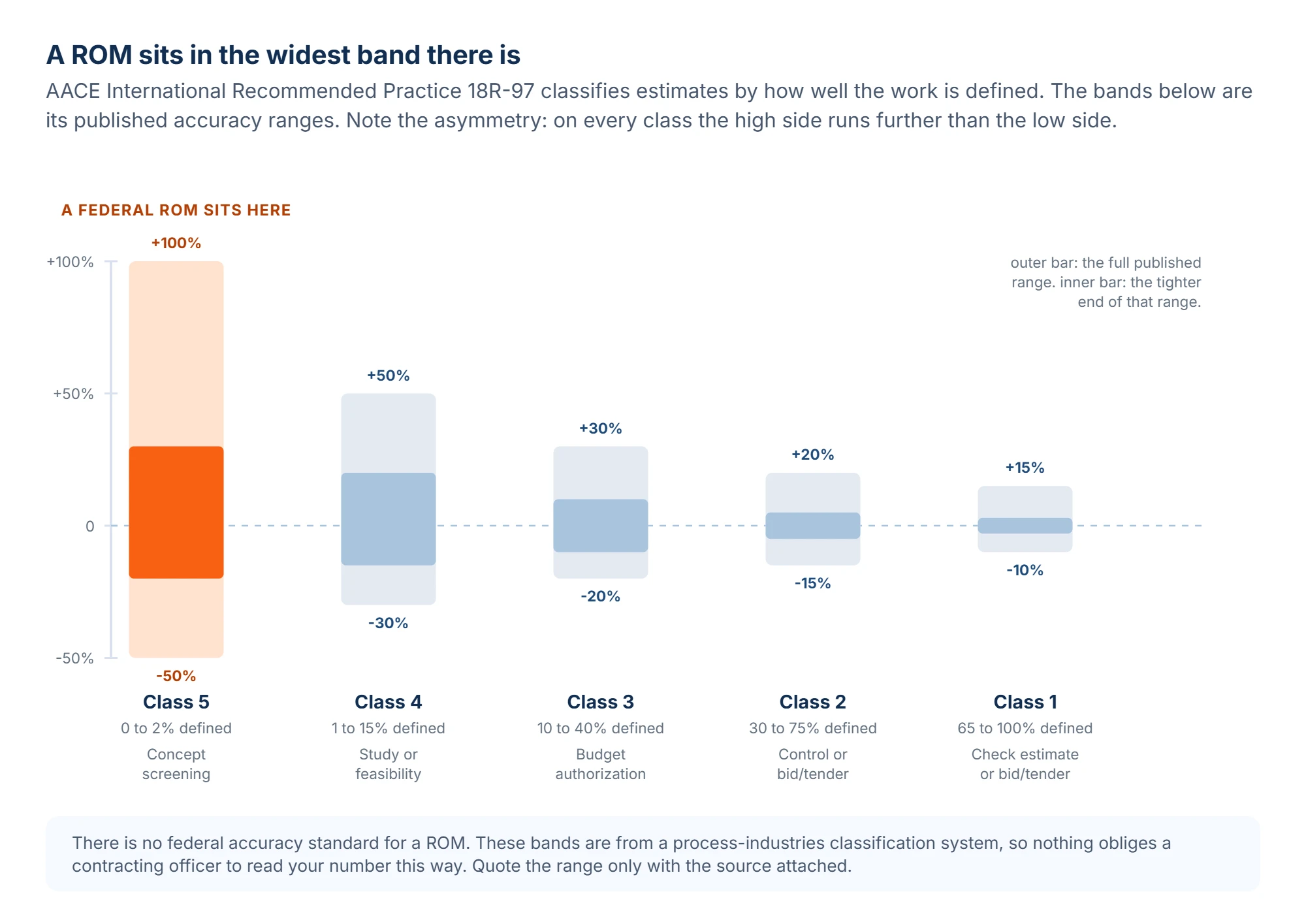
There is no federal accuracy standard for a ROM. No FAR provision sets one, and the GAO guide describes the characteristics of a reliable estimate rather than publishing a tolerance band for rough ones.
The ranges people quote come from somewhere specific, and it is worth naming it rather than repeating the number as folklore. AACE International Recommended Practice 18R-97, a cost estimate classification system for the process industries, defines a Class 5 estimate as one produced at 0 to 2 percent project definition, used for concept screening, built by capacity factoring, parametric models, judgment or analogy. Its expected accuracy range is minus 20 to minus 50 percent on the low side and plus 30 to plus 100 percent on the high side.
Two caveats matter before you use that. It is a process-industries standard, not a federal one, so nothing obliges a contracting officer to read your ROM that way. And the spread is asymmetric: the high side runs much further than the low side, which matches how estimates actually fail. If you quote a range at all, quote it with the source attached.
What Is a Basis of Estimate?
A basis of estimate, usually shortened to BOE, is the written explanation of how you arrived at a proposed cost: the method, the source data, the assumptions and the calculations. It is the difference between a number and a defensible number.
Like ROM, the term BOE is not defined in the FAR. Unlike ROM, the substance of it is required by the FAR, which is the detail that gets missed. FAR 15.408 Table 15-2, the instructions for submitting cost or price proposals, requires an offeror to explain the estimating process, including “the judgmental factors applied and the mathematical or other methods used in the estimate.”
The same table works through it element by element. For direct labor, provide a time-phased breakdown of hours, rates and cost by category and “furnish bases for estimates.” For materials and services, provide a consolidated priced summary and “the basis for pricing (vendor quotes, invoice prices, etc.).” For indirect costs, show trends and budgetary data supporting the reasonableness of the proposed rates. And disclose the nature and amount of any contingency included in the price.
So a BOE is not a document you produce because a proposal manager likes documents. It is the artifact that satisfies Table 15-2, and on any acquisition where certified cost or pricing data is required it is the thing an auditor reads first.
What Are G&A Expenses?
G&A stands for general and administrative expense: the cost of running the business as a whole rather than the cost of doing any particular job. Executive salaries, corporate finance and accounting, legal, human resources, business development and corporate IT typically live here.
This term does have a formal definition, in Cost Accounting Standard 410. It is “any management, financial, and other expense which is incurred by or allocated to a business unit and which is for the general management and administration of the business unit as a whole.”
The definition carries an exclusion that decides a lot of arguments: an expense is not G&A where the beneficial or causal relationship to cost objectives can be more directly measured by a base other than a cost input base. In plain terms, if a cost can be tied to specific work by a better measure, it belongs in a different pool or charged direct.
G&A is also the pool with the widest base, and CAS 410 defines what that base is made of. Cost input is “the cost, except G&A expenses, which for contract costing purposes is allocable to the production of goods and services during a cost accounting period.” Everything else you spend on doing the work is the base that G&A spreads across.
What Does NTE, Not to Exceed, Mean?
NTE means not to exceed: a stated dollar figure that caps something. What it caps depends entirely on which instrument it appears in, and that is where the confusion starts, because at least three different things get called an NTE.
- A limit on government liability on an undefinitized action. On a letter contract, FAR 52.216-24, Limitation of Government Liability, prescribed at FAR 16.603-4(b)(2), states a dollar figure the contractor is not authorized to exceed and a maximum amount for which the government will be liable if the contract is terminated. This is the strictest form: it binds both sides.
- A ceiling on a time-and-materials contract. FAR 16.601(d)(2) requires a ceiling price that the contractor exceeds at its own risk. It is not a cap on your effort, it is a cap on what is payable, which is covered in detail in our contract types guide.
- An informal cap in a request or a quote. An agency asking for a number “not to exceed” a figure, or a contractor offering to work “NTE $X”, is using the term commercially rather than under a clause. It has whatever force the resulting contract gives it, and often none until then.
The practical rule is to find the clause. If an NTE figure is not attached to a clause in the contract, ask which document is supposed to make it binding and on whom. If it is attached to a clause, read that clause, because the three above allocate risk very differently.
ROM vs Budgetary Quote vs Firm Quote
These are not three shades of the same thing. They differ in what they commit you to, where they sit in the process and what has to stand behind them.
| What it is | What it commits you to | Where it sits in the process | What must stand behind it |
|---|---|---|---|
| ROM estimate | Nothing contractually. It is information, not an offer | Pre-solicitation exchange under FAR 15.201, or market research | Whatever you choose. There is no FAR requirement, and no FAR definition |
| Budgetary quote | Nothing contractually, but it is understood as closer and more considered than a ROM | Requirements definition, when the agency is building its own estimate | Enough work that you would defend the shape of it, though not a full BOE |
| Firm offer or quote | Everything. It is capable of acceptance and becoming a contract | In response to a solicitation | A basis of estimate meeting FAR 15.408 Table 15-2, and certified cost or pricing data where required |
| NTE figure | Depends entirely on the clause it sits under | Letter contracts and undefinitized actions, or a T&M ceiling | FAR 52.216-24 on a letter contract, FAR 16.601(d)(2) on a T&M ceiling, or nothing at all if it is informal |
The row that matters is the first one. A ROM commits you to nothing, which is exactly why people send them casually, and it is also why the number can travel a long way without anybody treating it as provisional.
G&A vs Overhead vs Fringe: The Three-Pool Structure
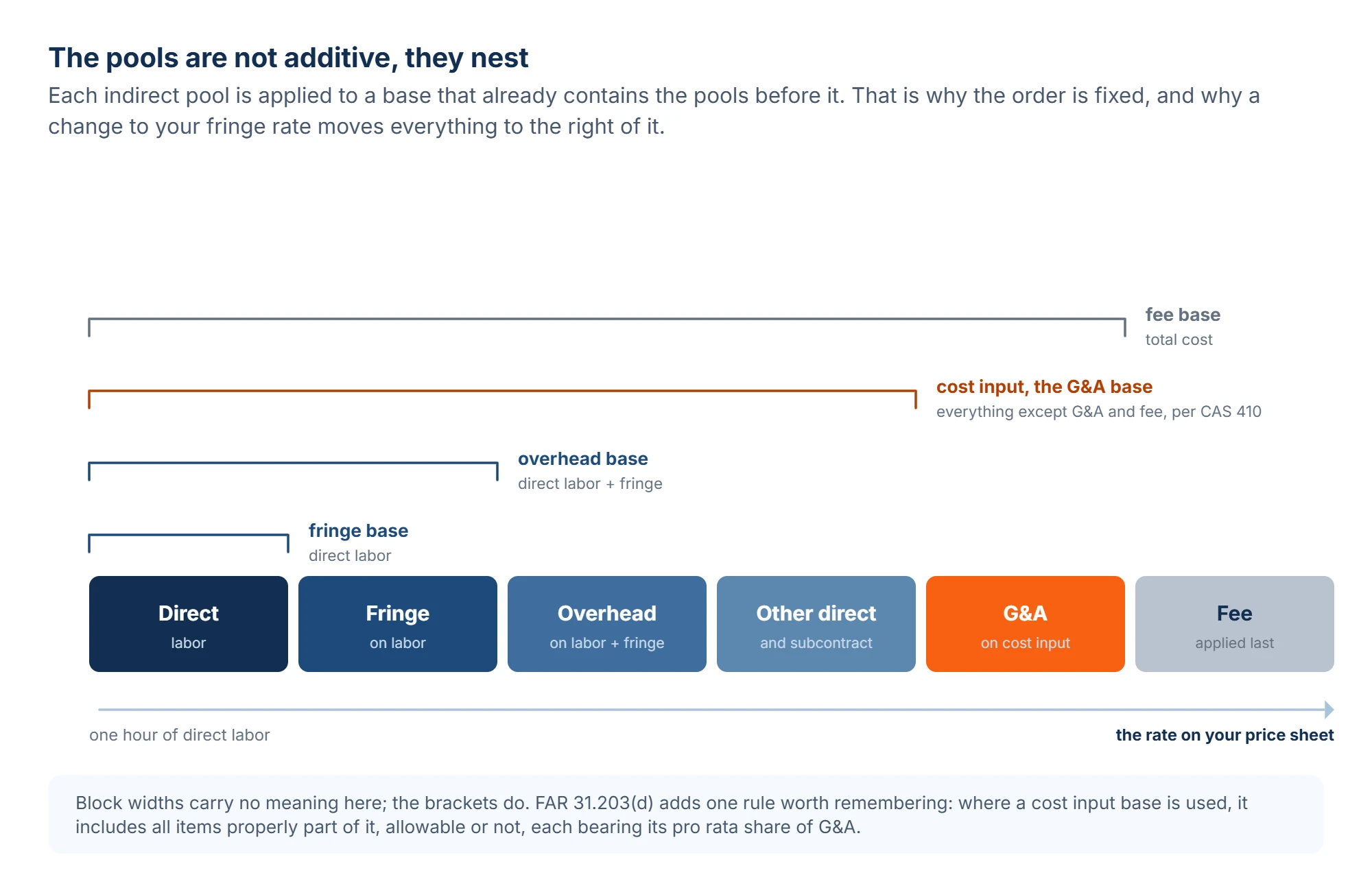
Most indirect rate confusion comes from treating the three pools as three separate percentages that get added together. They are not additive. They are sequential, and each one is applied to a base that already contains the pools before it.
- Fringe covers the cost of employing people beyond their salary: payroll taxes, health insurance, retirement contributions, paid leave. Its base is direct labor.
- Overhead covers the cost of the environment the work happens in: supervision, facilities, tools and equipment used across jobs. Its base is typically direct labor plus fringe.
- G&A covers running the company as a whole. Its base, per CAS 410, is cost input, meaning everything else allocable to producing goods and services.
Because the bases nest, the order is not a presentational choice. A change in your fringe rate moves the overhead base, which moves the G&A base, which moves the price. This is also why two companies quoting the same nominal rates can produce different prices: the composition of each pool and the definition of each base differ.
One rule that catches people out is in FAR 31.203(d). Where a cost input base is used to allocate G&A, the base must include all items properly part of it, whether allowable or unallowable, and every item bears its pro rata share of G&A. You do not get to shrink the base by removing unallowable costs, which would inflate the rate applied to everything else.
How to Build a Defensible Basis of Estimate
There is a usable standard for this, and it is not a proposal-shop convention. The GAO Cost Estimating and Assessment Guide defines a well-documented estimate as one that “can easily be repeated or updated and can be traced to original sources through auditing,” with documentation that explicitly identifies the primary methods, calculations, results, rationales, assumptions and sources.
GAO puts the test even more usefully elsewhere in the guide: the documentation should describe how the estimate was developed “so that a cost analyst unfamiliar with the program could understand what was done and replicate it.”
That is the bar. A BOE that only your pricing lead can explain has already failed it. Working backwards from that standard gives five things every estimate element needs:
- The method, named. Analogy to a prior contract, parametric from a rate and a quantity, engineering build-up from tasks, or vendor quote. Table 15-2 asks for the mathematical or other methods used, so name it rather than describing the result.
- The source data, identified well enough to be found again. A prior contract number, a specific quote with its date, a labor standard, an actuals report for a named period. “Historical experience” is not a source.
- The assumptions, written as assumptions. Government-furnished equipment available on day one, a stated staffing profile, a specific escalation rate. If an assumption fails, the estimate should visibly fail with it.
- The calculation, shown. Hours times rate, or quantity times unit cost, with the arithmetic present. This is what makes an estimate repeatable rather than assertable.
- The contingency, disclosed. Table 15-2 requires the nature and amount of any contingency in the proposed price. A contingency buried inside inflated hours is not disclosed, and it is the version that causes trouble in an audit.
The discipline that separates firms that do this well is unglamorous: the BOE is written while the estimate is being built, not reconstructed afterwards from a spreadsheet whose author has moved on.
How G&A Flows Into the Rate You Actually Bill
Start from one hour of direct labor and follow it. That hour picks up fringe, then overhead on the labor-plus-fringe amount, which gives a fully burdened labor cost. Add other direct costs and subcontract costs and you have cost input. G&A is applied to that, and fee is applied last. The result is the rate on your price sheet.
Two consequences follow that are worth stating plainly, because they change bids.
- Subcontract and material costs usually carry G&A. Under a total cost input base they sit in the base, so passing through a large subcontract can move a meaningful amount of G&A onto work you are not performing. That is why the base choice is a commercial decision, not just an accounting one.
- The same G&A pool spread over a bigger base produces a lower rate. Growth lowers your rate mechanically. So does the reverse: a year where revenue falls while the corporate cost base does not raises the rate you have to bid next year.
CAS 410 recognizes three cost input bases and is specific about when each is appropriate. A total cost input base is “generally acceptable as an appropriate measure of the total activity of a business unit.” A value-added base, which strips material and subcontract cost out, “shall be used … where inclusion of material and subcontract costs would significantly distort the allocation of the G&A expense pool in relation to the benefits received.” A single element base such as direct labor dollars may be used “where it produces equitable results,” and is inappropriate where it is an insignificant part of the total cost of some final cost objectives.
If your business has swung heavily toward subcontracted delivery since your base was set, that is the paragraph to read. The full mechanics of building the rate are worked through in our wrap rate calculator guide, and the complete worked example sits in the federal bid pricing guide.
Which FAR and CAS Rules Govern Indirect Cost Allocation?
Two bodies of rule, and they do different jobs. The FAR cost principles govern what is allowable and how indirect cost is grouped and allocated on government contracts. The Cost Accounting Standards govern consistency and measurement for contractors covered by them.
FAR 31.203 is the operative cost principle. It defines indirect cost as what remains after direct costs are determined and charged directly, to be allocated to two or more final cost objectives. On grouping and base selection it is directive: the contractor “shall determine each grouping so as to permit use of an allocation base that is common to all cost objectives to which the grouping is to be allocated,” and the base selected “shall allocate the grouping on the basis of the benefits accruing to intermediate and final cost objectives.”
That benefits test is the whole logic of indirect allocation. A base is defensible when it tracks the benefit the pool provides, and indefensible when it was chosen because it produced a convenient rate.
On the CAS side, CAS 410 is the one that governs G&A specifically. Its fundamental requirement is that G&A “shall be grouped in a separate indirect cost pool which shall be allocated only to final cost objectives,” and that the pool “shall be allocated to final cost objectives … by means of a cost input base representing the total activity of the business unit.”
Two implications for a bidder. G&A goes only to final cost objectives, so it does not get layered into another indirect pool. And the base has to represent total activity, which is the standard any base change has to be argued against.
What Happens When Your ROM Becomes the Number
This is the part nobody covers, and it is the reason a ROM deserves more care than its informality suggests. A ROM is not binding. The number in it very often is, in every practical sense that matters.
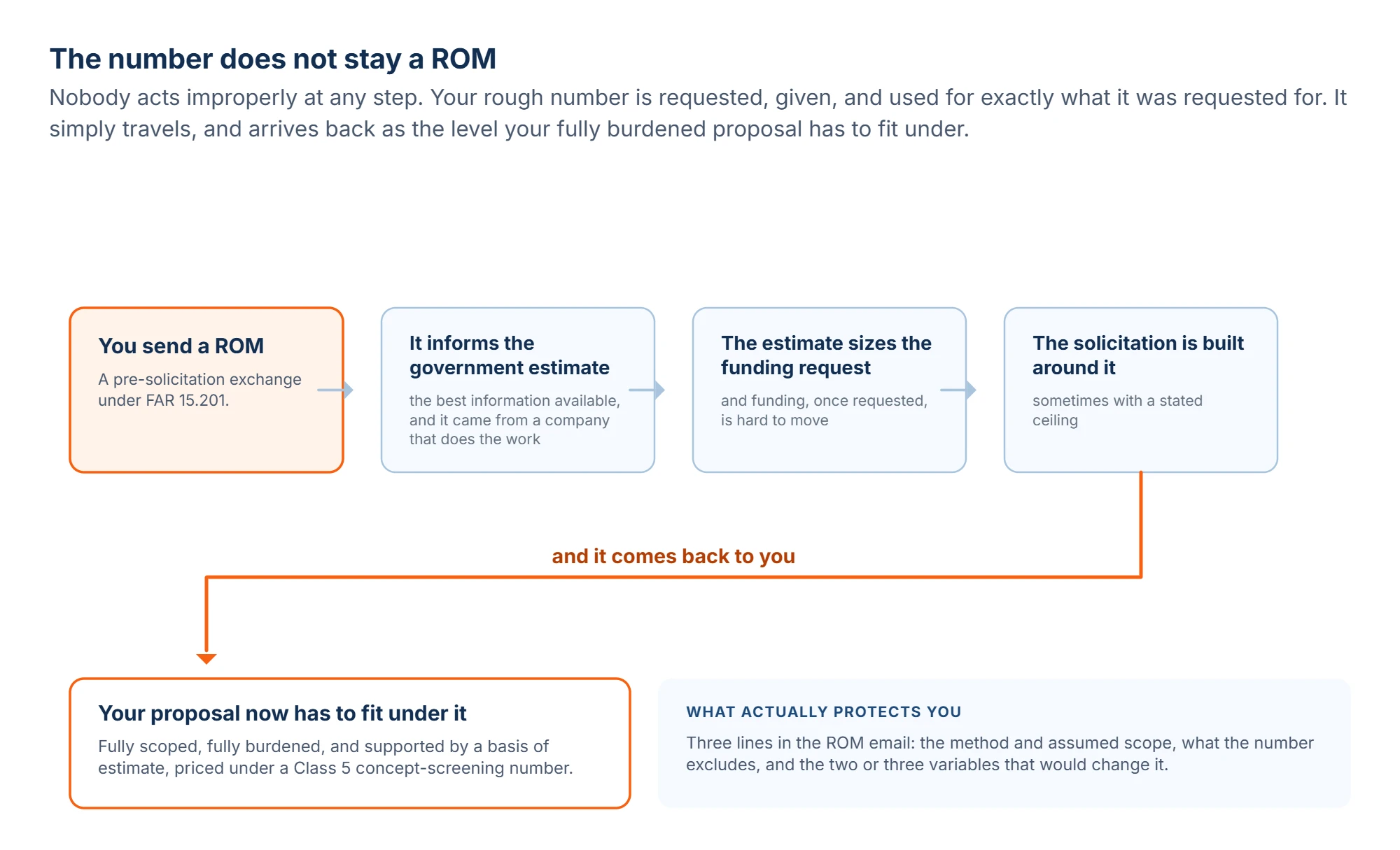
The mechanism is mundane. FAR 15.201 encourages exchanges of information from the earliest identification of a requirement, and lists market research, one-on-one meetings, presolicitation notices, draft RFPs and RFIs among the techniques. Your ROM enters through one of those doors. From there:
- The number informs the government estimate for the requirement, because it is the best information available and it came from a company that does the work.
- The government estimate sizes the funding request, and funding once requested is difficult to move.
- The solicitation is built around that funding, sometimes with a stated ceiling.
- You bid, and your own early guess is now the number you have to fit a fully scoped, fully burdened, BOE-supported price under.
Nobody acted improperly at any step. The information was requested, given, and used for exactly what it was requested for. The failure is that a Class 5 concept-screening number was carried forward as though it were a budget-quality estimate, which is the thing GAO says a ROM must never be treated as.
What actually protects you is cheap and takes one paragraph:
- State the basis in the ROM itself. Two or three lines naming the method, the assumed scope and the assumed period of performance. This is the smallest useful BOE and it makes the number auditable later.
- State what it excludes. Travel, government-furnished equipment, security requirements, surge, transition. Exclusions are what get silently absorbed when the number is reused.
- Give a range rather than a point where you honestly have one, and say what would narrow it. A point estimate reads as precision you do not have.
- Say what would change it. Naming the two or three variables that drive the number is the most useful sentence in the whole email, because it tells the reader when to come back to you.
When in the Capture Cycle Does a ROM Get Requested?
Early, and usually at one of three moments. During market research, when an agency is testing whether a requirement is feasible and affordable. At the RFI or sources sought stage, sometimes explicitly requested alongside capability information. And during requirements definition, when a program office is building the estimate that will support its funding request.
All three sit before a solicitation exists, which is precisely why the number has room to travel. Once a solicitation is issued, FAR 15.201(f) makes the contracting officer the focal point for exchanges, and the informal channel that carried your ROM closes.
How to Keep BOEs and Indirect Rates Consistent Across Bids
Individual estimates are rarely the problem. Consistency across estimates is, and it fails quietly in three specific ways.
- Rate drift. A provisional rate is updated, and the bids in flight keep using the old one because nobody told the people writing them.
- Assumption drift. The same assumption is written three different ways across three proposals, so when one is challenged there is no consistent position to defend.
- The orphaned ROM. A number goes out by email with no record that it was sent, and reappears months later in a solicitation that nobody connects back to it.
The third one is the expensive one, and it is a tracking problem rather than a pricing problem. If nobody can answer “what number did we give them, when, and on what basis”, then the first time you see the figure again is in a document you now have to price against.
That gives four questions worth being able to answer on any working day:
- Which pursuits have had a ROM or budgetary number sent, to whom, on what date, and on what stated basis?
- Which indirect rate set is current, and which proposals in flight are using an older one?
- Which assumptions recur across bids, and are they worded the same way in each?
- When a rate changes, which live pursuits need repricing before submission?
GovOps360 keeps the pursuit, the numbers given to the customer, the date and basis they were given on, and the rate set they were built from in one record, so a ROM sent in March is still findable when the solicitation lands in September. GovFind finds the opportunity. GovOps360 wins it.
See Where GovOps360 Fits Your Pipeline
Bring a pursuit you lost and one you won. We will model both, show you where the platform helps and tell you where another tool on this list is the better fit.
Frequently Asked Questions
1. Is a ROM estimate binding?
No. A ROM is information rather than an offer, it is exchanged before a solicitation exists, and nothing in the FAR makes it enforceable. The practical risk is different: the number can inform the government estimate and the funding, and come back as the level you have to bid under.
2. Is a ROM the same thing in construction and project management?
The idea is the same, a quick estimate on little information, but the surrounding rules are not. Outside federal work a ROM is often classified against a standard such as AACE 18R-97. In federal contracting there is no defined status, no format and no required accuracy.
3. What is the difference between NTE and a T&M ceiling?
A T&M ceiling comes from FAR 16.601(d)(2) and is a cap on what is payable, which the contractor exceeds at its own risk. An NTE under FAR 52.216-24 on a letter contract caps both what the contractor may spend and what the government will be liable for. Informal NTE language may bind nothing.
4. What is a basis of estimate in a proposal?
The written explanation of how each cost element was derived: method, source data, assumptions and calculations. FAR 15.408 Table 15-2 requires bases for estimates, the judgmental factors and methods used, and disclosure of any contingency in the price.
5. How is a G&A rate calculated?
The G&A expense pool is divided by a cost input base. CAS 410 defines cost input as the cost, other than G&A, allocable to producing goods and services in the period. The base may be total cost input, value-added, or a single element where that produces equitable results.
6. Does G&A apply to subcontractor costs?
Under a total cost input base, yes, because subcontract costs sit in the base. CAS 410 allows a value-added base instead where including material and subcontract costs would significantly distort the allocation relative to the benefits received.
7. What is the difference between G&A and overhead?
Overhead is the cost of the environment the work happens in and is allocated over a labor-related base. G&A is the cost of running the business as a whole and is allocated over cost input. CAS 410 excludes from G&A any expense whose relationship is better measured by another base.
8. When do I have to submit certified cost or pricing data?
FAR 15.403-4 requires it above the threshold, which is $2.5 million for prime contracts awarded on or after 1 July 2018 and is adjusted for inflation under FAR 1.109. Exceptions apply, including adequate price competition, so check the specific acquisition.
References and Sources
All FAR and CAS citations were verified against acquisition.gov and ecfr.gov, and the GAO and AACE references against gao.gov and the published recommended practice, on 5 September 2026.
- FAR 31.203, Indirect costs, including the grouping and base selection requirements and the cost input base rule at (d)
- FAR 15.408 and Table 15-2, Instructions for Submitting Cost/Price Proposals
- FAR 15.403-4, Requiring certified cost or pricing data
- FAR 15.201, Exchanges with industry before receipt of proposals
- FAR 52.216-24, Limitation of Government Liability, prescribed at FAR 16.603-4(b)(2)
- FAR Subpart 16.6, including the time-and-materials ceiling at FAR 16.601(d)(2)
- CAS 410 definitions at 48 CFR 9904.410-30, including general and administrative expense and cost input
- CAS 410 fundamental requirement at 48 CFR 9904.410-40
- CAS 410 techniques for application at 48 CFR 9904.410-50, including the three cost input bases
- GAO Cost Estimating and Assessment Guide, GAO-20-195G, March 2020
- AACE International Recommended Practice 18R-97, Cost Estimate Classification System, revised 1 March 2016
Related reading: the wrap rate calculator guide works the indirect build end to end, how to price a federal bid carries the full example, and government contract types covers the T&M ceiling this article contrasts with an NTE.

Alaa Negeda
Senior Solution Architect with 23 years of experience in different Technology sectors. Diligent, forward-thinking, and adaptable to dynamic company, customer, and project needs.
Related Articles

 Sep 30,2026
 RFP vs RFQ vs RFI: Which Solicitation You Are Looking At and What to Do
 Sep 28,2026
 DDQ Meaning: What a Due Diligence Questionnaire Asks and How to Answer It
 Sep 25,2026