



 By Alaa Negeda
What Does RFQ Mean in Government Contracting?
The RFQ meaning most people carry into federal work is close enough to be dangerous. A Request for Quotation is not a small Request for Proposal. It sits under a different part of the FAR, it produces a different legal document, and the thing you send back is not an offer the government can accept.
That last point is written down in one sentence at FAR 13.004(a), and almost nobody quotes it: a quotation is not an offer and cannot be accepted by the Government to form a binding contract. Everything else in this guide follows from it, including what your quote actually commits you to and why the usual proposal reflexes are the wrong ones here.
Below: what RFQ means in a federal context, which FAR part governs it, the current thresholds that decide when an agency uses one, how RFQs differ from RFPs and RFIs, how to respond, where they are actually posted, why quotes get dropped, and what the FAR Overhaul is doing to all of it. Two thresholds in here changed recently and most competing pages still carry the old numbers.
An RFQ is a request from a government agency for a price and terms on a defined requirement, issued under simplified acquisition procedures. It asks what you would charge to supply something the agency has already described. It does not ask you to propose an approach, and it does not, by itself, start a negotiation.
The document you send back is a quotation: information about price, delivery and terms. The government reads it, decides, and then issues a purchase order. That order is the offer. You accept it, in writing or by performing, and only at that point does a contract exist.
That sequence is the whole difference between an RFQ and every other solicitation you will see. In a Part 15 negotiated acquisition your proposal is the offer and the government accepts it. In an RFQ the roles are reversed.
What Does RFQ Stand For?
RFQ stands for Request for Quotation. You will also see Request for Quote, which means the same thing; the FAR uses “request for quotations” and the standard form is the SF 18, Request for Quotations. For commercial products and services the form is usually the SF 1449, which doubles as the solicitation, the contract and the order.
Which FAR Part Governs RFQs?
FAR Part 13, Simplified Acquisition Procedures. Within it, FAR 13.106 covers soliciting competition, evaluating quotations and making the award, and FAR 13.004 sets the legal effect of a quotation. This is the authority almost no page on this topic cites, and it is where every practical answer lives.
FAR 13.003(a) makes the policy mandatory rather than optional: agencies shall use simplified acquisition procedures to the maximum extent practicable for purchases at or below the simplified acquisition threshold, unless the requirement can be met from a required source under Part 8, an existing indefinite-delivery contract, or another established contract.
Two other parts overlap it and cause most of the confusion. Orders against a GSA Schedule use an RFQ but follow FAR 8.405, not Part 13. Commercial products and services above the threshold can still be bought with simplified procedures under FAR subpart 13.5, which is why you sometimes see an RFQ on a multi-million dollar requirement.
What Is the Simplified Acquisition Threshold?
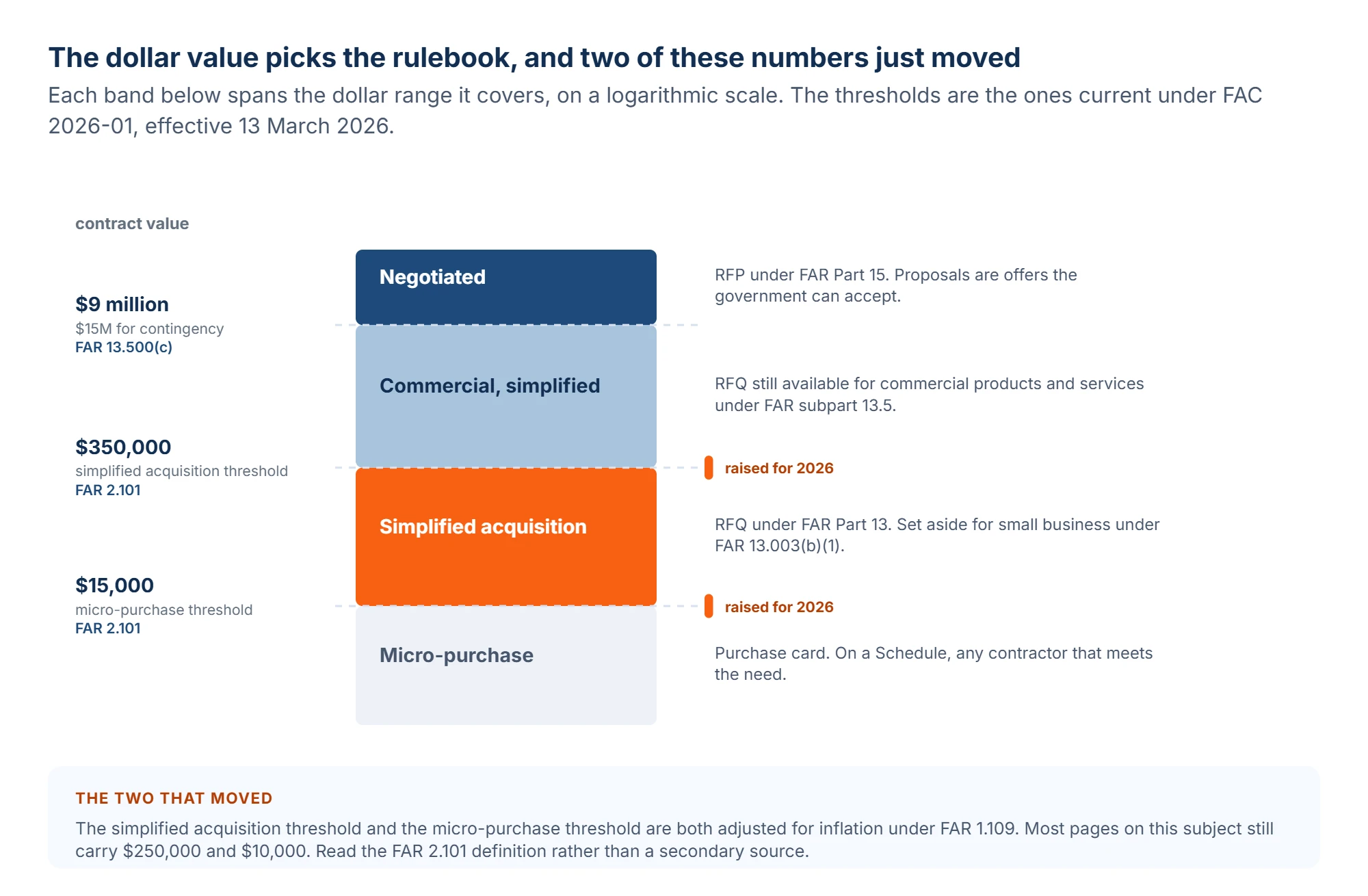
As of FAC 2026-01, effective 13 March 2026, the simplified acquisition threshold is $350,000 and the micro-purchase threshold is $15,000. Both are defined at FAR 2.101 and both are adjusted for inflation under FAR 1.109. Most pages on this subject still say $250,000 and $10,000. Check the definition rather than a secondary source before you rely on either number.
Three variations matter in practice. The micro-purchase threshold drops to $2,000 for construction subject to the Wage Rate Requirements statute and $2,500 for services subject to the Service Contract Labor Standards statute. And for contingency, emergency or major-disaster acquisitions, FAR 2.101 raises the simplified acquisition threshold to $1 million inside the United States and $2 million outside it.
Above the threshold, FAR 13.003(c)(1) and FAR 13.500 allow simplified procedures for commercial products and services up to $9 million, or $15 million for the contingency and emergency categories at 13.500(c). That ceiling was $7 million for years; it is worth re-reading rather than remembering.
Why a Quote Is Not an Offer
FAR 13.004(a) is worth reading in full, because it is short and it is the entire legal basis for how RFQs behave.
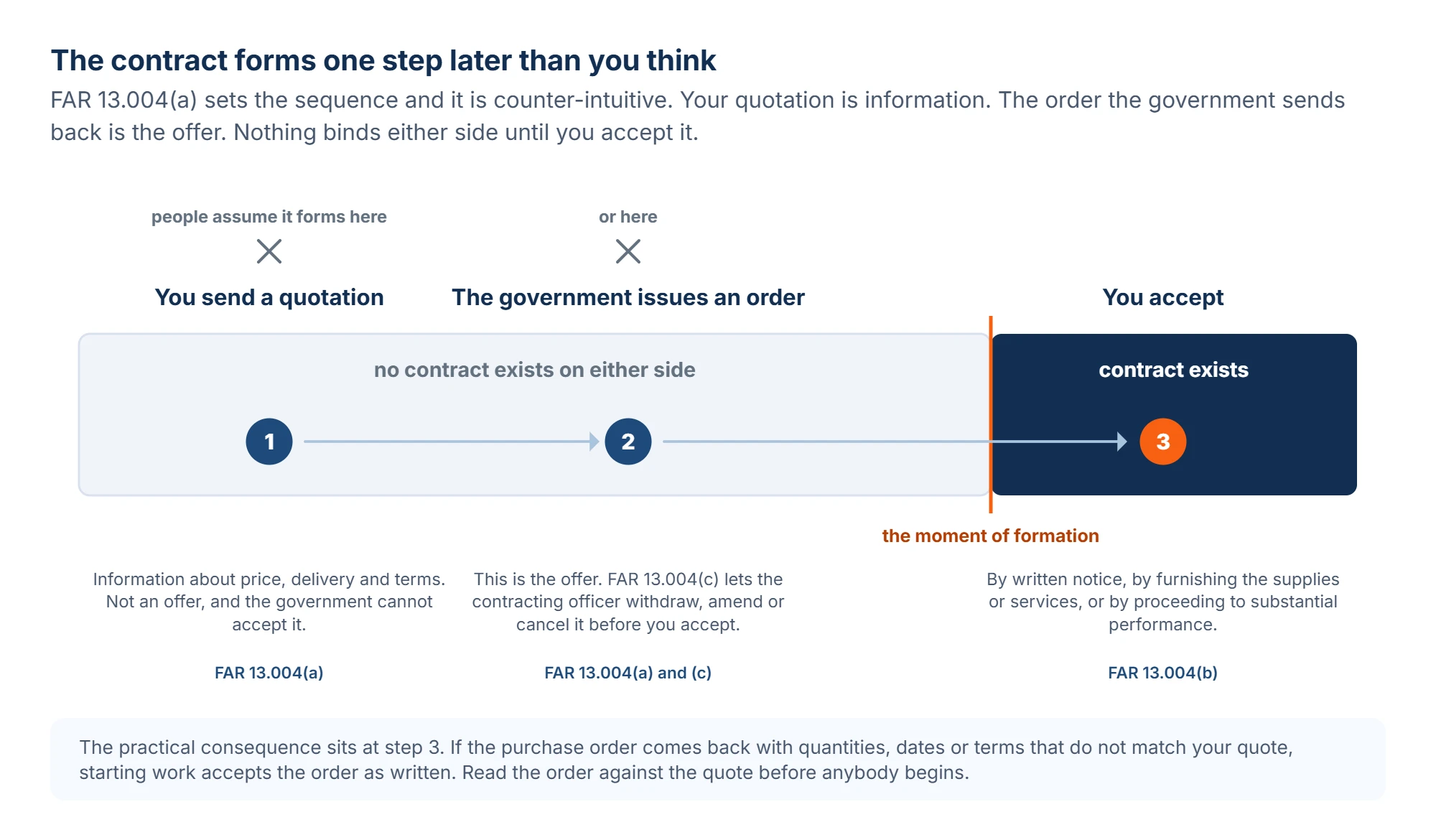
“A quotation is not an offer and, consequently, cannot be accepted by the Government to form a binding contract. Therefore, issuance by the Government of an order in response to a supplier’s quotation does not establish a contract. The order is an offer by the Government to the supplier to buy certain supplies or services upon specified terms and conditions. A contract is established when the supplier accepts the offer.”
Three practical consequences follow, and the third one surprises people.
- You are not bound when you quote. Submitting a quote does not obligate you to perform. It is information, not a promise.
- The government is not bound when it issues the order. The order is its offer. FAR 13.004(c) lets the contracting officer withdraw, amend or cancel that offer by written notice at any time before you accept it.
- You are bound the moment you accept, including by starting work. FAR 13.004(b) says the supplier may indicate acceptance by written notification, by furnishing the supplies or services, or by proceeding with the work to the point where substantial performance has occurred. Beginning performance is acceptance.
So the risk on an RFQ is not at the quoting stage, it is at the order stage. If a purchase order arrives with terms, quantities or dates that do not match what you quoted, performing on it accepts those terms. Read the order against the quote before anybody starts work.
RFQ vs RFP
An RFP asks you to propose. An RFQ asks you to price. FAR 15.203(a) describes RFPs as used in negotiated acquisitions to communicate Government requirements to prospective contractors and to solicit proposals. A proposal under Part 15 is an offer capable of acceptance. A quotation under Part 13 is not.
The procedural gap is wider than the definitional one, and FAR 13.106-2(b) is explicit about it: the procedures prescribed in parts 14 and 15 are not mandatory. The contracting officer has broad discretion to fashion evaluation procedures and may use one, some or none of them.
That produces four differences you can plan around.
- No stated weighting. FAR 13.106-1(a)(2)(iii) says solicitations are not required to state the relative importance of each evaluation factor, nor to include subfactors. You will often be told award is on price and past performance and nothing more.
- No competitive range, no discussions, no scoring. FAR 13.106-2(b)(3) says formal evaluation plans, establishing a competitive range, conducting discussions and scoring are not required. Comparative evaluation is allowed instead.
- Past performance without a database. The same paragraph lets the contracting officer rely on personal knowledge of the item, customer surveys, CPARS, or any other reasonable basis.
- Price reasonableness, not price realism. FAR 13.106-3(a) requires only that the contracting officer determine the proposed price fair and reasonable, based on competitive quotes where possible. How to price a federal bid covers building a number that survives that test.
The practical read: an RFQ response is short because the rules let the evaluation be short. Sending a Part 15 style volume set into a Part 13 acquisition costs you money and wins nothing.
RFQ vs RFI
An RFI is market research. An RFQ is a solicitation. The two are frequently confused because neither response is an offer, but only one of them can lead to an award.
FAR 15.201(e) covers RFIs: they may be used when the government does not presently intend to award a contract but wants price, delivery, other market information or capabilities for planning purposes, and responses are not offers and cannot be accepted by the Government to form a binding contract. An RFQ, by contrast, is issued when the agency does intend to buy, and it ends in a purchase order.
The test is intent, not format. If the notice describes a requirement the agency plans to fill and asks for pricing against it, it is a solicitation whatever it is labeled. If it asks how you would approach a problem the agency has not finished defining, it is market research.
| Instrument | Governing authority | What your response is | How it is evaluated | What award looks like |
|---|---|---|---|---|
| RFI | FAR 15.201(e), market research under Part 10 | Information. Not an offer, and no award can follow from it | Not evaluated for award. It informs the requirement | No award. A solicitation may follow later |
| RFQ | FAR Part 13, and FAR 8.405 on a GSA Schedule | A quotation. Not an offer, per FAR 13.004(a) | Broad contracting officer discretion. Parts 14 and 15 procedures are not mandatory | The government issues a purchase order, which is its offer to you |
| RFP | FAR Part 15, negotiated acquisition | A proposal, which is an offer capable of acceptance | Stated evaluation factors and their relative importance, with discussions if held | The government accepts your offer and a contract exists |
| IFB | FAR Part 14, sealed bidding | A bid, which is an offer, opened publicly | Responsiveness under FAR 14.301, then price alone | Award to the lowest responsive, responsible bidder |
Short definitions for each of these terms are in the GovCon glossary.
When Agencies Use an RFQ Instead of an RFP
Mostly because the dollar value lets them, and because Part 13 is faster. But there are three specific situations, and knowing which one you are in tells you how to respond.
- At or below the simplified acquisition threshold. FAR 13.003(a) makes simplified procedures the default rather than a choice, for anything at or below $350,000 that cannot be met from a required source or an existing contract.
- Commercial products and services above it. FAR subpart 13.5 extends simplified procedures to commercial acquisitions up to $9 million, or $15 million in the categories at 13.500(c). The stated purpose is to vest contracting officers with additional procedural discretion and flexibility.
- Orders against an existing vehicle. On a GSA Schedule, FAR 8.405-2(c) runs the whole ordering process through an RFQ. This is the most common place a large company meets one.
One rule in this band is worth more to a small business than anything else in this article. FAR 13.003(b)(1) requires that acquisitions above the micro-purchase threshold and at or below the simplified acquisition threshold be set aside for small business concerns. That is a mandatory set-aside across the whole $15,000 to $350,000 band, not a preference. If you are small, that band is reserved competition.
How to Respond to a Government RFQ
Short, exact and on time, in that order. The evaluation is discretionary and light, so the things that decide it are the things the contracting officer can see quickly.
- Quote the line items as written. Match the quantities, units and delivery points in the solicitation exactly. A quote that reorganizes the schedule is harder to compare, and comparability is the whole point.
- Answer the stated basis for award. FAR 13.106-1(a)(2)(i) requires the contracting officer to tell you whether award is on price alone or price and other factors. Whatever is named there is what your response should address, and nothing else.
- Give past performance in a usable form. Under FAR 13.106-2(b)(3) the contracting officer may rely on CPARS, customer surveys, personal knowledge or any other reasonable basis. Two or three recent, relevant, contactable references beat a long narrative.
- Do not offer a prompt payment discount as a price lever. FAR 13.101(b)(3) states plainly that prompt payment discounts shall not be considered in the evaluation of quotations.
- Include your representations and certifications. Missing reps and certs are the most common reason a competitive quote goes nowhere.
One thing not to do: build a technical volume nobody asked for. FAR 13.106-2(b)(3) tells the contracting officer to ensure quotations can be evaluated in an efficient and minimally burdensome fashion. Volume works against you here.
How Long Do You Have to Respond?
There is no minimum. FAR 5.203(b) requires the contracting officer to establish a response time that affords a reasonable opportunity to respond, considering complexity, commerciality, availability and urgency. No number is attached. The 30-day floor at FAR 5.203(c) applies to solicitations above the simplified acquisition threshold and expressly does not apply to commercial products or services, which is most of what RFQs buy.
In practice that means windows measured in days. FAR 13.003(h)(2) tells contracting officers to allow a reasonable opportunity, and FAR 13.003(h)(3) tells them to consider all quotations that are timely received. Timely is the operative word, and the clock is short and unpredictable by design.
Why Quotes Get Dropped, and Why It Is Not Non-Responsiveness
Debriefs and vendor advice both use the phrase “your quote was non-responsive”. As a legal matter that is the wrong term, and the confusion hides what actually happened.
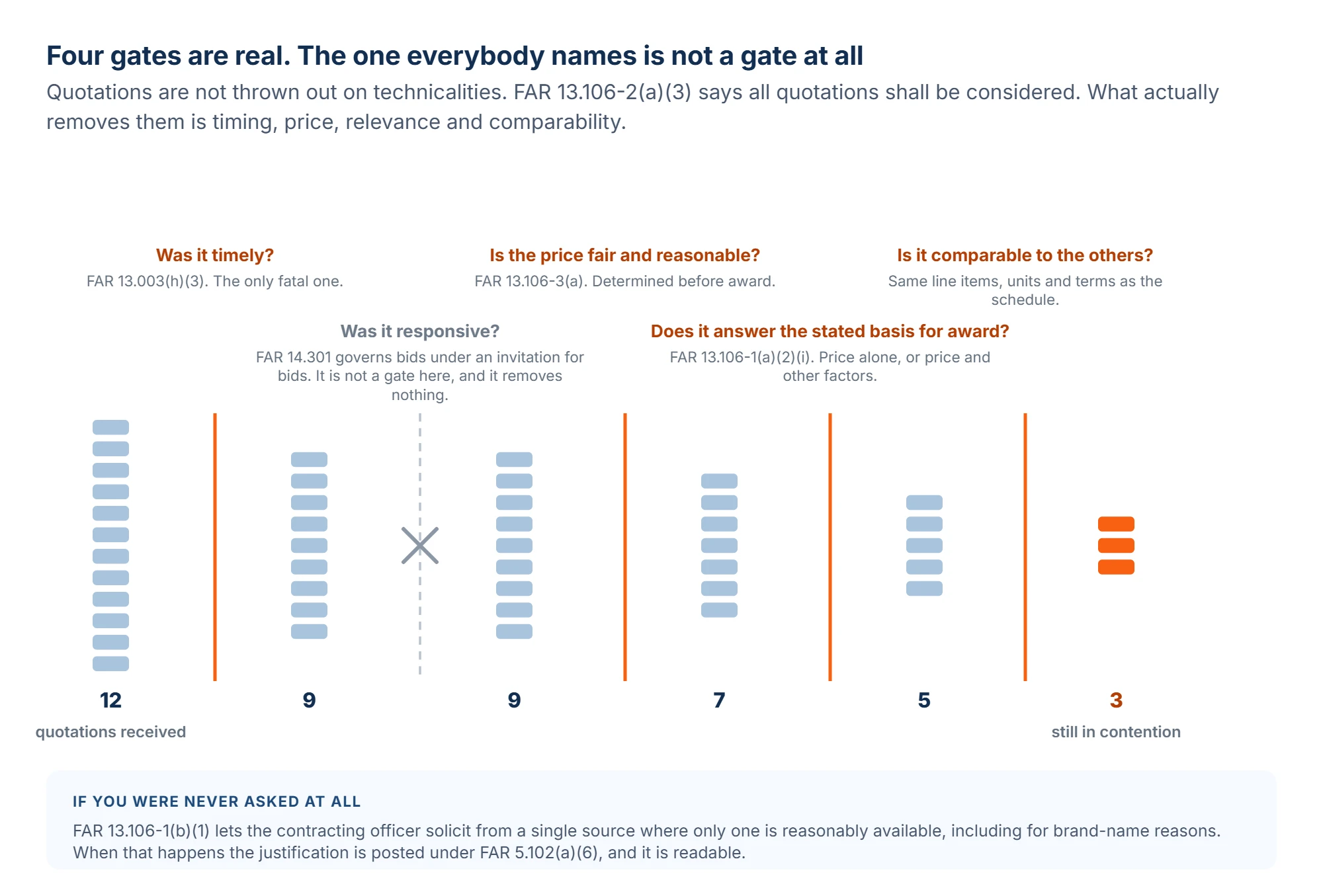
Responsiveness is a sealed-bidding concept. FAR 14.301(a) states that to be considered for award a bid must comply in all material respects with the invitation for bids, so that bidders stand on an equal footing and the integrity of the sealed bidding system is maintained. It governs Part 14. A quotation is not a bid, an RFQ is not an invitation for bids, and FAR 13.106-2(a)(3) points the other way: all quotations or offers shall be considered.
So a quote is rarely thrown out on a technicality. It loses for one of four reasons, and each has a different fix.
- It arrived late. The one genuinely fatal category. FAR 13.003(h)(3) obliges the contracting officer to consider quotations that are timely received, which leaves a late quote outside the duty entirely.
- The price was not found fair and reasonable. Under FAR 13.106-3(a) the contracting officer must make that determination before award, based on competitive quotes where possible and otherwise on market research, price lists, an independent government estimate or any other reasonable basis. A price with no visible basis is hard to defend and easy to skip.
- It did not address the stated basis for award. If the notice said price and past performance and the quote carried only price, there is nothing to evaluate on the second factor.
- It was not comparable. Different units, different quantities, missing line items, or terms that do not match the schedule. The contracting officer is working fast and comparing side by side.
There is one more, and it is not about your quote at all. FAR 13.106-1(b)(1) lets the contracting officer solicit from a single source where only one is reasonably available, including for brand-name reasons. If that is what happened, the justification is posted under FAR 5.102(a)(6) and you can read it.
Where Government RFQs Are Actually Posted
There is no RFQ notice type on SAM.gov. The notice types are Special Notice, Sources Sought, Presolicitation, Solicitation, Combined Synopsis/Solicitation, Award Notice, Justification, Intent to Bundle Requirements and Sale of Surplus Property. An RFQ appears as a Solicitation or, far more often, as a Combined Synopsis/Solicitation.
That second type is why RFQs move fast. FAR 13.105(b) lets the contracting officer combine the synopsis and the solicitation for commercial acquisitions, and FAR 5.203(a)(2) confirms it as an alternative to the 15-day wait between synopsis and solicitation. The notice and the solicitation are one document, published once, with a short reply window.
Schedule RFQs live somewhere else entirely. FAR 8.402(d) describes eBuy as GSA’s electronic request for quotation system, and FAR 8.405-2(c) sets three tiers for services with a statement of work: at or below the micro-purchase threshold the ordering activity may go to any Schedule contractor; above it and up to the simplified acquisition threshold it must provide the RFQ to at least three Schedule contractors; above the threshold it must post on eBuy so all Schedule contractors offering the service can respond.
Practical consequence: if you hold a Schedule and only watch SAM.gov, you are missing the RFQs aimed directly at you. They were never required to appear there.
RFQ Meaning in Business and Construction
Outside federal contracting the term is looser, and two variants dominate search results for it.
- Commercial procurement. A buyer sends an RFQ to shortlisted suppliers for pricing on a specified item or service. There is no regulatory framework, the legal effect depends on the wording and the governing contract law, and an RFQ is often a stage between an RFI and an RFP in a private sourcing process.
- Construction. An RFQ frequently means Request for Qualifications, not Request for Quotation. It asks a firm to demonstrate experience, licensing, bonding capacity and key personnel, and it is used to shortlist before pricing is ever discussed. That is a different document with a different purpose.
Both readings are legitimate in their own context and neither describes a federal RFQ. In federal construction work the distinction bites: qualifications-based selection for architect-engineer services runs under FAR subpart 36.6, and FAR 13.106-1(d) requires a written solicitation for construction requirements exceeding $2,000. Read the issuing authority before assuming which RFQ you are looking at.
The FAR Overhaul Moves the Quote Rule Out of Part 13
Everything above cites the FAR as published, FAC 2026-01, effective 13 March 2026. The Revolutionary FAR Overhaul has published model deviation text that restructures Parts 12 and 13, and where an agency has adopted it by class deviation the paragraph numbers in the solicitation will not match this article or any other source written against the published FAR.
Three changes matter for anyone who quotes.
- Part 13 becomes noncommercial only. The model 13.000 limits the part to noncommercial products and services at or below the simplified acquisition threshold, and 13.001(a) says its procedures may be used only where no commercial product or service can satisfy the need and the requirement is not available from a required source.
- RFQ mechanics move to Part 12. Model 13.201 sends you to 12.201-1 for issuing RFQs and 13.202 to 12.203 for evaluation. Model 12.201-1(a) is blunt about the shape of it: for acquisitions valued up to $9 million, issue a request for quotations followed by a purchase order.
- The quote rule survives, renumbered. Model 12.201-1(b), Legal effect of quotations, keeps the substance: neither a quotation nor the purchase order issued in response forms a binding contract, and a binding contract is formed when the supplier accepts, by written acceptance or substantial performance.
One change is new rather than relocated. Model 13.202 tells the contracting officer to exercise good business judgment in deciding whether or not to accept a quotation received after the due date or time. Part 15 has a rigid late-proposal rule; this is discretion, written down. It does not make lateness safe, but it does mean a late quote under a deviation-adopting agency is a judgment call rather than an automatic exclusion.
Model 12.201-1(c) also keeps the three-source expectation for direct solicitation at or below the threshold, and adds that quotations should be sought from two sources not included in the previous solicitation whenever practicable. Read the solicitation for which text applies before relying on any paragraph number, including the ones here.
How to Handle RFQ Volume Without a Proposal Team
RFQs are a volume problem, not a proposal problem. Each one is small, the window is short, they arrive on at least two channels, and the work of answering one is almost entirely retrieval: what did we quote last time, at what price, on what terms, and did it win.
Four things break at volume, and none of them are about writing quality.
- The channels are separate. SAM.gov carries the combined synopsis/solicitations. eBuy carries the Schedule RFQs and is only visible to Schedule holders. Agency portals carry the rest. Nobody merges them for you.
- The window closes before anyone notices. With no minimum response time in the FAR, a notice that sits unread for three days can be most of the opportunity.
- Pricing gets re-derived every time. The same catalog item is quoted at three different prices in one quarter because three people built the quote from scratch.
- Nobody knows the hit rate. Individual RFQ awards are small enough that no one reconstructs the pattern, so the decision to keep bidding a customer is made on impression.
That gives four questions worth being able to answer without a meeting:
- Which RFQs came out this month across every channel, which did we quote, and which closed before we saw them?
- What did we last quote this agency for this item, at what price, and on what terms?
- What is our quote-to-award rate by agency and by product line, and which way is it moving?
- Which purchase orders arrived with terms that did not match the quote we sent?
GovOps360 keeps the opportunity, the quote that went out, the price and terms it carried, and the outcome in one record, so the fourth question is answerable before anybody starts performing on an order. GovFind finds the opportunity. GovOps360 wins it.
See Where GovOps360 Fits Your Pipeline
Bring a month of RFQs you quoted and two you missed. We will walk through how the flow would be tracked across SAM.gov and eBuy, and tell you where another tool is the better fit.
Frequently Asked Questions
1. Can an agency award a contract directly from an RFQ?
2. Is an RFQ binding?
3. Where are government RFQs posted?
4. What is the simplified acquisition threshold in 2026?
5. Do RFQs have to be set aside for small business?
6. What is the difference between an RFQ and a purchase order?
7. How many sources does an agency have to ask?
8. Can an agency accept a late quote?
References and Sources
Every FAR citation was read on acquisition.gov against FAC 2026-01, effective 13 March 2026, on 5 September 2026. The Revolutionary FAR Overhaul model deviation text for Parts 12 and 13 was read on the same day.
- FAR Part 13, Simplified Acquisition Procedures, including 13.003, 13.004, 13.101, 13.104, 13.105, 13.106 and subpart 13.5
- FAR 2.101, the definitions of simplified acquisition threshold and micro-purchase threshold
- FAR subpart 8.4, including 8.402(d) on eBuy and 8.405-2(c) on Schedule request for quotation procedures
- FAR 15.203, Requests for proposals, and FAR 15.201(e) on requests for information
- FAR 14.301, Responsiveness of bids, the sealed-bidding concept often misapplied to quotations
- FAR 5.203, Publicizing and response time, including the commercial-item exception to the 30-day rule
- Revolutionary FAR Overhaul, model deviation text for Part 13, including 13.201, 13.202 and 13.203
- Revolutionary FAR Overhaul, model deviation text for Part 12, including 12.201-1 and its legal effect of quotations paragraph
Related reading: RFI meaning covers the market-research notice this is constantly confused with, IDIQ contracts covers the vehicles many RFQs are placed against, and government contract types covers what a purchase order actually is.

Alaa Negeda
Senior Solution Architect with 23 years of experience in different Technology sectors. Diligent, forward-thinking, and adaptable to dynamic company, customer, and project needs.
Related Articles
 Sep 30,2026
 RFP vs RFQ vs RFI: Which Solicitation You Are Looking At and What to Do
 Sep 28,2026
 DDQ Meaning: What a Due Diligence Questionnaire Asks and How to Answer It
 Sep 25,2026