

GovOps360
GovOps360 GovOps360

GSA Schedule: What It Is and How to Get On One

clock Nov 18,2026
pen By Alaa Negeda
gsa schedule explained what it is and how to get on

What Is a GSA Schedule?

A GSA Schedule is a contract that lets federal agencies buy from you without running a full competition every time. It does not make them buy.

That gap is the part most guides skip. MAS sales passed $52 billion in fiscal year 2025, yet GSA’s own training tells new holders the contract “provides no guarantee of sales.” Getting on the schedule is a qualification step. Winning orders is a separate job.

This guide covers what a GSA Schedule is, how the GSA Multiple Award Schedule is organized, which rules govern it after the FAR overhaul, who can buy from it, the 2026 eligibility requirements, the seven steps to get on one, how pricing and fees work now that Transactional Data Reporting is mandatory, and what changed in 2025 and 2026.

A GSA Schedule is a long-term, governmentwide contract between the General Services Administration and a commercial company. GSA describes the Multiple Award Schedule (MAS) as “an indefinite-delivery, indefinite-quantity (IDIQ) contract” made up of “long-term governmentwide contracts with commercial firms.” Once you hold one, federal agencies and other eligible buyers can order your listed products and services at prices GSA has already found fair and reasonable.

Three things define it:

  • It is pre-negotiated. GSA negotiates your pricing and terms once, at award. Agencies order against that baseline instead of negotiating a new contract from scratch.
  • It is governmentwide. Any federal agency can use it, plus state, local and tribal buyers in specific programs.
  • It carries no sales guarantee. In GSA’s words, “it is up to you to market your company.”

Because MAS is an IDIQ vehicle, it follows the same open-ended quantity model as other IDIQs, with orders placed and competed after award. Our guide to IDIQ contracts compares schedules, GWACs, BPAs and agency IDIQs side by side.

GSA Schedule, MAS and Federal Supply Schedule: Same Program

You will see three names for the same thing. GSA’s program page says MAS is “also called schedules or Federal Supply Schedule.” Contractors and agencies use “GSA Schedule” in everyday conversation, and GSA’s own training materials use it too. The formal program name is the Multiple Award Schedule, or MAS.

How the GSA Multiple Award Schedule Is Organized

The GSA Multiple Award Schedule is one solicitation divided into 12 large categories. Each category breaks into subcategories, and each subcategory into Special Item Numbers (SINs). A SIN is the specific line of business you are awarded, and it decides which orders you can accept.

The 12 large categories are:

  1. Facilities
  2. Furniture and Furnishings
  3. Human Capital
  4. Industrial Products and Services
  5. Information Technology
  6. Miscellaneous
  7. Office Management
  8. Professional Services
  9. Scientific Management and Solutions
  10. Security and Protection
  11. Transportation and Logistics Services
  12. Travel

GSA says the program gives buyers access to “over 25 million commercial products and commercial services.” That scale cuts both ways. Agencies have choice, and you have competition inside every SIN you hold.

Pick SINs by where agencies actually buy, not by everything you can do. Every SIN you add is a SIN you must support with pricing, documentation and, over time, sales. A narrow, well-supported SIN set is easier to get awarded and easier to keep.

Which Rules Govern the GSA Schedule?

Two layers of regulation apply:

  • FAR Subpart 8.4, Federal Supply Schedules. This is the governmentwide rule for how agencies use schedules.
  • GSAM Part 538, Federal Supply Schedule Contracting. This is GSA’s own supplement, covering how schedules are established and administered (538.2) and how eligible non-federal entities use them (538.70).

What the FAR Overhaul Changed

Under the Revolutionary FAR Overhaul, the model deviation text for Part 8 (issued August 14, 2025, updated August 29, 2025) keeps schedules in Subpart 8.4 but retitles it “Ordering under the Federal Supply Schedule.” It states that “agencies must use the FSS, in accordance with 8.104,” and that agencies must follow ordering procedures established by GSA at subpart 538.71.

In practice, the step-by-step ordering rules that contractors knew as FAR 8.405 now live in GSA’s FSS ordering procedures, published under a GSA deviation on acquisition.gov. GSA’s MAS page notes its FAR citations reflect GSA Class Deviations RFO-2025-01 through RFO-2025-53. If you are reading older guidance that cites FAR 8.405 clause by clause, check the GSA procedures before relying on it. Our FAR vs DFARS guide explains how deviations and supplements layer on top of the base FAR.

Who Can Buy From a GSA Schedule?

Federal agencies are the core buyers. State, local and tribal governments can also order, but only through four specific programs, and only for what each program covers.

Who can order from a GSA Schedule outside the federal government, and for what.

Program Who can buy What they can buy
Cooperative Purchasing State, local and tribal governments and other eligible MAS buyers IT, security and law enforcement SINs
Disaster Purchasing Eligible non-federal buyers Products and services for disaster preparedness, response and recovery, including presidentially declared major disasters under the Stafford Act and recovery from terrorism or nuclear, biological, chemical or radiological attack
Public Health Emergencies Eligible non-federal buyers Purchases tied to public health emergencies under Section 319 of the Public Health Service Act
1122 Program State and local governments Equipment for counter-drug, homeland security and emergency response activities

One detail matters for your sales plan: GSA states that “MAS contractors can accept or decline Cooperative Purchasing, Disaster Purchasing, PHE, and 1122 orders.” Non-federal orders are optional for you. If state and local buyers are a target market, read our guide to SLED contracting before you rely on schedule access alone.

How Long Does a GSA Schedule Contract Last?

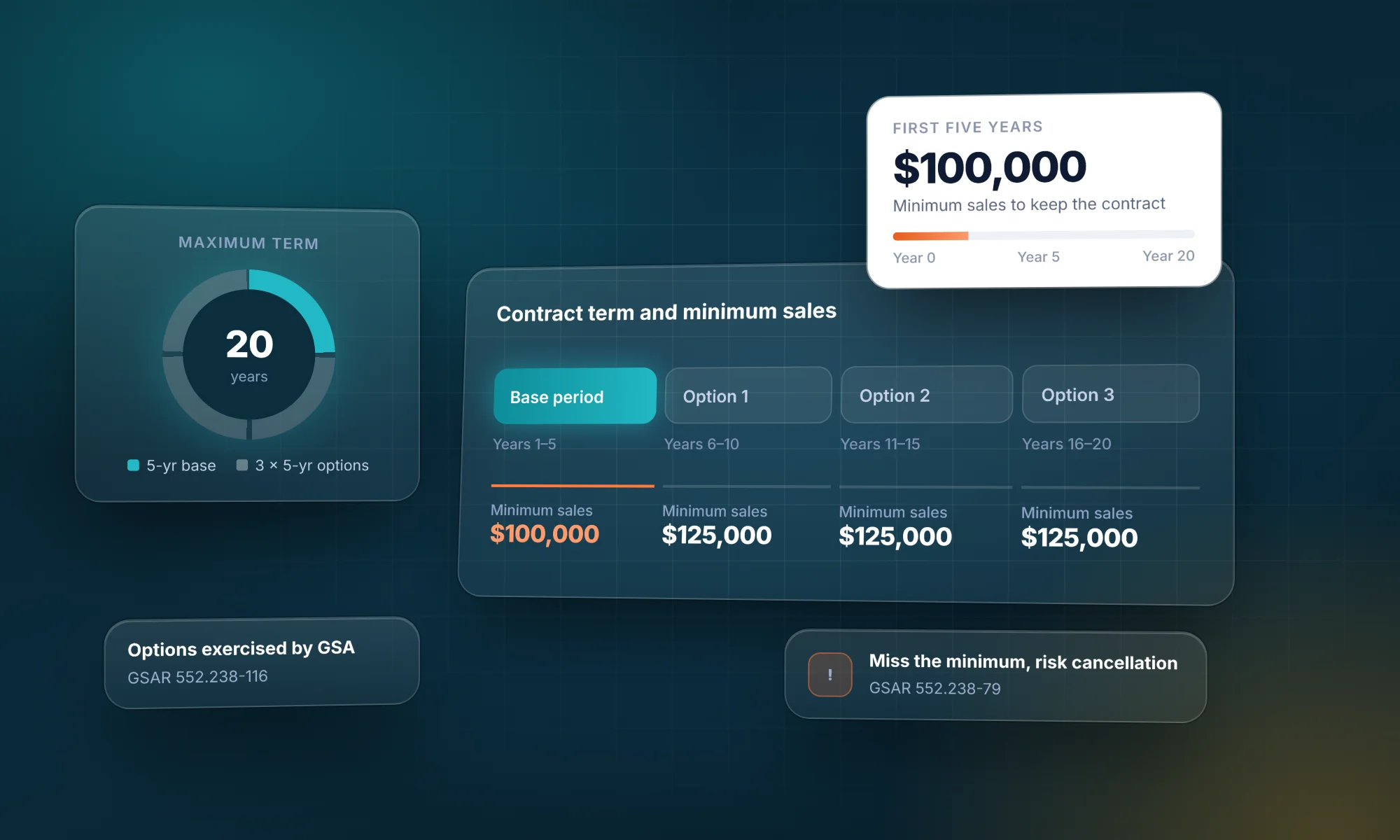
GSA states that “MAS contracts are awarded with a five-year base period and three five-year option periods.” That is up to 20 years if GSA exercises every option, under the option clause at GSAR 552.238-116.

The Minimum Sales Requirement

Options are not automatic. GSA can cancel a schedule that does not sell. GSA’s current guidance says:

  • $100,000 in sales within the first five years, and
  • $125,000 in each five-year period after that.

The cancellation authority is GSAR 552.238-79. Older guides that cite a $25,000 threshold are out of date. In March 2025, GSA also announced it would let MAS contracts that do not meet the sales thresholds in clause I-FSS-639, Contract Sales Criteria, expire. A schedule you never sell through is now a schedule you are likely to lose.

Illustration of a GSA Schedule contract term of up to 20 years: a five-year base period and three five-year options exercised by GSA, with minimum sales of $100,000 in the first five years and $125,000 in each later five-year period
The contract can run 20 years, but only if each five-year period clears its sales minimum.

Who Is Eligible for a GSA Schedule?

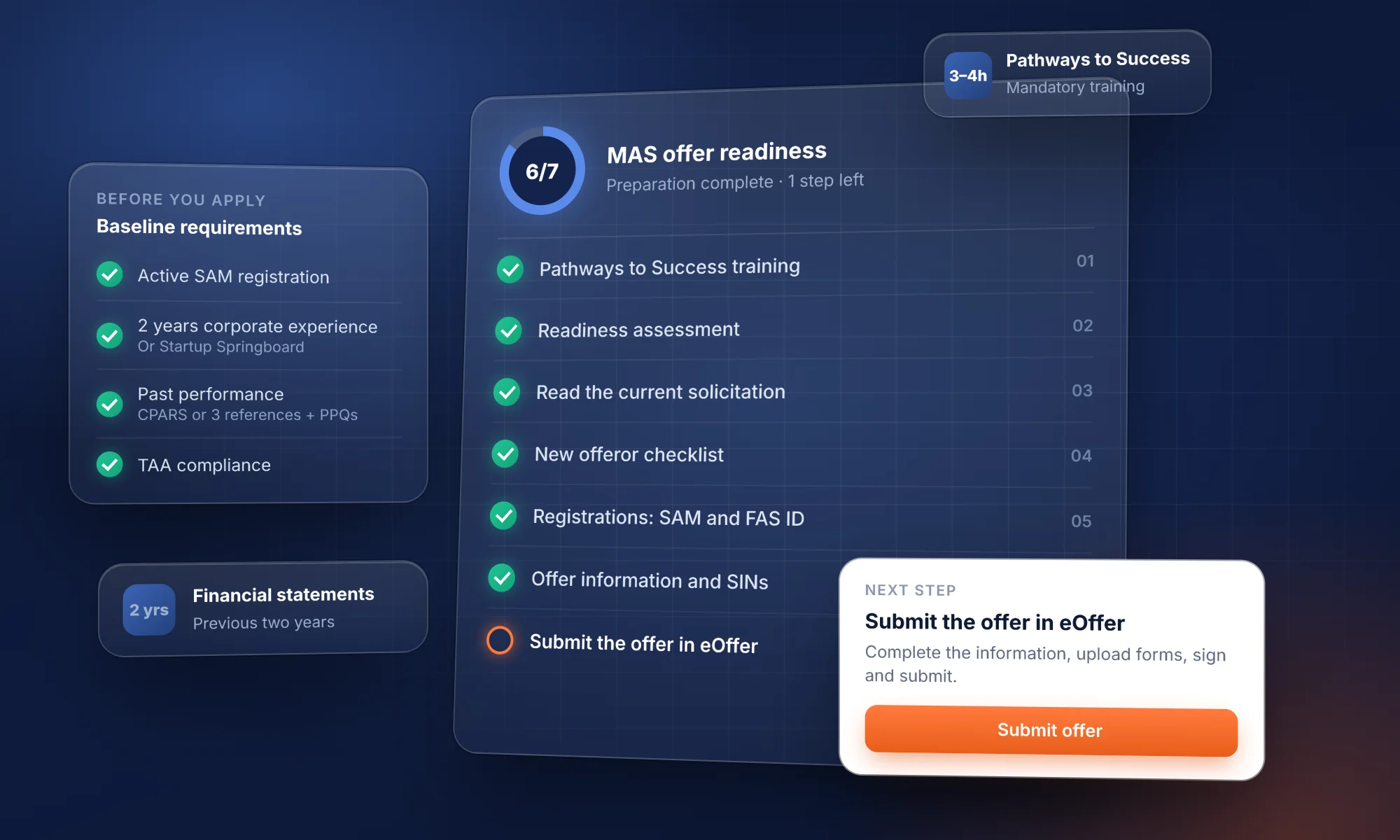
GSA’s MAS solicitation (SCP-FSS-001, Refresh 33) sets the baseline. To make an offer you need:

  • An active SAM registration. “The offeror must be registered with the System for Award Management (SAM).” Our UEI and CAGE code guide walks through it.
  • Two years of corporate experience, “unless submitting under Startup Springboard.”
  • Financial statements for the previous two years, audited if available.
  • Past performance. If you have three or more interim or final CPARS evaluations, you verify them in eOffer. If not, you submit three customer references and three Past Performance Questionnaires.
  • Trade Agreements Act (TAA) compliance. “All proposed products and services must comply with the Trade Agreements Act (TAA).”
  • Commercial pricing support, such as a current, dated commercial price list, commercial catalog or other standard market pricing.

Startup Springboard After Refresh 31

Startup Springboard is GSA’s alternative path for companies that do not yet have two years of corporate experience. Since Refresh 31 (February 2026), “the Startup Springboard Program will be limited to offerors that also qualify under FASt Lane.” Refresh 33 (September 2026) opened FASt Lane eligibility to all MAS categories. If your company is under two years old, confirm you meet both programs’ conditions before you build an offer around Springboard.

How to Get on a GSA Schedule: The 7 Steps

GSA’s roadmap to get a MAS contract lays out seven steps. Here is how to get on a GSA Schedule in the order GSA expects:

  1. Complete Pathways to Success training. This mandatory training takes three to four hours. You acknowledge it in eOffer, and it must be within the past year.
  2. Complete the readiness assessment. “A designated Authorized Negotiator who is also an employee of the company must complete the readiness assessment.” A consultant cannot take it for you.
  3. Read the solicitation. The MAS solicitation is refreshed several times a year. Work from the current refresh, not a saved copy.
  4. Review the new offeror checklist. GSA publishes a checklist for each refresh. It is the fastest way to catch missing documents.
  5. Complete your registrations. This includes SAM and a FAS ID for eOffer, which now requires multi-factor authentication.
  6. Gather your offer information and choose your SINs. This is where you assemble financials, past performance, pricing support and technical narratives for each SIN.
  7. Submit through eOffer. “Log into eOffer using your FAS ID and then complete the information, upload forms, sign, and submit your completed offer.”

After submission, a GSA contracting officer reviews the offer. Per the solicitation, the contracting officer “will review your price proposal to determine whether offered prices are fair and reasonable,” and negotiations follow before award.

How Long Does It Take?

GSA does not publish a fixed MAS award timeline. Its general guidance is that the process “may take several weeks to months to complete.” Incomplete offers, unsupported pricing and missing past performance documents are the usual causes of delay, so the checklist in step 4 is the step that saves you the most time.

Illustration of GSA Schedule offer readiness: baseline requirements (SAM registration, two years of corporate experience or Startup Springboard, past performance, TAA compliance, two years of financial statements) beside the seven GSA steps, with six complete and submitting the offer in eOffer still to do
Six steps of preparation, then one submission in eOffer.

How GSA Schedule Pricing Works in 2026

Pricing is where 2026 guidance differs most from older articles.

Transactional Data Reporting Is Now Mandatory

GSA states: “Effective with Refresh 31, Transactional Data Reporting, or TDR, is mandatory for all Multiple Award Schedule SINs.” For offers under TDR, the Commercial Sales Practices disclosure, most-favored-customer and basis-of-award information, and price reduction tracking are not required. Refresh 31 also states that non-TDR references “will be removed from the Solicitation” and that Price Reductions Clause liability “ends effective on the 1st day of the next sales reporting quarter.”

What replaces those disclosures is reporting. Under TDR, you report transactional data on your schedule sales monthly, while the fee below is still remitted quarterly.

The Industrial Funding Fee

GSA funds the program through the Industrial Funding Fee (IFF). GSA states the MAS IFF rate “is currently 0.75%.” You build it into your schedule prices, collect it on each order and remit it to GSA through the FAS Sales Reporting Portal within 30 days after each reporting period ends.

Because the IFF sits inside your price, it belongs in your rate build from day one. Our guides to pricing federal bids and wrap rates show where fees like this fit in a fully burdened rate.

How Agencies Order From GSA Schedule Holders

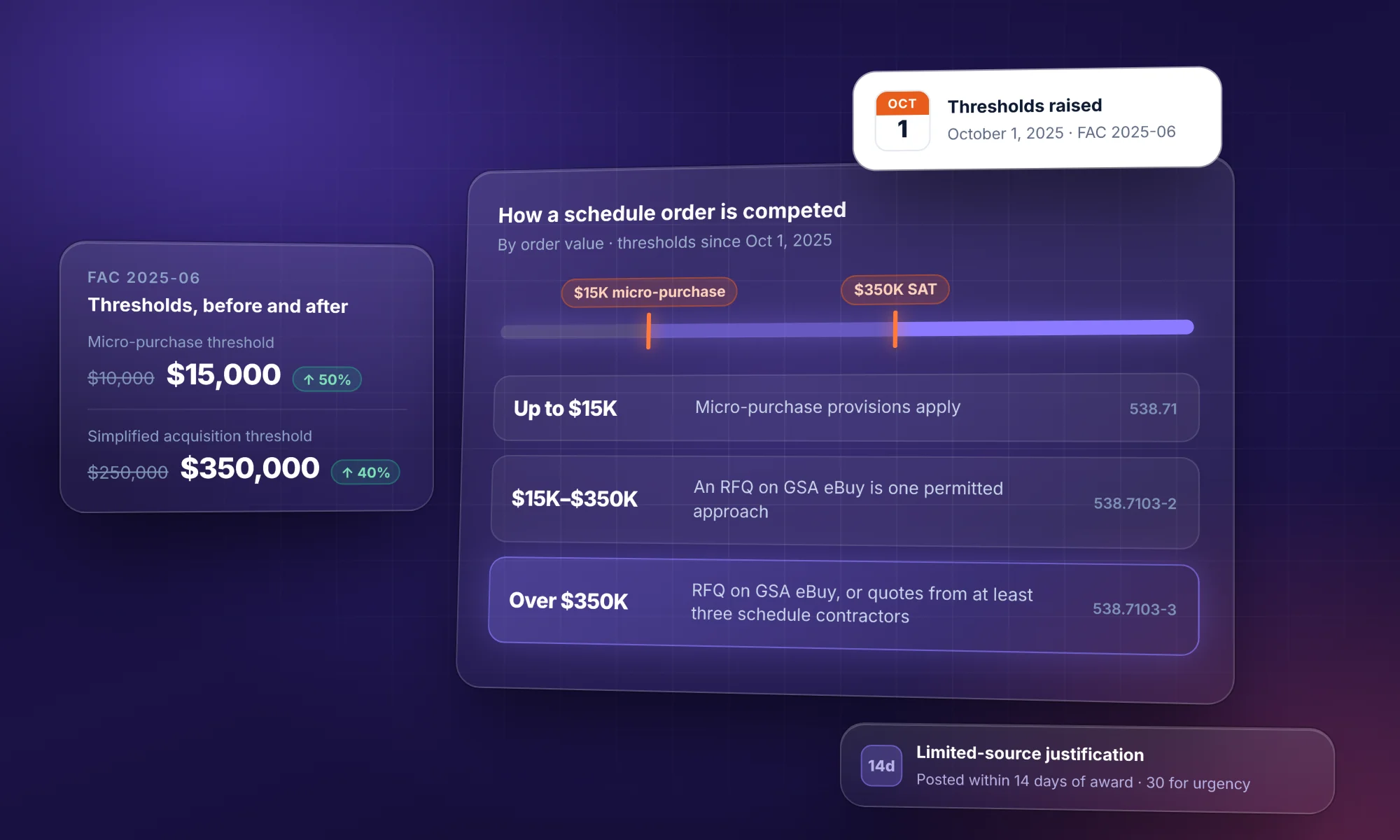
Holding a schedule puts you in the pool. How an agency picks from that pool depends on the order’s value. Two thresholds drive it, both raised effective October 1, 2025:

  • Micro-purchase threshold: $15,000 (was $10,000)
  • Simplified acquisition threshold (SAT): $350,000 (was $250,000)

Under GSA’s FSS ordering procedures:

  • Above the micro-purchase threshold up to the SAT, posting a request for quotation on GSA’s eBuy is one of the permitted approaches (538.7103-2).
  • Above the SAT, the ordering activity must publish an RFQ on eBuy or seek quotes from at least three schedule contractors (538.7103-3).

Most schedule competition happens through those RFQs. Our guide to RFQ meaning in government contracting covers how to read and answer one.

Agencies can also restrict an order to fewer sources when a listed exception applies. Above the SAT, GSA’s procedures set five exceptions and require the justification to be posted within 14 days of award, or 30 days for urgency (538.7104-3). Our sole source justification guide explains how those exceptions work in practice.

The Three Buyer-Side Tools You Should Know

  • GSA Advantage! is GSA’s “online shopping and ordering system” for federal buyers.
  • GSA eBuy is GSA’s “online Request for Quotation (RFQ) tool.” Agencies post schedule RFQs here for schedule contractors to answer.
  • GSA eLibrary is GSA’s “one source for the latest GSA contract award information.” It is the public record of who holds which schedule contracts.
Illustration of how GSA Schedule orders are competed by value after FAC 2025-06 raised the micro-purchase threshold from $10,000 to $15,000 and the SAT from $250,000 to $350,000: up to $15,000 micro-purchase provisions apply; $15,000 to $350,000 an eBuy RFQ is one permitted approach; over $350,000 an RFQ on eBuy or quotes from at least three schedule contractors
Above the $350,000 SAT, the agency must post an RFQ on eBuy or seek quotes from at least three schedule contractors.

What Changed for GSA Schedules in 2025 and 2026

These are the changes since early 2025 that affect current and prospective schedule holders:

  • Procurement consolidation (March 2025). Executive Order 14240, “Eliminating Waste and Saving Taxpayer Dollars by Consolidating Procurement,” was signed March 20, 2025. It directed a consolidation plan and named GSA executive agent for governmentwide IT contracts.
  • MAS rightsizing (March 2025). GSA announced it would let MAS contracts that miss the sales criteria in I-FSS-639 expire.
  • OneGov (2025). GSA describes OneGov as “a comprehensive plan to transform how government buys almost everything,” and lists it within its MAS program pages.
  • FAR overhaul Part 8 deviation (August 2025). Ordering procedures moved to GSA’s 538.71 procedures, as covered above.
  • Higher thresholds (October 1, 2025). Micro-purchase rose to $15,000 and the SAT to $350,000.
  • Refresh 31 (February 2026). TDR became mandatory for all SINs, and Startup Springboard was limited to FASt Lane–qualified offerors.
  • Refresh 32 (June 2026). Clauses were aligned with the FAR overhaul.
  • Refresh 33 (September 2026). FASt Lane opened to all MAS categories.

The direction is consistent: GSA expects every holder to be active, current and reporting.

Why GSA Schedule Holders Win a Contract and Not Orders

The schedule gets you a license to quote. Agencies still choose, order by order. Holders that never see revenue usually share four patterns:

  1. They wait for eBuy. By the time an RFQ posts, the agency has often shaped the requirement with vendors it already knows.
  2. They hold the wrong SINs. A SIN with little agency demand produces few RFQs, however strong your offer is.
  3. They market “GSA Schedule” instead of a solution. To a contracting officer, a schedule is the buying route, not the reason to pick you.
  4. They lose track of opportunities across vehicles. Schedule RFQs, agency IDIQ task orders and open-market solicitations arrive in different places on different timelines. Missing a response date is the cheapest way to lose.

Treat the schedule as one channel in your pipeline. Track which agencies buy under your SINs, build relationships before RFQs post, and plan capacity for the quote volume you want.

GovFind finds the opportunity. GovOps360 wins it.

See Where GovOps360 Fits Your Pipeline

Bring your schedule pipeline and target agencies. We will walk through how your team tracks opportunities today and where GovOps360 fits.

Frequently Asked Questions

1. What is a GSA Schedule in one sentence?

A GSA Schedule, formally the Multiple Award Schedule (MAS), is a long-term, governmentwide IDIQ contract between GSA and a commercial company that lets federal agencies and other eligible buyers order its products and services at pre-negotiated prices.

2. Is a GSA Schedule the same as the Multiple Award Schedule?

Yes. GSA says the Multiple Award Schedule is "also called schedules or Federal Supply Schedule." "GSA Schedule" is the everyday name for the same program.

3. How long does it take to get on a GSA Schedule?

GSA does not publish a fixed timeline. Its general guidance is that the process "may take several weeks to months." Complete documentation, supportable pricing and a clean offer checklist are what shorten it.

4. Does a GSA Schedule guarantee sales?

No. GSA states the contract "provides no guarantee of sales" and that "it is up to you to market your company." Holders must also meet minimum sales of $100,000 in the first five years to avoid cancellation.

5. Can a new company get a GSA Schedule?

The standard requirement is two years of corporate experience. Newer companies may qualify through Startup Springboard, which since Refresh 31 is limited to offerors that also qualify under FASt Lane.

6. What fee does GSA charge on schedule sales?

GSA charges an Industrial Funding Fee, currently 0.75% for MAS. You include it in your prices and remit it through the FAS Sales Reporting Portal within 30 days after each reporting period.

7. Can state and local governments buy from a GSA Schedule?

Yes, through Cooperative Purchasing, Disaster Purchasing, Public Health Emergencies and the 1122 program, each limited to specific purposes or SINs. Schedule holders can accept or decline those orders.

8. How long does a GSA Schedule contract last?

MAS contracts are awarded with a five-year base period and three five-year option periods, up to 20 years total, provided you keep meeting the minimum sales requirements.
Alaa Negeda, author and federal contracting subject matter lead at GovOps360

Alaa Negeda

Senior Solution Architect with 23 years of experience in different Technology sectors. Diligent, forward-thinking, and adaptable to dynamic company, customer, and project needs.
Related Articles

Capture Management Explained Process, Capture Plan & Manager Role
clock Nov 20,2026

What Is Capture Management? The Process and the Capture Manager’s Role

What capture management is, the capture process stage by stage, what goes in a capture plan, and what a capture manager does, sourced to the…
Read the Article

GovOps360 article cover: RFP vs RFQ vs RFI, showing that an RFI creates no offer, an RFQ makes the government order the offer, and an RFP makes your proposal the offer.
clock Sep 30,2026

RFP vs RFQ vs RFI: Which Solicitation You Are Looking At and What to Do

What does RFP mean, and how does it differ from an RFQ and an RFI? The FAR authority behind each, what the agency is really…
Read the Article

GovOps360 article cover: DDQ, the due diligence questionnaire, showing the published federal requirement counts behind a single questionnaire question as proportional bars.
clock Sep 28,2026

DDQ Meaning: What a Due Diligence Questionnaire Asks and How to Answer It

DDQ meaning: what a due diligence questionnaire covers, how it differs from an RFI, and the security and financial evidence to have ready before one…
Read the Article