



 By Alaa Negeda
The Short Answer: Which CRM Fits Which Contractor
There is no best CRM for government contractors. There is a best CRM for a firm of your size, with your compliance obligations, that already owns or does not own an accounting system. Those three variables decide the answer, and they decide it differently for a two-person 8(a) consultancy than for a 900-person defense integrator.
So this comparison of the best CRM for government contractors is organized by fit rather than by rank. Eight platforms, what each one is actually built for, and an explicit statement of who should not buy it. That last part includes our own product.
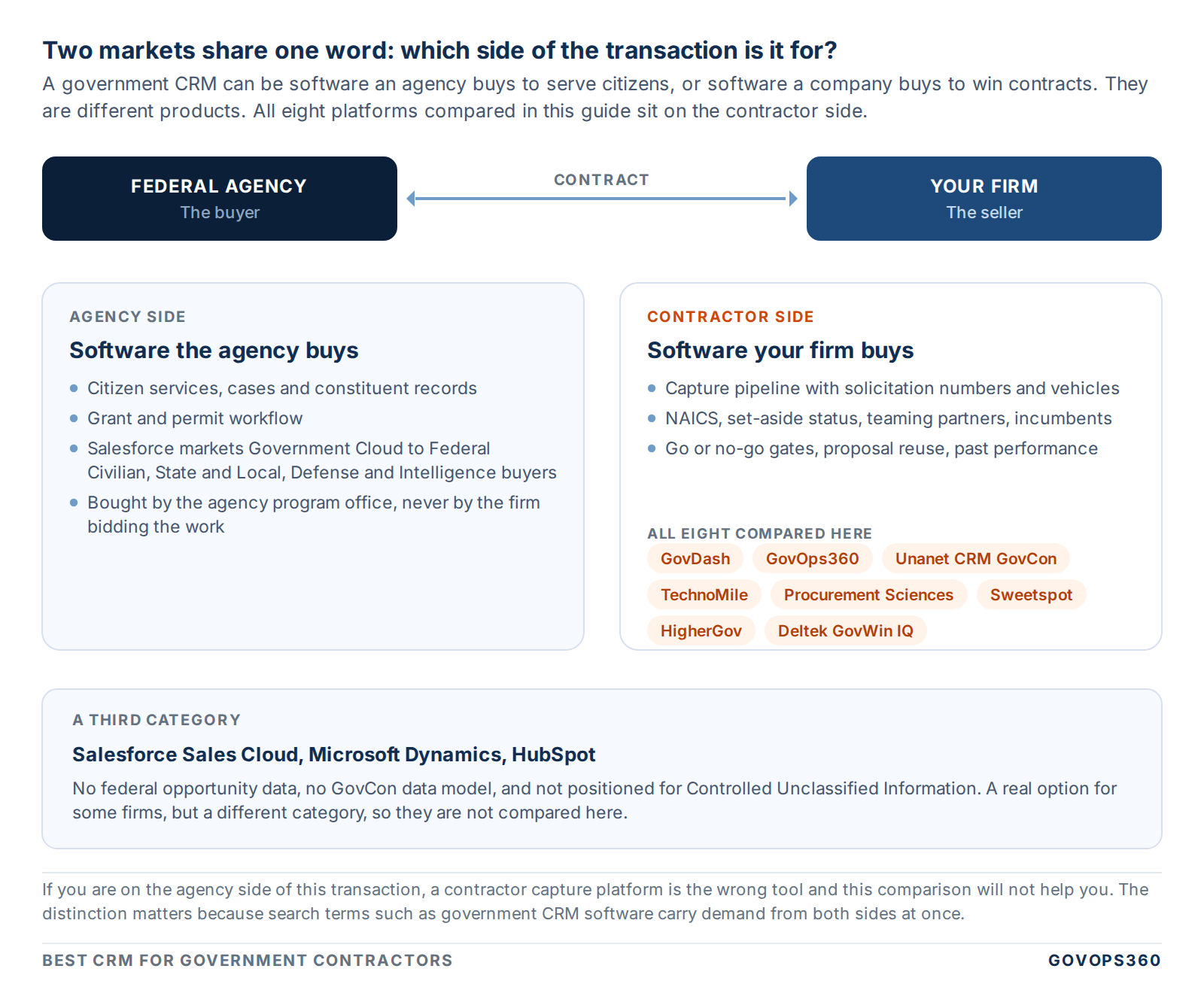
Before the table, one distinction has to be cleared up, because it is the single most common reason contractors buy the wrong tool.
What a CRM for government contractors actually has to do
Search volume reflects the confusion. Terms like crm for government agencies and government crm solutions carry meaningful monthly volume, and almost none of it comes from contractors. If you are pursuing federal work, you want a capture and pipeline system with government-specific fields: solicitation numbers, NAICS and set-aside status, contract vehicles, teaming partners, incumbent data, and go or no-go gates.
Everything below is judged on that basis, and every one of the eight is purpose-built for the contractor side. General-purpose platforms such as Salesforce, Microsoft Dynamics and HubSpot are a real alternative for some firms, but they are not GovCon products and so they are not compared here. If you are on the agency side of the transaction, this is the wrong article, and our forthcoming guide to government contract management software unpacks that split in detail.
1 of 8
Platforms that publish an actual price. HigherGov lists $500 a year for a single user. Every other vendor here is contact sales
4 of 8
Platforms making some kind of FedRAMP claim, and no two use the same words. Authorized, equivalent and in progress are three different things
1 of 8
That is not a CRM at all, despite appearing on nearly every published list of CRMs for government contractors
What a Government Contracting CRM Does That a Standard CRM Cannot
A government contracting CRM is not a general sales CRM with federal labels applied. The pipeline it tracks is shaped by the acquisition process, and that changes what the software has to store.
A commercial CRM models a deal as an account, a contact and a close date. A government contracting CRM has to model an opportunity that arrives as a solicitation notice, carries a NAICS code and a set-aside status, moves through sources sought and RFI stages before an RFP exists, and may be competed under a vehicle you either hold or do not. None of those fields exist in Salesforce or HubSpot out of the box.
Three differences do most of the work:
- Opportunity data has an external source of truth. Records originate in SAM.gov and agency forecasts, not from a rep entering a lead. The system either ingests that data or your team retypes it.
- Teaming is part of the pipeline. A single opportunity can involve a prime, several subcontractors and a teaming agreement that changes who owns the relationship. Commercial CRMs model one seller per deal.
- The decision gates are formal. Bid/no-bid, pink team, red team and gold team reviews are scheduled events with owners and exit criteria, not pipeline stages you rename.
If a platform cannot represent those three things, it is a CRM you will end up operating alongside a spreadsheet.
Choosing the Best Government Contracting Software: Where a GovCon CRM Fits
Search for the best government contracting software and you will get results describing at least four different products: capture and CRM tools, proposal management software for government contractors, contract management systems, and government accounting platforms. They are not competitors. They sit at different points on the same contract lifecycle, and buying one when you needed another is the most expensive mistake in this category.
The split that matters is pre-award and post-award.
- Pre-award is everything up to submission: finding opportunities, qualifying them, teaming, pricing the bid and producing the proposal. This is where a GovCon CRM lives, and it is what the eight platforms on this page are compared on.
- Post-award starts the day you win: clause tracking, CDRL deliverables, CPARS windows, modifications, invoicing and closeout. Different software, different vendors, largely a different buying committee.
A GovCon CRM will not administer your contracts, and a contract management system will not build your pipeline. Firms that try to make one tool do both usually end up with a system of record that is authoritative for neither.
If you are buying for the first time, decide which side of award your current bottleneck sits on before you shortlist anything.
How We Compared These Platforms
Comparison articles in this category tend to assert capabilities without saying where the information came from, and to publish precise monthly prices for vendors that have never published a price. We are not doing either. Every claim below is drawn from the vendor’s own public material, and where a vendor has not stated something, the cell reads not publicly stated rather than a guess.
That produces a table with more blanks than you may be used to. The blanks are the accurate answer. A vendor that has not published its CUI position has not published it, and inventing one on their behalf helps nobody making a real buying decision.
Built For
Full lifecycle capture, capture paired with an ERP or finance system, AI-native proposal generation, or opportunity intelligence that feeds a pipeline.
Opportunity Data
Whether federal opportunity data is inside the product, sold separately by the same vendor, or absent and left to you.
Proposal Capability
Whether the platform generates proposal content and reuses past performance and resumes, or stops at pipeline tracking.
CUI and Security Posture
What the vendor publicly states, measured against the DFARS clause rather than against marketing language, and read carefully for scope.
Pricing Transparency
A published price, published tiers without amounts, or contact sales only.
Fit By Firm Size
Whether the product is aimed at solo consultants, the ten to two hundred person middle market, or enterprise integrators.
What we deliberately left out
You will not find SOC 2 report dates, penetration test summaries, SSO protocol support or subprocessor lists in the table. Not because they do not matter, they matter enormously once you are in procurement, but because almost none of the eight vendors publish them. A table showing that detail for one or two platforms and blanks for the rest is not a comparison, it is an advertisement wearing a comparison’s clothes.
Ask for those documents on your first sales call instead. Any vendor selling to government contractors should produce a SOC 2 report, a subprocessor list and a customer responsibility matrix without hesitation.
The Comparison Table
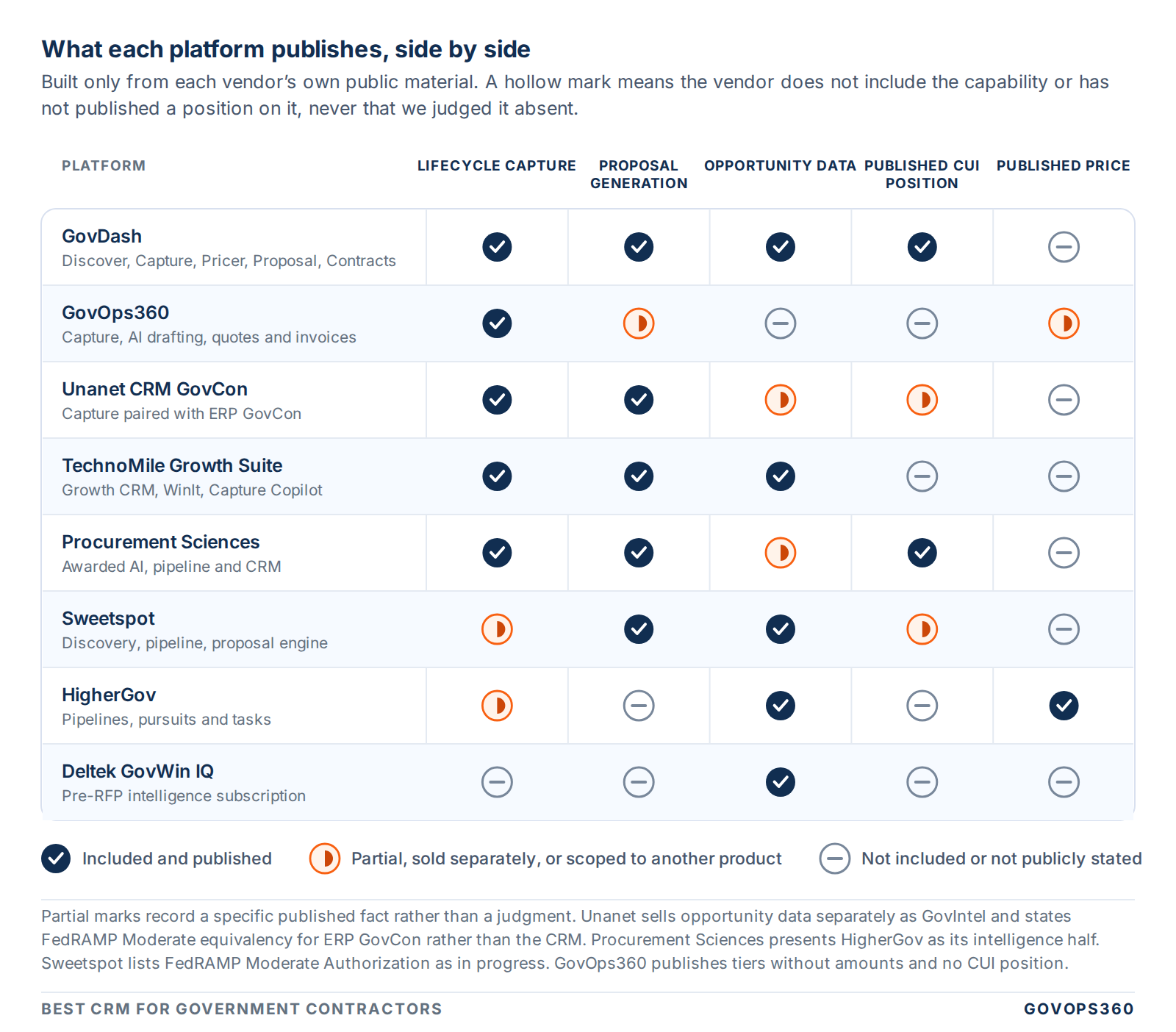
The eight rows below cover the CRM for government contractors options that belong on a serious shortlist. They are grouped purpose-built lifecycle platforms first, then the AI-native challengers, then the intelligence layer, and the order within each group is not a ranking. Read the CUI column with particular care. It records what each vendor states publicly, not an assessment of whether the claim is adequate for your contract, and the wording differences between rows are the whole point. The section on the FedRAMP question explains why.
| Platform | Built for | Opportunity data | Public CUI and security position | Pricing |
|---|---|---|---|---|
| GovDash | Full lifecycle, small business to enterprise | Native Discover module | FedRAMP Moderate equivalent and ready, C3PAO audited, DFARS 252.204-7012 stated, no model training | Not published |
| GovOps360 | Capture through invoicing, small to mid-size | Not publicly stated | Not publicly stated | Three tiers, amounts not published |
| Unanet CRM GovCon | Capture paired with its own GovCon ERP | Sold separately as GovIntel | Equivalency claimed for ERP GovCon, not stated for the CRM | Not published |
| TechnoMile Growth Suite | Enterprise and small business editions, WinIt on Salesforce | GovSearchAI included | Not publicly stated | Not published |
| Procurement Sciences Awarded AI | AI capture and proposal with pipeline and CRM, growth stage to enterprise | HigherGov, from the same company | FedRAMP Moderate Authorization, SOC 2 Type 2, CUI-compliant options, GovCloud options | Not published |
| Sweetspot | AI-native capture for BD, capture and proposal teams | SAM.gov, Grants.gov, DIBBS, FPDS, state and local | CMMC Level 2, SOC 2 Type II, FedRAMP Moderate Authorization in progress | Not published |
| HigherGov | Market intelligence with pipeline and pursuit tracking | That is the core product | Not publicly stated | $500 to $2,500 a year, published |
| Deltek GovWin IQ | Opportunity intelligence, not a CRM | That is the entire product | Not publicly stated | Not published |
Three patterns are worth naming before we go platform by platform.
Almost nobody publishes a price. HigherGov is the single exception, and its $500 a year single-user tier is the only number in this category a solo consultant can plan against without a sales call. The pricing section covers what actually drives the quotes you will get from everyone else.
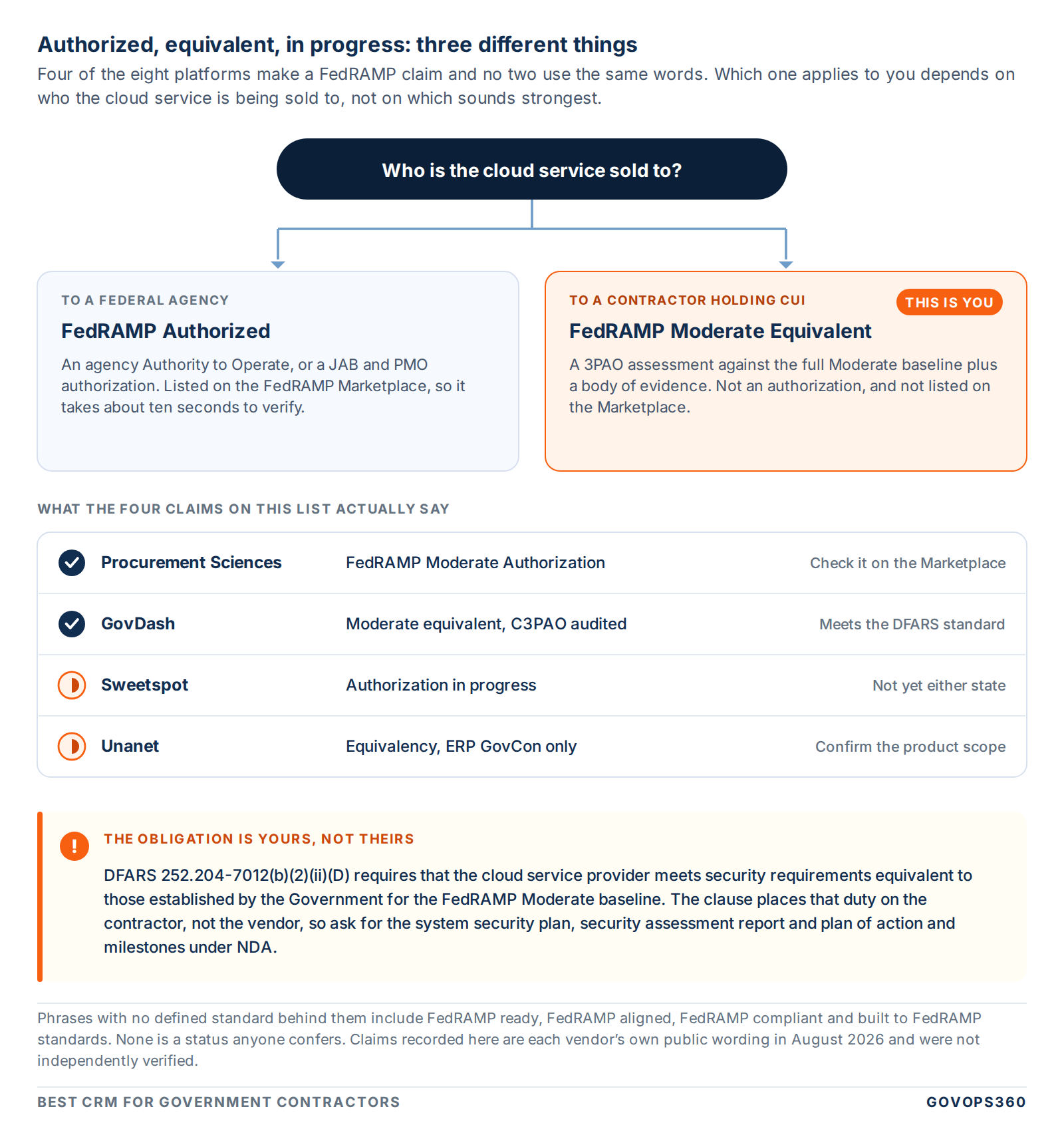
The FedRAMP column is four different claims wearing similar words. One vendor claims authorization, one claims equivalency, one says authorization is in progress, and one claims equivalency for a different product in its own portfolio. Those are not interchangeable, and the difference decides whether you can legally put CUI in the tool.
Opportunity data is often a separate purchase. GovDash, TechnoMile and Sweetspot include it. Unanet sells it as GovIntel. Procurement Sciences presents HigherGov alongside Awarded AI as its intelligence half. Deltek and HigherGov are the intelligence layer itself.
The Four Lifecycle Platforms
These four aim to hold the whole pursuit, from opportunity through proposal and in two cases through contract or invoice. Each knows what a solicitation number is without being told, which is why a general-purpose CRM needs months of configuration to reach the same starting line.
The numbering groups platforms by type and is not a ranking. Nobody is first because they scored highest, and our own product sitting at number two is not a claim about it. The Built for column in the table above is where fit is summarized.
1. GovDash
GovDash positions itself as covering the full contracting lifecycle in one system, and its public module list is the most complete of any platform here: Discover for opportunity identification, Capture, Pricer, Proposal, Contracts, a Dash AI Agent for workflow automation, a Data Library for documents and resumes, and Reports. It targets everything from small businesses to enterprises across defense, federal civilian, health and SLED.
Its compliance page is the strongest published position in this comparison. GovDash states FedRAMP Moderate equivalency and readiness with a C3PAO audit, NIST SP 800-53 aligned controls, DFARS 252.204-7012 CUI protection, data isolation with customer data not used for model training, and a self-hosted deployment option. Whether or not you buy GovDash, that list is a reasonable template for what to ask every other vendor.
The gap is integrations. Its site speaks generally about connecting to your stack without naming specific systems, so if you run Deltek Costpoint or Unanet ERP for accounting, make that conversation the first one you have.
2. GovOps360
Our own platform, described here strictly from what we publish so you can check it. Three tiers on our plans page: GovOps Launch for small consultants and solo federal contractors, GovOps Accelerate for growing government contractors, and GovOps Command for established vendors and larger contractors.
Launch covers lead and opportunity tracking, activity logging and calendar integration. Accelerate adds AI-assisted proposal drafting and requirement analysis. Command adds quotes and invoices lifecycle tracking plus a Chart of Accounts and Finance module. Outlook integration is the named integration. Pricing is contact sales at every tier.
The design intent is the span from capture through invoicing without a second finance system, which is the join most firms handle in spreadsheets. Our capture intelligence and contract lifecycle pages go into that in detail.
What we do not publish, and therefore will not claim here: a SAM.gov integration, a CUI or DFARS 252.204-7012 position, FedRAMP status, or a SOC 2 report. Read the who should not choose GovOps360 section before you shortlist us.
Full detail on the relationship layer is on the relationship management feature page.
3. Unanet CRM GovCon
Unanet runs a deliberately split product line: ERP GovCon and CRM GovCon for government contractors, ERP AE and CRM AEC for architecture and engineering firms, plus ProposalAI, GrowthStudio, Enterprise SubK, GovIntel and a Champ AI engine across the platform. If you are evaluating Unanet, confirm you are being shown the GovCon editions and not the AEC ones.
CRM GovCon publishes a credible capture feature set: capture management driven by real-time data from across the organization, drag-and-drop pipeline management with win rates and bids against goal, proposal auto-generation that pulls in resumes and prior winning content, customizable go or no-go forms with approval gates, a cloud document repository, and interactive dashboards.
Its real advantage is the ERP pairing. Unanet states that the CRM integrates with Unanet ERP to combine project performance data with pipeline insight, which is the loop most contractors cannot close: knowing whether the work you are bidding resembles work you have actually delivered profitably.
One point of precision, because it is widely misreported. Unanet’s public FedRAMP Moderate equivalency statement is attached to ERP GovCon. The CRM product page makes no CRM-specific compliance claim. If you intend to keep CUI in the CRM, ask Unanet to confirm the scope of that equivalency in writing rather than assuming it covers the whole platform.
4. TechnoMile Growth Suite
TechnoMile takes the unusual step of shipping two distinct CRMs. Growth CRM addresses mature enterprise opportunity management, while WinIt CRM is aimed at small business growth and is described as delivered on proven Salesforce platform technology. Around them sit Capture Copilot for AI-assisted capture, GovSearchAI for federal opportunity and market intelligence, AI proposal generation through a partnership with pWin.ai, GovSearch NoticesIQ for task order management, and GovSearch Contact Intelligence, a government contact database.
The Salesforce foundation under WinIt is a genuine consideration in both directions. If your firm already has Salesforce administrators, reporting conventions and integration patterns, that is a real head start. If you do not, you inherit the Salesforce platform’s complexity alongside the GovCon layer.
Also note that TechnoMile runs a broader portfolio, a Contracts Suite for the contract lifecycle and a SIMS Suite for industrial security and cleared workforce management. If you hold facility clearances, that adjacency may matter more than any CRM feature.
The AI-Native Challengers and the Intelligence Layer
5. Procurement Sciences (Awarded AI)
Procurement Sciences is the platform most likely to be missing from the comparison you read before this one, and on published compliance it is the strongest of the eight.
Awarded AI covers bid and no-bid analysis, capture planning, win themes, proposal drafting, compliance automation, pricing intelligence, past performance management, gate reviews, graphics support, pipeline and CRM, contract handoff and recompete support. It is aimed at growth-stage firms, mid-tier contractors and enterprise GovCons, and the site claims more than 3,000 businesses including over 40 of the top 100 contractors.
The compliance list is what sets it apart: FedRAMP Moderate Authorization, SOC 2 Type 2, CUI-compliant options, GovCloud options, and no public model training. Note the word Authorization, not equivalency. If accurate, that is a materially higher bar than anyone else here claims, and it is the one claim in this article you can verify yourself in about ten seconds on the FedRAMP Marketplace. Do that before you rely on it, for the same reason you should check ours.
One thing to know for clarity rather than criticism: Procurement Sciences presents HigherGov on its own site as its opportunity intelligence half, alongside Awarded AI. They appear on this list separately because they are bought and used separately, but you should know the relationship before you assume you are getting two independent quotes.
6. Sweetspot
Sweetspot is the most explicit of the eight about where its data comes from, which is refreshing in a category that tends to say “top federal sources” and stop. It names SAM.gov and agency solicitations, Grants.gov, the DIBBS defense logistics marketplace, state and local opportunities, and analysis drawn from USAspending and FPDS.
The product covers opportunity discovery, federal market intelligence, agentic monitors that watch for changes, pipeline management, a proposal engine, an organization library and enterprise security. It is aimed at business development, capture and proposal teams at mid-to-large contractors with an established track record, and cites more than 500 GovCon teams.
Its published security position is the second strongest here: CMMC Level 2, SOC 2 Type II, and FedRAMP Moderate Authorization listed as in progress. That last phrase is doing honest work. In progress is not authorized, and a vendor willing to say so plainly is telling you something useful about how it will describe other things.
7. HigherGov
HigherGov describes itself as market intelligence and business development tools to find opportunities, build relationships and win government contracts and grants. What makes it relevant to a CRM comparison is that pipeline tracking is included rather than sold as an upgrade: unlimited pipelines, pursuits and tasks, forecasted opportunities, funnel and projection analysis, and teammate collaboration through tasks and discussions.
It is also the only platform in this comparison that publishes a price. Starter is $500 a year for one user, Standard is $2,500 a year for up to ten users, and Enterprise is custom for unlimited users. All three tiers include the market intelligence, pursuit management, AI tools, vendor database, labor pricing tool, API access, eBuy and task order imports and a Zapier integration. What changes between tiers is mainly export volume, from 1,000 records per search on Starter to 100,000 on Enterprise, and the level of support.
For a solo consultant or a firm making its first structured attempt at pipeline discipline, $500 a year against a category where everyone else says contact sales is a genuinely different proposition. What you do not get is proposal generation, contract management or invoicing, and the site publishes no FedRAMP, SOC 2 or CUI position.
8. Deltek GovWin IQ, which is not a CRM
GovWin IQ appears on almost every published list of the best CRM for government contractors. It does not belong there, and the mistake is worth correcting because it leads firms to believe they have bought a pipeline system when they have not.
Deltek’s own business development page names two products in this space: GovWin IQ, which gives federal, SLED and AEC firms the intelligence to decide which opportunities fit before committing, and ProPricer, a proposal pricing platform for federal contractors. Deltek Vantagepoint is positioned as ERP for architecture and engineering firms, and Polaris as a resource and services automation tool. None is presented as a dedicated CRM or business capture system.
What GovWin IQ actually is, and it is very good at it, is a pre-RFP intelligence subscription. It surfaces opportunities before they hit SAM.gov, with agency budget context and competitor history. Contractors typically run it alongside a CRM and push selected opportunities across.
The FedRAMP Question Every Comparison Gets Wrong
If you handle Controlled Unclassified Information, and you probably do the moment a solicitation attachment lands in your CRM, this section matters more than every feature comparison above it.
Look again at the CUI column in the table. Four vendors make a FedRAMP claim and all four are worded differently. That is not sloppiness on their part. They are describing genuinely different things, and the industry uses the terms loosely enough that most comparison articles flatten them into one.
How to use this when you are being sold to
Four questions, in this order, cut through most of it:
- Are you FedRAMP Authorized, or FedRAMP Moderate equivalent, or neither yet? A vendor that cannot separate those three cleanly is telling you something. On this list, Procurement Sciences claims the first, GovDash the second, Sweetspot says the first is in progress, and the remaining four state nothing.
- Who performed the assessment, and when? GovDash names a C3PAO audit publicly. An unnamed assessment is not an assessment you can rely on.
- What exactly is in scope? Unanet’s public equivalency statement covers ERP GovCon. Assuming it covers a different product in the same portfolio is precisely the error this section exists to prevent.
- Will you provide the body of evidence under NDA? This is the question that separates an engineering claim from a marketing one.
One moving part to check before you rely on any of this. On 13 July 2026 the Department of Defense announced an immediate suspension of CMMC Phase II requirements, which had been scheduled to begin on 10 November 2026, pending a comprehensive review. Phase I self-assessment obligations remain. The DFARS 252.204-7012 requirements described above are unaffected, but confirm the current CMMC position directly before treating any vendor’s CMMC statement as decisive. Sweetspot’s CMMC Level 2 claim, for instance, sits against a moving regulatory backdrop.
Why equivalency is the standard that applies to you
Here is the actual regulatory hook. DFARS 252.204-7012 at paragraph (b)(2)(ii)(D) requires that where a contractor uses an external cloud service to store, process or transmit covered defense information, the contractor must require that
“the cloud service provider meets security requirements equivalent to those established by the Government for the Federal Risk and Authorization Management Program (FedRAMP) Moderate baseline”
Read that carefully. The word is equivalent. A CRM holding your CUI does not need to be FedRAMP Authorized, because it is not being sold to an agency. Equivalency is the correct and sufficient standard.
But note who carries the obligation. The clause is on you. It requires the contractor to require it of the provider. A vendor asserting equivalency on a marketing page has not discharged your duty, which is why serious buyers ask for the body of evidence, typically a system security plan, a security assessment report and a plan of action and milestones, under NDA.
How to use this when you are being sold to
Four questions, in this order, cut through most of it:
- Are you FedRAMP Authorized, or FedRAMP Moderate equivalent? A vendor that cannot separate those two terms cleanly is telling you something.
- Who performed the assessment, and when? GovDash names a C3PAO audit publicly. An unnamed assessment is not an assessment you can rely on.
- What exactly is in scope? Unanet’s public equivalency statement covers ERP GovCon. Assuming it covers a different product in the same portfolio is precisely the error this section exists to prevent.
- Will you provide the body of evidence under NDA? This is the question that separates an engineering claim from a marketing one.
One moving part to check before you rely on any of this. On 13 July 2026 the Department of Defense announced an immediate suspension of CMMC Phase II requirements, which had been scheduled to begin on 10 November 2026, pending a comprehensive review. Phase I self-assessment obligations remain. The DFARS 252.204-7012 requirements described above are unaffected, but confirm the current CMMC position directly before treating any vendor’s CMMC statement as decisive.
What GovCon CRM Pricing Actually Depends On
Ask what a CRM for government contractors costs and seven of the eight platforms here will not tell you. Competing comparison articles fill that gap with numbers, and those numbers are invented. Rather than join in, here is what genuinely drives the figure you will be quoted, so you can estimate your own range and recognize when a quote is out of line.
Seat count and seat type
Most platforms distinguish full capture seats from read-only or approver seats. Firms routinely overbuy full seats for executives who only need dashboards.
Module mix
Capture, proposal, pricing and contracts are usually separately licensed. A pipeline-only deployment costs a fraction of a lifecycle deployment.
Opportunity data subscription
This is frequently the largest single line and it is often a different vendor. Intelligence subscriptions are priced independently of CRM seats.
Implementation and data migration
Purpose-built GovCon tools carry real configuration effort. Where the horizontal vendors disclose it, HubSpot charges $1,500 for Professional onboarding and $3,500 for Enterprise.
Compliance environment
A government cloud tenancy, a self-hosted deployment or a dedicated instance all cost materially more than shared commercial infrastructure.
The one published price in this comparison
HigherGov is the only platform here that lists what it costs: $500 a year for a single user on Starter, $2,500 a year for up to ten users on Standard, and custom pricing for unlimited users on Enterprise. All tiers carry the same core functionality, with export volume and support level as the main differences.
Use that as your floor, not your benchmark. It buys opportunity intelligence with pipeline and pursuit tracking. It does not buy proposal generation, contract management or invoicing, so it is not a like-for-like substitute for a lifecycle platform. What it does give you is a reference point: if a vendor quotes many multiples of that figure, you are entitled to ask precisely which of the five drivers above accounts for the difference.
And run the three-year total rather than the seat price. Opportunity data, integration work and the internal time to configure a data model that a purpose-built tool ships with are the lines that move a decision, and none of them appear on a per-seat quote.
Who Should Not Choose GovOps360, and How to Decide
We build a CRM for government contractors ourselves, so this comparison is only worth something if we are willing to argue against our own product. So, plainly.
Do not shortlist us if any of these apply
- You handle CUI and need a published position on it. We do not publish a DFARS 252.204-7012 position, a FedRAMP status or a SOC 2 report. Procurement Sciences publishes the strongest position of the eight, claiming FedRAMP Moderate Authorization and SOC 2 Type 2 with CUI-compliant and GovCloud options. GovDash publishes Moderate equivalency with a named C3PAO audit and a self-hosted option. On this criterion both are ahead of us today, and if CUI is in play you should be talking to them.
- You need opportunity data in the product at signature. We do not publish a SAM.gov integration. Sweetspot names SAM.gov, Grants.gov, DIBBS and FPDS explicitly. GovDash has Discover, TechnoMile has GovSearchAI, HigherGov is opportunity data by definition.
- You are committed to Unanet or Deltek for accounting. Unanet CRM GovCon’s integration with its own ERP closes the pipeline-to-delivered-performance loop in a way a third-party CRM will struggle to match.
- You are a large Salesforce shop. Fighting your own platform standard to adopt a separate CRM rarely ends well. TechnoMile’s WinIt on Salesforce is the more sensible route.
- You need a published price to get budget approval. Our tiers are contact sales. HigherGov is the only platform here that will tell you what it costs without a call.
- You are a solo consultant on a tight budget. HigherGov at $500 a year is difficult to argue against, and it will give you real opportunity data alongside pipeline tracking.
Where we are worth a conversation
The span from capture to invoicing without a second finance system, for small and mid-size contractors. GovOps Command carries quotes and invoices lifecycle tracking plus a Chart of Accounts and Finance module, which is the join most firms in that size band currently handle in spreadsheets between their CRM and their accountant. None of the other seven is built around that particular seam.
A 30-day evaluation that actually tells you something
Whichever way you go, resist the scripted demo. Take one real pursuit you lost in the last year and one you won, and ask each vendor to model both in a trial tenant. Then check three things: whether the go or no-go gate would have changed your decision, whether the proposal module could genuinely reuse your past performance and resumes, and whether the pricing you build in the tool reconciles with your actual indirect rates. If you are unsure of those rates, our wrap rate guide and calculator is the place to start, because a CRM cannot fix a rate structure you have not verified.
The firms that regret this purchase are almost never the ones that picked the wrong feature set. They are the ones that bought a lifecycle platform and used it as a contact list, or bought a contact list and needed a lifecycle platform.
See Where GovOps360 Fits Your Pipeline
Bring a pursuit you lost and one you won. We will model both, show you where the platform helps and tell you where another tool on this list is the better fit.
Frequently Asked Questions
1. What is the best CRM for government contractors?
2. Is a government CRM the same as a CRM for government contractors?
3. Does a CRM for government contractors need to be FedRAMP authorized?
4. Can I use Salesforce or HubSpot as a CRM for government contracting?
5. Is Deltek GovWin IQ a CRM?
6. How much does a CRM for government contractors cost?
7. Do I need a separate opportunity intelligence subscription?
References & Sources
- GovDash product modules and compliance claims
- Unanet product line and ERP GovCon FedRAMP Moderate equivalency statement
- Unanet CRM GovCon capabilities
- TechnoMile Growth Suite modules, WinIt CRM on Salesforce platform technology
- TechnoMile product suites
- Procurement Sciences, Awarded AI modules and compliance claims
- Sweetspot capabilities, named data sources and compliance claims
- HigherGov platform capabilities
- HigherGov published pricing tiers
- Deltek business development products, GovWin IQ and ProPricer
- Salesforce for Government, public sector positioning
- GovOps360 plans and tier features
- DFARS 252.204-7012, cloud service provider equivalency and flow-down
- FedRAMP Marketplace, authorization status lookup
- DoD CIO, CMMC program status
Vendor capabilities, compliance statements and pricing were taken from each vendor’s own public pages in August 2026 and are recorded as published claims rather than independent verification. FedRAMP authorization claims can and should be checked on the FedRAMP Marketplace before you rely on them. Where a vendor has not published a position, this article says so rather than estimating one. Pricing is not published by GovDash, Unanet, TechnoMile, Procurement Sciences, Sweetspot, Deltek or GovOps360. Confirm all figures and compliance scope directly with the vendor before making a purchase decision, and confirm the current CMMC position, which was under review at the time of writing.

Alaa Negeda
Senior Solution Architect with 23 years of experience in different Technology sectors. Diligent, forward-thinking, and adaptable to dynamic company, customer, and project needs.
Related Articles

 Sep 30,2026
 RFP vs RFQ vs RFI: Which Solicitation You Are Looking At and What to Do
 Sep 28,2026
 DDQ Meaning: What a Due Diligence Questionnaire Asks and How to Answer It
 Sep 25,2026