



 By Alaa Negeda
What Does RFP Mean?
Three acronyms, three different questions, and one expensive habit of treating them as interchangeable. An RFI asks what the market can do. An RFQ asks what something costs. An RFP asks you to compete for an award. Respond to one as though it were another and you either waste the effort or lose the seat.
This is the hub page for the three. Each has its own full guide, and this one answers the question those guides cannot: which one am I actually looking at, and what changes because of it. The short version is that the difference is not the document title. It is the FAR authority behind it, and that authority decides whether your response is legally an offer.
What follows covers what each acronym means, the side-by-side comparison, the FAR part that authorizes each one, how to tell them apart on SAM.gov when the notice does not use any of the three names, how your response should change, where each sits in the acquisition lifecycle, where Sources Sought, IFBs and task order solicitations fit, and the single most common misread and what it costs.
What does RFP mean in government contracting? RFP stands for request for proposal. It is the solicitation an agency issues when it intends to award a contract through negotiation rather than by sealed bid, and it is authorized by FAR Part 15, Contracting by Negotiation.
FAR 15.203(a) says requests for proposals are used in negotiated acquisitions to communicate government requirements to prospective contractors and to solicit proposals. A competitive RFP must at minimum describe four things:
- The government requirement.
- The anticipated terms and conditions that will apply to the contract, though the solicitation may authorize offerors to propose alternatives.
- The information required in the offeror’s proposal.
- The factors and significant subfactors that will be used to evaluate the proposal, and their relative importance.
That fourth item is the one that separates an RFP from everything else on this page. An RFP tells you how you will be scored. Nothing else in this article does, and it is why an RFP response is a persuasion document while the others are information documents. Short definitions for every term used here are in the GovCon glossary.
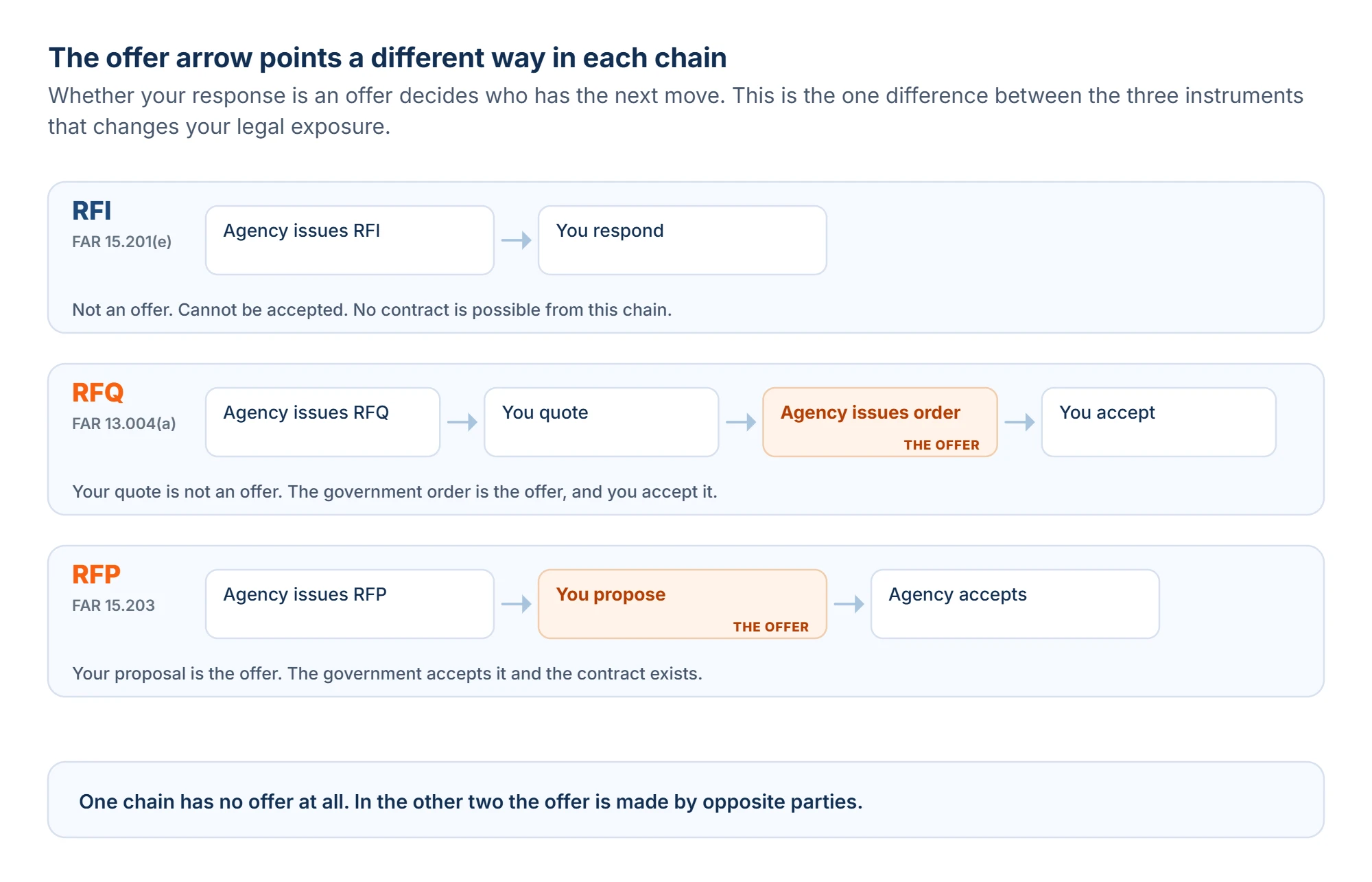
One consequence worth stating early: a proposal submitted in response to an RFP is an offer. The government can accept it and form a contract. That is not true of the other two.
What Does RFQ Mean?
RFQ stands for request for quotation. It is how agencies buy under the simplified acquisition procedures in FAR Part 13, and it is by far the most common of the three by volume because most federal purchases are small.
The rule that defines it is FAR 13.004(a): a quotation is not an offer and cannot be accepted by the government to form a binding contract. Issuing an order in response to a quotation does not establish a contract either. The government order is the offer, and the contract is formed when the supplier accepts it.
That inversion has a practical edge. If a purchase order comes back with terms that do not match what you quoted, performing on it accepts it as written. The full working, including the current thresholds and why a dropped quote is not “non-responsive”, is in the RFQ meaning guide.
What Does RFI Mean?
RFI stands for request for information. It is a market research instrument, not a solicitation, and it is authorized by FAR 15.201(e), which permits an RFI when the government does not presently intend to award a contract but wants price, delivery, other market information or capabilities for planning purposes.
The same paragraph settles the legal question in one line: responses to an RFI are not offers and cannot be accepted by the government to form a binding contract.
An RFI is therefore not a competition you can win. It is the one moment where you can influence the requirement before it hardens, which is a different and often larger prize. The RFI meaning guide works through the influence window and why an RFI is not the same thing as a Sources Sought notice.
RFP vs RFQ vs RFI, Side by Side
This is the comparison the rest of the article expands on. Read the third row first, because everything else follows from it.
| RFI | RFQ | RFP | |
|---|---|---|---|
| FAR authority | FAR 15.201(e), exchanges before receipt of proposals | FAR Part 13, simplified acquisition procedures | FAR Part 15, contracting by negotiation, and FAR 15.203 |
| What the agency is doing | Researching the market before a requirement exists | Buying something it has already defined | Running a competition it intends to award |
| Is your response an offer? | No. FAR 15.201(e) says responses are not offers and cannot be accepted | No. FAR 13.004(a) says a quotation is not an offer; the government order is | Yes. A proposal is an offer the government can accept |
| Can it lead to an award? | Not directly. It shapes a solicitation that may follow | Yes, through a purchase order you then accept | Yes, directly |
| How price is treated | Rough, for planning. Not a commitment | Central. Usually the deciding factor | One evaluation factor among several, with stated relative importance |
| Discussions | The exchange is the point | Not required. FAR 13.106-2(b)(3) does not require a competitive range or discussions | Permitted and structured under FAR Part 15 |
| Evaluation criteria published? | None. Nothing is being evaluated | Often minimal. FAR 13.106-1(a)(2)(iii) does not require relative importance or subfactors | Yes. FAR 15.203(a)(4) requires factors, subfactors and their relative importance |
| Where it appears on SAM.gov | Usually a Sources Sought or Special Notice | Solicitation or Combined Synopsis/Solicitation, or GSA eBuy | Presolicitation then Solicitation |
| What a good response is | A capability narrative that shapes the requirement | A compliant price with the terms you can actually accept | A scored proposal written against the stated factors |
If you take one thing from the table, take the offer row. It decides what you are exposed to, how carefully the document has to be reviewed before it goes out, and who has the next move after you send it.
Which FAR Part Authorizes Each One
The names are conventions. The authorities are not, and knowing which part you are in tells you the rules of the game before you read a word of the requirement.
- FAR Part 15, contracting by negotiation. The home of the RFP. It carries the proposal evaluation rules, the competitive range, discussions, and the requirement at FAR 15.203(a)(4) that evaluation factors and their relative importance be stated up front.
- FAR 15.201, exchanges with industry before receipt of proposals. The home of the RFI, and worth reading in full because it also authorizes draft RFPs, presolicitation notices and industry days. Subsection (a) encourages exchanges from the earliest identification of a requirement through receipt of proposals.
- FAR Part 13, simplified acquisition procedures. The home of the RFQ. FAR 13.106-2(b)(1) states plainly that the procedures prescribed in Parts 14 and 15 are not mandatory here, which is why an RFQ can look so much thinner than an RFP.
- FAR Part 14, sealed bidding. The home of the invitation for bids, which is not an RFP under a different name. See the section below.
- FAR Part 12, acquisition of commercial products and commercial services. Not a fourth kind of solicitation but a layer over the others. FAR 12.203 directs contracting officers to use Part 12 policies together with the procedures of Part 13, 14 or 15, whichever is appropriate.
That last point is the one that produces the most confusion in practice. A commercial acquisition can arrive as an RFQ under Part 13 or as an RFP under Part 15, and Part 12 sits over either. The Part 12 label on a notice tells you what is being bought, not how it will be awarded.
How to Tell Which One You Are Looking At on SAM.gov
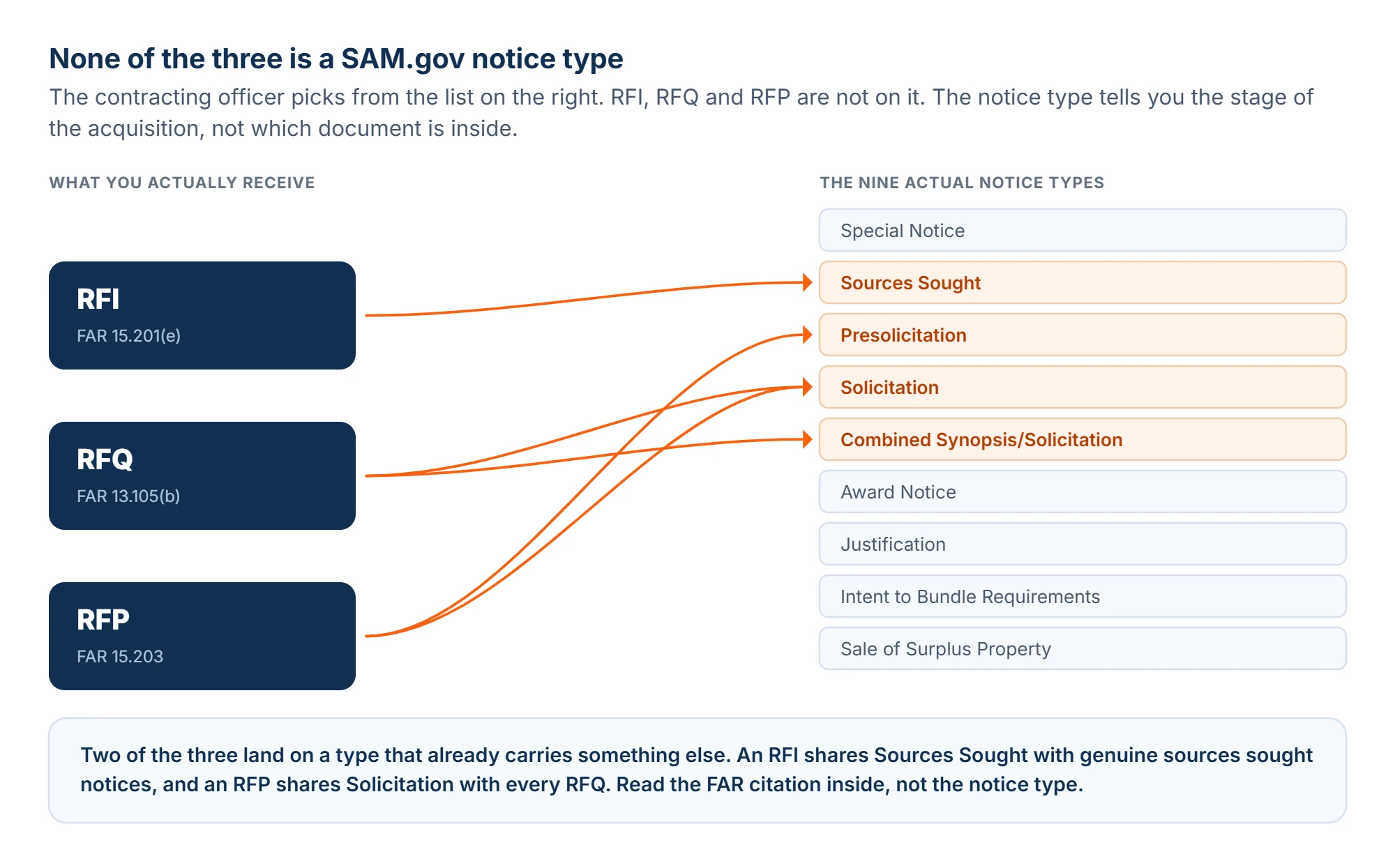
Here is the thing almost nobody writing about this says plainly: none of the three names is a notice type on SAM.gov. There is no RFI notice type, no RFQ notice type and no RFP notice type. The dropdown a contracting officer picks from contains none of them.
The actual notice types are Special Notice, Sources Sought, Presolicitation, Solicitation, Combined Synopsis/Solicitation, Award Notice, Justification, Intent to Bundle Requirements and Sale of Surplus Property. The notice type tells you the stage of the acquisition. The document inside tells you the instrument.
So the three names map onto the notice types many-to-one, and the mapping is lossy:
- An RFI usually posts as Sources Sought. The DoD Guidebook for Publicizing Notices in Contract Opportunities directs contracting officers to use the Sources Sought notice type for requests for information and other market research. That means the notice type cannot distinguish an RFI from a genuine Sources Sought, and the two ask different questions.
- An RFQ posts as Solicitation or Combined Synopsis/Solicitation, per FAR 13.105(b) and FAR 5.203(a)(2). Schedule RFQs do not appear on SAM.gov at all; they run on GSA eBuy under FAR 8.402(d).
- An RFP usually posts as Presolicitation first and Solicitation second. The presolicitation notice is the synopsis; the solicitation is the RFP itself.
The practical triage, in order:
- Read the FAR citations in the notice, not the title. A document headed “RFP” that cites FAR Part 13 is an RFQ with an ambitious name.
- Look for stated evaluation factors and their relative importance. Present means Part 15. Absent means you are almost certainly in Part 13.
- Look for the words “this is not a solicitation”. That is the RFI and Sources Sought marker, and it usually appears in the first paragraph.
- Check whether a due date creates an offer. If the notice asks for a signed offer with an acceptance period, it is an RFP or an IFB, whatever it is called.
How Your Response Should Change for Each
The three documents reward completely different behavior, and the most common cause of wasted effort is writing the same response for all of them.
- To an RFI, write to shape. The agency has not decided what it wants. Describe capability in terms that favor how you actually deliver, name the constraints that would exclude good vendors, and say what you would recommend the requirement look like. Do not price it precisely, and do not treat it as a capability statement drop.
- To an RFQ, write to be easy to buy from. A compliant price, the right line item structure, delivery, and a clear statement of the terms you accept. Because the government order will be the offer, the terms you state in the quote are the terms you are exposed to.
- To an RFP, write to be scored. Answer the evaluation factors in the order they are stated, in the language they are stated in, and inside the page limits. An RFP response is the only one of the three where a better argument beats a better price, because relative importance is published.
The cost profile differs just as sharply, which is the real reason triage matters.
What Each One Costs You in Bid and Proposal Hours
There is no published federal figure for this and any number quoted online comes from a vendor survey with an undisclosed sample, so no averages appear here. What is written down is how the cost is treated: FAR 31.205-18 makes bid and proposal costs allowable as an indirect cost, allocated on the same basis as general and administrative expense. That is a real budget line and it is worked through in the ROM, BOE and G&A guide.
The shape, rather than the number, is what to plan against. An RFI response is hours. An RFQ response is hours to a day once your pricing is set up. An RFP response is weeks of several people, and it is the only one of the three that can consume a quarter of a small company’s capacity. Triage exists because that asymmetry is enormous.
Which of the Three Can Actually Result in an Award
Only two, and only one directly. An RFP can result in an award because a proposal is an offer the government can accept. An RFQ can result in an award, but through a step most people skip over: the government issues an order, which is its offer, and the contract exists when you accept it under FAR 13.004(b). An RFI cannot result in an award at all.
One prerequisite applies to all of them. You cannot receive an award without an active registration, so a lapsed SAM.gov record removes you regardless of how good the response was. The UEI and CAGE registration guide covers what has to be current.
Where Each One Sits in the Acquisition Lifecycle
The three are not alternatives to each other. They are stages, and they usually appear in a fixed order on any given requirement.
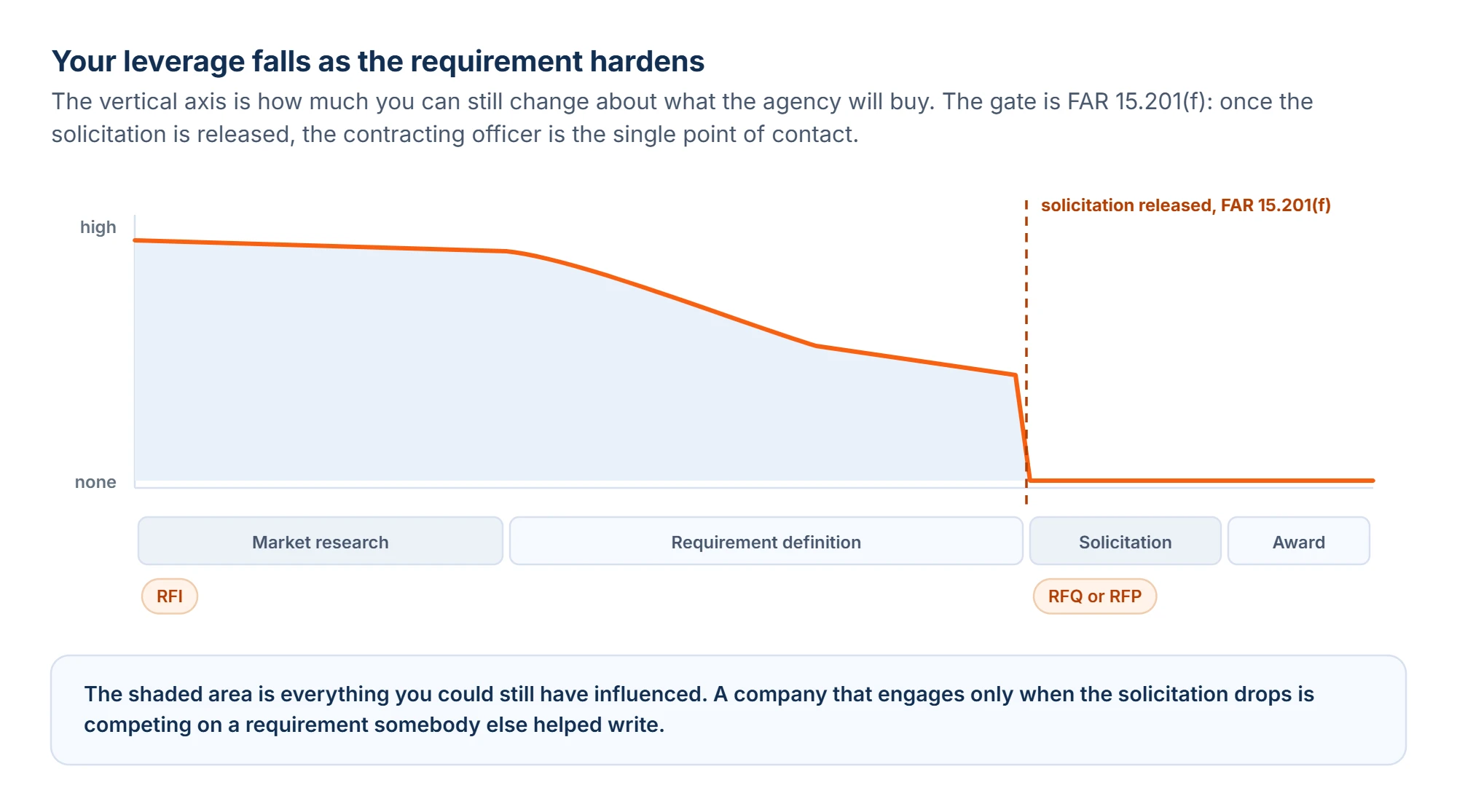
- Market research. The agency does not yet know what it will buy. FAR 10.001 requires market research; FAR 15.201(c) lists the techniques, including RFIs, draft RFPs, presolicitation notices and industry days. This is where an RFI lands, and it is the only stage where you can change the requirement.
- Requirement definition. The agency writes the statement of work and picks its route. Above the simplified acquisition threshold it usually heads for Part 15; below it, Part 13.
- Solicitation. The RFQ or the RFP is released. FAR 15.201(f) marks the change of state: once the solicitation is released, the contracting officer is the single point of contact, and information given to one offeror must be made available to all. The informal conversations stop here.
- Evaluation and award. Proposals are evaluated against the published factors, or quotes are compared and an order is issued.
The reason this sequence matters commercially is that your leverage is highest at stage one and near zero at stage three. A company that only engages when the solicitation drops is competing on a requirement somebody else helped shape.
Where Sources Sought, IFBs and Task Order Solicitations Fit
Four adjacent instruments come up constantly and none of them is one of the three.
| Instrument | Authority and purpose | What your response is |
|---|---|---|
| Sources Sought | FAR 19.502-2(b) rule of two. The agency is counting capable small businesses to decide whether to set the work aside | A capability statement whose job is to be countable in the right socioeconomic category |
| Invitation for bids (IFB) | FAR Part 14 sealed bidding. FAR 14.101 requires public opening of sealed bids, evaluation without discussions, and award to the responsible bidder whose conforming bid is most advantageous considering only price and price-related factors | A sealed bid. It is an offer, it is opened in public, and there are no discussions |
| Request for task order proposal (RFTOP or RTEP) | FAR 16.505. An order-level competition among holders of a multiple-award contract, under the fair opportunity requirement at FAR 16.505(b)(1)(i) | A proposal, but only if you already hold the vehicle. Orders above $7.5 million trigger the enhanced procedures at FAR 16.505(b)(1)(iv) |
| Request for solutions, white papers or prototype proposals | Other transaction and consortium instruments, which sit outside the FAR entirely | Whatever the consortium agreement says. Do not assume FAR protest rights or FAR evaluation rules apply |
The IFB deserves a second look because it is the one people most often call an RFP. It is not. Under FAR 14.101(d) bids are evaluated without discussions, and under 14.101(e) award goes to the responsible bidder whose conforming bid is most advantageous considering only price and price-related factors. No tradeoff, no technical scoring, no negotiation. If you see a public bid opening date, you are in Part 14.
The RFTOP is the one most likely to be missed entirely, because it is not competed in public. It goes to the vehicle holders. If you are not on the IDIQ, you will never see it.
The Most Common Misread, and What It Costs
The expensive mistake is not confusing an RFI with an RFP. Those look different enough. It is treating an RFQ like an RFP, and it costs in both directions.
- Overbuilding the response. A thirty page technical volume against an RFQ that will be decided on price and delivery. FAR 13.106-1(a)(2)(iii) does not require the solicitation to state the relative importance of evaluation factors, and FAR 13.106-2(b)(3) does not require a formal evaluation plan or discussions. There is often nothing there to score the volume against.
- Underreading the terms. The other direction, and worse. Because the government order is the offer under FAR 13.004(a), the terms on the purchase order govern once you perform. A company that treats an RFQ as low stakes and does not read the order it receives has accepted whatever it says.
- Missing the influence window entirely. Skipping RFIs because they cannot be won, then competing on a requirement shaped by whoever did respond.
- Assuming a familiar acronym means a familiar process. In the commercial world an RFP is a vendor selection document with no legal weight. In federal contracting it produces an offer that can be accepted. The word is the same; the exposure is not.
There is one more that shows up in teaming rather than in bidding. Deciding to go after an RFP as a subcontractor usually triggers a due diligence questionnaire from the prime, on the prime’s schedule rather than yours. The triage decision and the diligence readiness are the same decision made two weeks apart.
How to Triage Inbound Solicitations at Volume
At one or two notices a week, triage is a judgment call. At forty, it is a process problem, and it fails in a specific way: the classification never gets written down, so every downstream decision is remade from the notice text by whoever happens to open it.
A working triage records four things about every inbound notice, and it records them once:
- Which instrument it is, judged from the FAR citation and the presence of evaluation factors rather than the title.
- What our response would legally be: an information response, a quote, or an offer. This decides who has to review it before it leaves.
- What the vehicle is, and whether we hold it. An RFTOP against a vehicle we are not on is not a bid decision, it is a contract vehicle decision for next year.
- The decision and who made it. Including the no-bids, because the pattern in your no-bids is the most useful capture data you own and almost nobody keeps it.
Three questions follow from that record, and being able to answer them on any working day is the whole point:
- How many RFIs did we see in our categories this quarter, and how many did we answer?
- Which solicitations that we no-bid came back as awards to companies our size?
- Which vehicles do our lost opportunities keep pointing at?
GovOps360 keeps that record: the notice, the instrument, the vehicle, the decision, who made it and what happened, in one place, so the no-bid pattern is visible as data rather than as a feeling. It is the difference between triaging each notice on its own and running a pipeline. GovFind finds the opportunity. GovOps360 wins it.
See Where GovOps360 Fits Your Pipeline
Bring the states and districts you already sell to, and the cooperative contracts you hold. We will walk through how the coverage gaps and renewal dates would be tracked, and tell you where another tool is the better fit.
Frequently Asked Questions
1. What does RFP stand for?
2. Is an RFP a contract?
3. What is the main difference between an RFP and an RFQ?
4. What is the difference between an RFI and an RFP?
5. Can an RFI become an RFP?
6. Does RFP mean the same thing in business as in government?
7. Which one gets posted on SAM.gov?
8. How long do you get to respond to each one?
References and Sources
Every FAR citation in this article was read against the official acquisition.gov text on 6 September 2026. Where a point was established in the dedicated RFI or RFQ article, this page states the conclusion and links there rather than repeating the working.
- FAR 15.203, requests for proposals and the four things a competitive RFP must describe
- FAR 15.201, exchanges with industry before receipt of proposals, including the RFI authority at (e)
- FAR 13.004, the legal effect of quotations, and why the government order is the offer
- FAR 13.106-1, soliciting competition under simplified acquisition procedures
- FAR 13.106-2, evaluation of quotations or offers, and what Part 13 does not require
- FAR 14.101, the elements of sealed bidding, including evaluation without discussions
- FAR 12.203, using Part 12 policies together with Part 13, 14 or 15 procedures
- FAR 16.505, ordering under multiple-award contracts and the fair opportunity requirement
- FAR 5.203, publicizing and response times, including where no minimum applies
- FAR 10.001, when market research is required
- FAR 19.502-2(b), the rule of two behind a Sources Sought notice
- FAR 31.205-18, bid and proposal costs as an allowable indirect cost
- FAR 8.402(d), why Schedule RFQs run on GSA eBuy rather than SAM.gov
- SAM.gov Contract Opportunities, where the notice types are actually selected
Related reading: RFI meaning and RFQ meaning carry the full working for two of the three instruments compared here, and government contract types covers what the resulting contract can look like once one of them is awarded.

Alaa Negeda
Senior Solution Architect with 23 years of experience in different Technology sectors. Diligent, forward-thinking, and adaptable to dynamic company, customer, and project needs.
Related Articles
 Sep 28,2026
 DDQ Meaning: What a Due Diligence Questionnaire Asks and How to Answer It
 Sep 25,2026
 ITAR Meaning and Compliance for Government Contractors
 Sep 23,2026