



 By Alaa Negeda
Three Different Things Get Called Sole Source
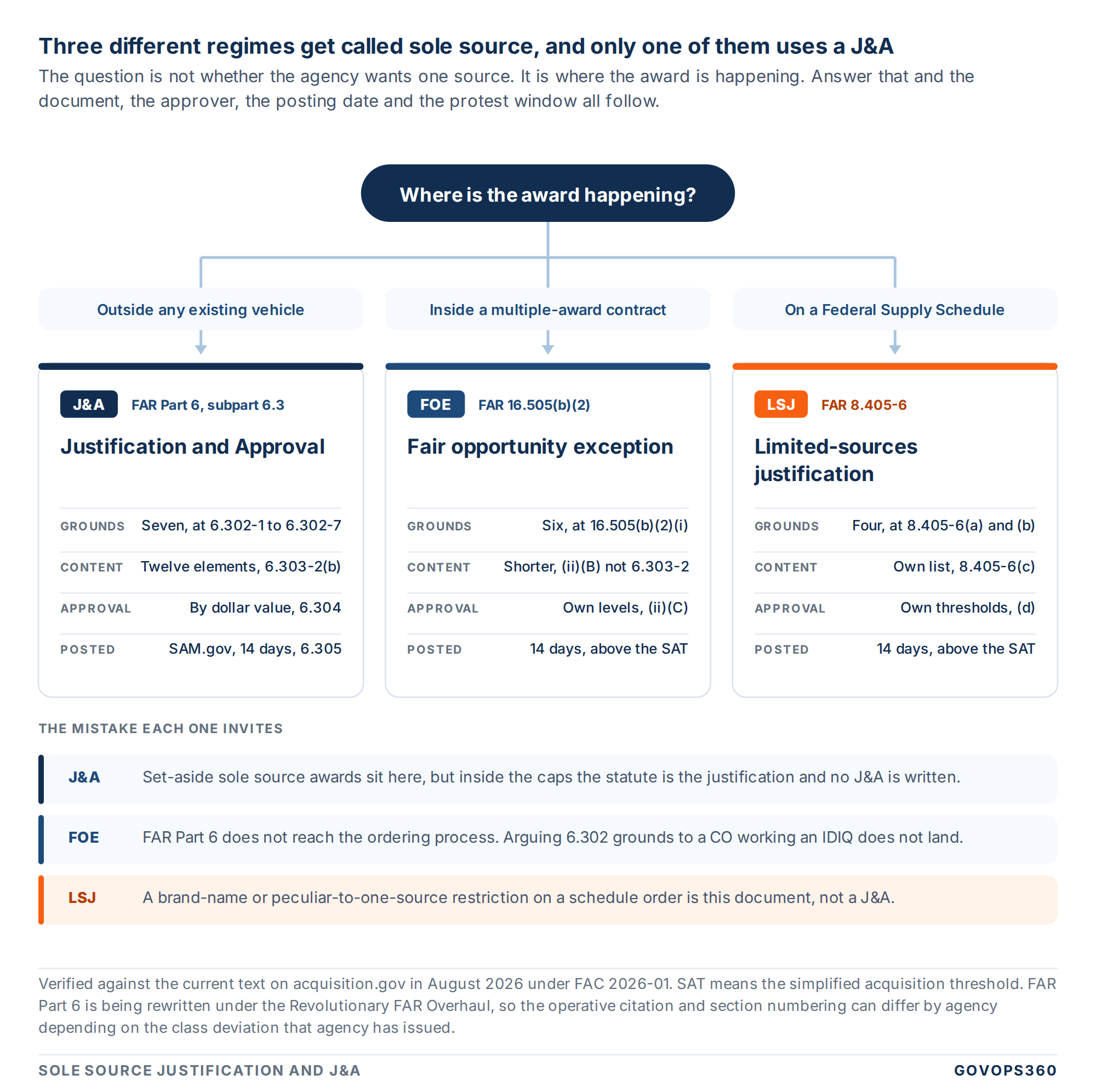
Before any of the rules governing a sole source justification make sense, one thing has to be separated out, because it is the reason most advice on this subject is answering a question you did not ask. Three different regimes get called sole source in conversation. They use different documents, different approval paths and different posting rules, and the FAR part that governs one of them does not govern the others at all.
Work out which one applies to your pursuit first. Everything downstream depends on it.
Why the distinction changes your strategy
If the requirement will be a new contract, you are in Part 6 and the agency needs one of the seven statutory exceptions, a written justification and an approval at a level set by dollar value. If the requirement will be a Schedule order, you are in FAR 8.405-6 and the document is shorter, though the approval bands are identical. If the requirement will be a task order under a vehicle you already hold, you are in FAR 16.505(b)(2) and the question is not whether competition can be avoided but whether one of six named exceptions to fair opportunity applies.
That last case is the one contractors most often misread. A task order sole source is not a J&A, and arguing FAR 6.302 grounds to a contracting officer working an IDIQ will not land. If you are still deciding which vehicle to chase in the first place, our guide to prime contractor versus subcontractor roles covers that decision.
Everything here is being renumbered
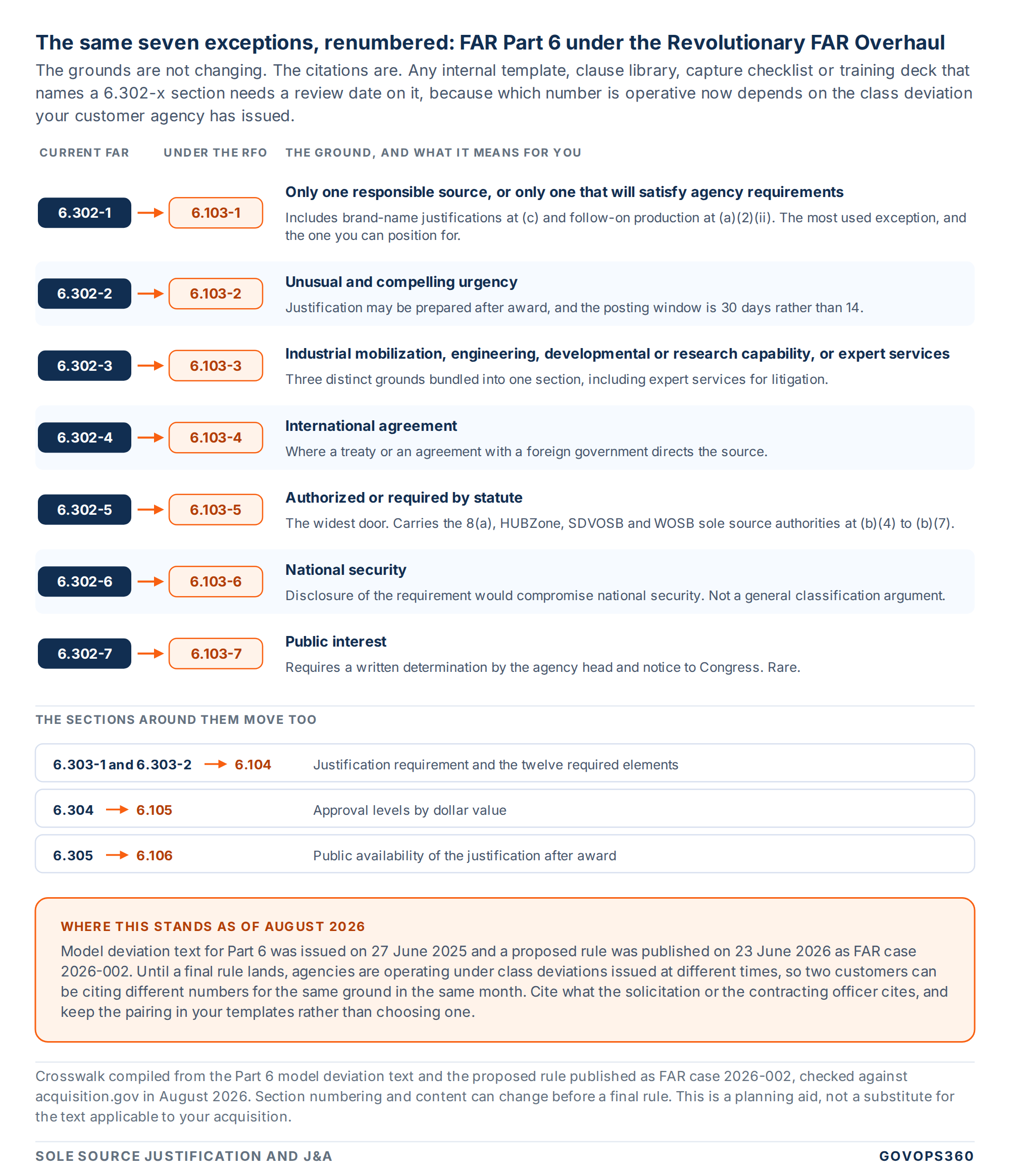
One more thing to hold before we start. FAR Part 6 is being rewritten under the Revolutionary FAR Overhaul. The seven exceptions survive intact but their numbers change, so this article gives both the current citation and the one replacing it. That crosswalk is in section 8, and it is the reason to bookmark this page rather than a competitor’s.
7 not 6
Exceptions to full and open competition at FAR 6.302. A surprising number of published guides count six, usually by folding national security into public interest
$900,000
The point above which a contracting officer can no longer approve their own justification. Raised from $750,000 effective 1 October 2025, so older guides understate it
14 days
The window after award in which the agency must post the justification publicly, which is also your window to read it. 30 days for the urgency exception
The Seven FAR Sole Source Exceptions, and Your Move on Each
FAR 6.302 lists seven circumstances that permit other than full and open competition. Every guide in this search result explains what they mean to the contracting officer. Almost none say what each one implies for a company trying to be the source. The right-hand column below is the part that is missing everywhere else.
| Exception | What it authorizes | Your move |
|---|---|---|
| 6.302-1 Only one responsible source | Award where only one source can meet the requirement. Covers unique supplies or services at (b)(1), limited data or patent rights at (b)(2), utility services at (b)(3), and an agency standardization determination at (b)(4). Brand-name descriptions sit separately at (c) | This is the exception you can actually influence. Own the data rights, hold the patent, or be the only firm whose approach the requirement can be written around. Then make sure the market research finds you, because (b)(1) turns on what the agency can document, not on what is true |
| 6.302-1(a)(2)(ii) Follow-on for development or production | A follow-on contract for continued development or production of a major system or highly specialized equipment, where a new source would cause substantial duplication of cost or unacceptable delay | Win the first increment and document the switching cost as you go. Configuration records, tooling, qualification test data and integration knowledge are the evidence base. DoD, NASA and the Coast Guard also have (a)(2)(iii) for continued highly specialized services |
| 6.302-2 Unusual and compelling urgency | Award where delay would cause serious injury to the Government. The contract period is limited to what the urgency requires and may not exceed one year including options unless the agency head finds exceptional circumstances | You cannot manufacture urgency, but you can be the firm already positioned when it appears: registered, cleared, on a vehicle, with staff who have current badges. Urgency awards go to whoever can start, not whoever is best |
| 6.302-3 Industrial mobilization, research capability or expert services | Maintaining a facility or capability for national emergencies, establishing or maintaining an essential engineering, developmental or research capability, or acquiring expert services for litigation | Relevant if you hold a genuinely scarce capability the Government needs to keep alive, or if you provide expert witness and litigation support. Narrow, but almost uncontested where it applies |
| 6.302-4 International agreement | Where the terms of an international agreement or treaty, or the written direction of a foreign government reimbursing the cost, specify the source | Nothing to position for directly. Worth knowing so you recognize why a foreign military sales requirement was never competed |
| 6.302-5 Authorized or required by statute | Where a statute expressly authorizes or requires the source. This is the door for 8(a), HUBZone, SDVOSB and WOSB sole source awards, and for other statutory authorities | The largest practical path for small business. Get certified, get the NAICS right, and understand the dollar caps. Section 6 covers each program and the caps that currently disagree between FAR and SBA |
| 6.302-6 National security | Where disclosure of the agency's needs would compromise national security. Note that this justifies limiting the sources solicited, not skipping the justification | Applies to cleared work. The positioning is the clearance and the facility, obtained long before the requirement exists |
| 6.302-7 Public interest | Where the agency head determines that full and open competition is not in the public interest for that particular acquisition. Individual justifications only, never class | Effectively unavailable as a strategy. It requires an agency head determination and congressional notification, and it is the rarest of the seven by a wide margin |
Where the leverage actually is
Read the right-hand column as a whole and a pattern appears. Four of the seven are not strategies at all. International agreement, national security, public interest and industrial mobilization either do not depend on anything you do or depend on a posture you established years earlier.
The three that reward deliberate action are 6.302-1, where data rights and documented uniqueness decide the outcome, 6.302-1(a)(2)(ii), where winning the first increment creates the switching cost that protects the second, and 6.302-5, where a socioeconomic certification is the authority. Almost everything worth doing about the FAR sole source rules happens in those three.
One clarification worth making because it comes up constantly. A brand-name requirement is not one of the seven. It sits at 6.302-1(c) and needs its own justification and approval, and the justification is posted with the solicitation rather than after award. A “brand name or equal” description is different again: it permits competition and needs no justification at all.
What a J&A Actually Has to Contain
The sole source justification FAR requirements sit at 6.303-2(b), which sets out twelve required elements. This matters to you for two reasons. If you are the intended source, half of these are facts the agency has to get from you, and the quality of what you supply decides whether the sole source justification survives review. If you are not the intended source, this is the checklist you read a published sole source justification against.
- The agency and contracting activity, and identification of the document as a justification under FAR 6.303.
- The nature and description of the action being approved.
- A description of the supplies or services, including the estimated value.
- The statutory authority relied upon, which means one of the seven exceptions and its citation.
- A demonstration that the contractor’s unique qualifications, or the nature of the acquisition, require this authority. This is the heart of the document and the paragraph you can most influence.
- A description of efforts to solicit offers from as many potential sources as practicable, including whether a notice was published and what responses came back.
- A determination by the contracting officer that the anticipated cost will be fair and reasonable. Without competing offers to compare against, this determination leans on your own build-up, so a defensible wrap rate is doing more work here than it does on a competitive bid.
- A description of the market research conducted, and the results, or a statement of why it was not conducted.
- Any other facts supporting the use of the authority, including relevant technical or cost data.
- A listing of sources that expressed written interest in the acquisition.
- A statement of the actions the agency may take to remove barriers to competition before any subsequent acquisition of the same supplies or services.
- The contracting officer’s certification that the sole source justification is accurate and complete to the best of their knowledge and belief.
Paragraph (c) adds one more: evidence that any supporting data from technical or requirements personnel has itself been certified as complete and accurate.
The three elements that decide the outcome
Element 5 is where the case is made or lost. Element 6 is where a challenger looks first, because a thin description of solicitation efforts is the most common weakness in a sole source justification. Element 11 of the sole source justification is the one that tells you when the door closes: the agency is committing, in writing, to steps that will make the next buy competitive, and that commitment is a roadmap for anyone planning to break in later.
Element 3 has a practical consequence too. The estimated value on the sole source justification drives the approval level, and FAR 6.304(d) requires all option value to be counted. A requirement that looks like it sits under a threshold often does not once options are added, which changes who has to sign.
Who Signs It, and Why Most Guides Have the Numbers Wrong
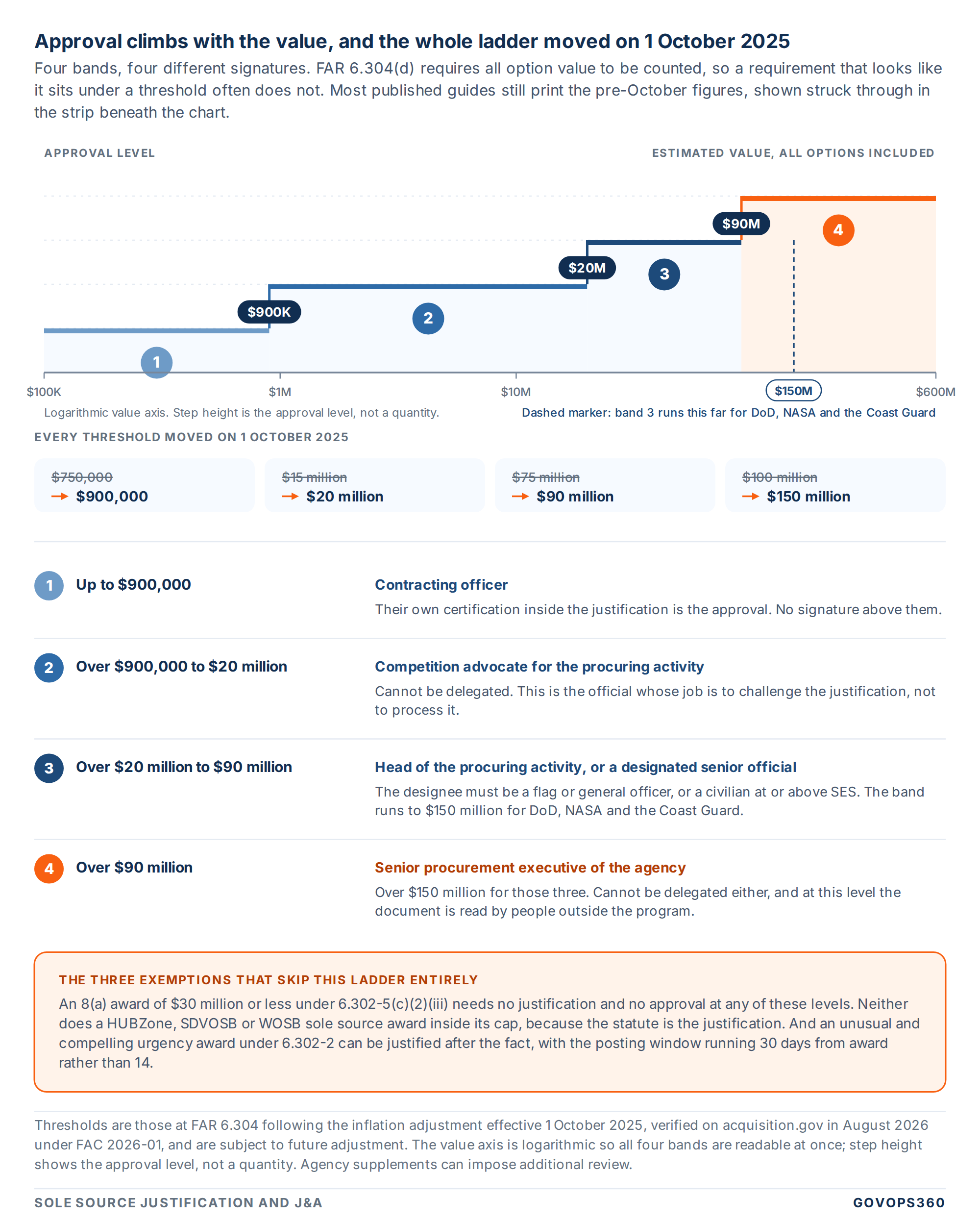
Approval authority under FAR 6.304 escalates with the estimated value, all options included. The figures below took effect on 1 October 2025 as part of the five-year inflation adjustment. The previous values were $750,000, $15 million, $75 million and $100 million, and any guide still showing those is out of date.
This is not trivia. The approval level tells you how hard the agency’s internal path is, which tells you how much help the intended source has to give the contracting officer, and how much resistance a challenger can expect the justification to have already survived.
Up to $900,000
The contracting officer's own certification under FAR 6.303-2(b)(12) serves as the approval, unless agency procedures set a higher bar. One signature, one desk, and the fastest path by a wide margin
$900,000 to $20 million
The competition advocate for the procuring activity, under FAR 6.501. This authority is not delegable. The competition advocate's job is literally to resist noncompetitive awards, so this is where a weak justification usually dies
$20 million to $90 million
The head of the procuring activity, or a designee who is a general or flag officer or a civilian above GS-15. For DoD, NASA and the Coast Guard this band runs to $150 million instead
Above $90 million
The senior procurement executive, not delegable except where the Under Secretary of Defense for Acquisition and Sustainment acts as the DoD senior procurement executive. For DoD, NASA and the Coast Guard the threshold is $150 million
The same ladder appears in three places
Those four bands are not unique to Part 6. FAR 13.501(a)(2) applies the identical thresholds to a sole source acquisition under simplified acquisition procedures, FAR 8.405-6(d) applies them to a limited-sources justification on a Schedule order, and FAR 16.505(b)(2)(ii)(C) applies them to a fair opportunity exception on a task order. Different documents, same signature ladder.
Simplified acquisitions are worth a note of their own. FAR 13.501(a)(1)(i) exempts them from Part 6, so there is no twelve-element format, but a sole source acquisition under subpart 13.5 still has to be justified in writing and approved at those same levels. Subpart 13.5 itself is capped at $9 million, or $15 million for contingency, defense against certain attacks, international disaster assistance and emergency or major disaster operations.
How to Position Before the Requirement Is Written
By the time a solicitation exists, the sole source decision has usually already been made or already been foreclosed. The work that produces a sole source award happens months earlier, in market research, in a sources sought response, and in what the agency can document about who is capable.
Four paths are worth real effort, and two of them are consistently under-covered.
Make the market research find you
Element 8 of the justification is a description of market research and its results. If the agency’s research shows two capable firms, the sole source justification fails. If it shows one, it writes itself. Sources sought notices and requests for information are not administrative noise, they are the record that decides this, and a non-response is read as an absence of capability. Respond to every one in your space, in the agency’s format, addressing the stated requirement rather than describing your company. Tracking those notices and your responses against named agency contacts is exactly the job a GovCon CRM is for, and doing it in a spreadsheet is why most firms cannot show a response history when it matters.
Own something the requirement needs
FAR 6.302-1(b)(2) names limited rights in data, patent rights, copyrights and secret processes as grounds. This is the most durable position available, and it is a decision made long before any pursuit: what you develop at private expense, what you deliver with restricted rights markings, and what you allow to become Government-purpose data. Firms give this away routinely and then wonder why the follow-on was competed.
Submit a genuine unsolicited proposal
This is the path almost no guide covers. FAR 15.607(b) allows a contracting officer to commence negotiations on a sole source basis from an unsolicited proposal, provided it received a favorable comprehensive evaluation, a justification and approval was obtained, funds and technical resources are available, and the Part 5 synopsis requirements are met. The bar is in FAR 15.603(c): the proposal must be innovative and unique, independently originated and developed by you, prepared without Government supervision or direction, detailed enough to judge, not an advance proposal for a known requirement obtainable competitively, and not a response to a previously published requirement. Marketing material, commercial product offers and routine technical correspondence do not qualify.
Use SBIR or STTR Phase III if you have the lineage
The other under-covered path. 15 U.S.C. 638(r)(4) provides statutory sole source authority for Phase III work that derives from, extends or completes a prior SBIR or STTR effort, with no dollar ceiling and no expiration. What the agency has to document is the nexus to the earlier phase. How that documentation is handled, and whether a formal justification is prepared, is set by the agency supplement rather than by the FAR itself, so confirm the practice with the contracting activity rather than assuming.
Sole Source Positioning Readiness
Check every statement that is true of your firm today. These are the facts an agency’s market research would surface, not the ones you would tell them in a capability briefing.
0 of 10
Check the statements above to see where you stand.
The Set-Aside Sole Source Paths
FAR 6.302-5 is the statutory authority exception, and in practice it is the widest sole source door in federal contracting. Four socioeconomic programs carry their own sole source authority, and within the caps no separate justification is needed at all, because the statute is the justification.
The four programs and their current caps
- 8(a) Business Development. FAR subpart 19.8, authority at 15 U.S.C. 637 and FAR 6.302-5(b)(4). Sole source is available below $8.5 million for manufacturing NAICS codes and $5.5 million for everything else under FAR 19.805-1. Tribally-owned, Alaska Native Corporation-owned and, for DoD, Native Hawaiian Organization-owned participants are exempt from the competitive thresholds entirely.
- HUBZone. FAR subpart 19.13, sole source at 19.1306, authority at 15 U.S.C. 657a and FAR 6.302-5(b)(5). Same caps of $8.5 million manufacturing and $5.5 million otherwise, and the requirement must not currently be performed by an 8(a) participant.
- Service-disabled veteran-owned. FAR subpart 19.14, sole source at 19.1406, authority at 15 U.S.C. 657f and FAR 6.302-5(b)(6). Caps are $8.5 million manufacturing and $5 million otherwise, and SBA certification is required, recorded in SAM.
- Women-owned and economically disadvantaged women-owned. FAR subpart 19.15, sole source at 19.1506, authority at 15 U.S.C. 637(m) and FAR 6.302-5(b)(7). Caps of $8.5 million manufacturing and $5.5 million otherwise, with the underrepresented or substantially underrepresented NAICS test deciding which designation applies.
Every one of them requires the same three findings: no reasonable expectation of two or more offers from that category, a responsible contractor, and a price the contracting officer can determine to be fair and reasonable. The second and third are where these awards actually fail.
The $30 million line, and where a J&A comes back
An 8(a) sole source award does not need a justification and approval, up to a point. FAR 6.302-5(c)(2)(iii) exempts contracts of $30 million or less awarded under that authority from the 6.303 and 6.304 requirements. Above $30 million, FAR 6.303-1(b) and 19.808-1 bring the full twelve-element justification, the 6.304 approval ladder and the 6.305 public posting back into play.
Separately, 13 CFR 124.506(b)(5) caps 8(a) sole source awards to exempt entity-owned participants at $25 million, or $100 million for a DoD agency, unless the contracting officer justifies exceeding it in writing. Those are two different ceilings doing two different jobs, and they are frequently conflated.
How to Compete Against Someone Else’s Sole Source
Most of this article assumes you want to be the source. The more common situation is the opposite: a requirement you could perform is heading to somebody else, and you want to know whether anything can be done. Something usually can, and the FAR is more helpful here than contractors expect.
- Answer the synopsis, because the agency has to consider you. This is the strongest and least used opening. Under FAR 5.207(c)(16)(ii), when an agency synopsizes an acquisition using the 6.302-1 authority, the notice must state that all responsible sources may submit a capability statement, proposal or quotation, and that it shall be considered. That is not an invitation to comment. It is a requirement that the agency evaluate what you send. A serious, requirement-specific capability statement filed against a sole source notice is the cheapest way to change an outcome, and it directly attacks element 6 of the justification.
- Read the published justification. FAR 6.305 requires the agency to post the justification at SAM.gov within 14 days after award, or 30 days for an urgency award, and to leave it up for at least 30 days. Brand-name justifications are posted with the solicitation instead. Read element 6 for how hard they actually looked, element 8 for the market research, and element 11 for the barriers they have committed to removing. Element 11 is your calendar for the next buy.
- Watch the urgency clock. An award under 6.302-2 is limited to the period the urgency requires and cannot exceed one year including options, unless the agency head finds exceptional circumstances. An urgency award is therefore a dated opportunity, not a lost one, and the follow-on has to be competed or justified afresh.
- Consider a protest, with clear eyes. GAO resolves over a thousand protests a year within its 100-day deadline, and protesters obtain some form of relief in roughly half of cases according to GAO-25-108652, published July 2025. That figure covers all protest grounds, not sole source specifically, and no reliable government-wide sustain rate for sole source protests exists. Treat a protest as the last option, after the capability statement, and take advice on timeliness before anything else.
What the FAR Overhaul Does to All of This
FAR Part 6 is being rewritten. Model deviation text was issued on 27 June 2025 and agencies have been implementing it through their own class deviations since. A proposed rule covering Part 6 published on 23 June 2026 as FAR case 2026-002, alongside Parts 7, 10, 18, 26, 37 and 41, and the comment period closed on 23 July 2026.
The substance survives. The seven exceptions are not repealed, the twelve justification elements are not reduced, and the approval ladder keeps its four bands. What changes is where all of it lives.
What to do about it in the meantime
Two practical consequences. First, because agencies implement through their own class deviations rather than waiting for a final rule, the operative citation can differ by agency right now. A justification from one agency may cite 6.302-1 while another cites 6.103-1 for the identical authority. Neither is wrong. If you are drafting a capability statement or reading a posted justification, match the numbering the agency is using rather than correcting it.
Second, any internal template, clause library or training material your team maintains against Part 6 citations needs a review date on it. This is the same problem software vendors face with FAR clause libraries, which our guide to government contract management software examines in the section on what to ask a vendor about clause maintenance.
Nothing here changes the strategy. Market research still decides 6.302-1, data rights are still the most durable position, statutory set-aside authority is still the widest door, and a capability statement filed against a sole source notice still has to be considered. Only the numbers on the door change.
Build the Capture Record That Earns a Sole Source
Sole source positions are won in market research and sources sought responses, months before a solicitation exists. Bring one pursuit you think should have been yours and we will walk the record that would have supported it. Or see GovOps360 plans if you would rather start with the pipeline first.
Frequently Asked Questions
1. What are the FAR sole source exceptions?
FAR 6.302 lists seven circumstances permitting other than full and open competition: 6.302-1 only one responsible source, 6.302-2 unusual and compelling urgency, 6.302-3 industrial mobilization or an essential engineering, developmental or research capability or expert services, 6.302-4 international agreement, 6.302-5 authorized or required by statute, 6.302-6 national security, and 6.302-7 public interest. Some published guides count six, usually by merging national security into public interest. Under the Revolutionary FAR Overhaul these become 6.103-1 through 6.103-7 in the same order.
2. What is a J&A in government contracting?
A Justification and Approval is the written document an agency prepares to award a contract without full and open competition. FAR 6.303-2(b) requires twelve elements, including the statutory authority relied on, a demonstration that the contractor's unique qualifications or the nature of the acquisition require it, a description of the efforts made to solicit other sources, the market research conducted, a fair and reasonable price determination, a list of sources that expressed written interest, and a statement of the actions the agency will take to remove barriers to competition next time. The contracting officer certifies it and an official at a level set by dollar value approves it.
3. Who has to approve a FAR sole source justification?
Under FAR 6.304, approval escalates with the estimated value including all option value. Up to $900,000 the contracting officer's own certification is the approval. Above $900,000 to $20 million it is the competition advocate for the procuring activity, and that authority cannot be delegated. Above $20 million to $90 million it is the head of the procuring activity or a senior designee, and for DoD, NASA and the Coast Guard that band extends to $150 million. Above $90 million, or $150 million for those three, it is the senior procurement executive. These figures took effect on 1 October 2025, replacing $750,000, $15 million, $75 million and $100 million.
4. When does a sole source justification become public?
FAR 6.305 requires the agency to post the justification at SAM.gov, or an agency website, within 14 days after contract award, and to leave it available for at least 30 days. For an award under the unusual and compelling urgency exception at 6.302-2 the window is 30 days after award, because the justification itself may be prepared after the fact. Brand-name justifications under 6.302-1(c) are posted with the solicitation rather than after award. Contractor proprietary data and material exempt from FOIA release is redacted first.
5. Does an 8(a) sole source award need a J&A?
Not usually. FAR 6.302-5(b)(4) treats the 8(a) program as authorized by statute, and 6.302-5(c)(2)(iii) exempts contracts of $30 million or less awarded under that authority from the justification and approval requirements. Above $30 million, FAR 6.303-1(b) and 19.808-1 require the full twelve-element justification, approval at the 6.304 levels and public posting under 6.305. Separately, 13 CFR 124.506(b)(5) caps sole source awards to exempt entity-owned 8(a) participants at $25 million, or $100 million for a DoD agency, without a written justification from the contracting officer.
6. Can I do anything if a requirement I could perform is going sole source?
Yes, and the most useful step is the least used. Under FAR 5.207(c)(16)(ii), a synopsis using the 6.302-1 authority must state that all responsible sources may submit a capability statement, proposal or quotation, and that it shall be considered. Filing a serious, requirement-specific capability statement therefore obliges the agency to evaluate you, and it directly tests the justification's account of what efforts were made to solicit other sources. After award, read the posted sole source justification within its 14-day window, paying attention to the market research described and to the stated actions for removing barriers before the next acquisition. A protest is a real but last option, and timeliness rules are strict.
7. Is a task order sole source the same as a J&A?
No, and confusing them is a common and costly error. FAR Part 6 does not apply to the ordering process under indefinite-delivery contracts. Giving a task order to one holder of a multiple-award contract without competing it among the others requires an exception to fair opportunity under FAR 16.505(b)(2), of which there are six, including urgency, only one capable source, a logical follow-on to an earlier order, satisfying a minimum guarantee, a statute specifying the source, and issuing the order under 15 U.S.C. 644(r). For orders above the simplified acquisition threshold a written justification is required and posted within 14 days. Federal Supply Schedule orders are a third regime again, governed by FAR 8.405-6, where the document is called a limited-sources justification.
References and Sources
- FAR 6.302, Circumstances permitting other than full and open competition
- FAR 6.302-1, Only one responsible source, including brand-name justifications at (c)
- FAR 6.302-2, Unusual and compelling urgency
- FAR 6.302-5, Authorized or required by statute, including the 8(a) exemption at (c)(2)(iii)
- FAR 6.303-1, Justifications, requirements
- FAR 6.303-2, Content of the justification, the twelve required elements
- FAR 6.304, Approval of the justification and the current dollar thresholds
- FAR 6.305, Availability of the justification
- FAR 5.207, Preparation and transmittal of synopses, including (c)(16)(ii)
- FAR 5.202, Exceptions to the synopsis requirement
- FAR 8.405-6, Limited sources justification for Federal Supply Schedule orders
- FAR 13.501, Special documentation requirements under simplified acquisition procedures
- FAR 16.505, Ordering, including the fair opportunity exceptions at (b)(2)
- FAR 15.603, Definitions and criteria for a valid unsolicited proposal
- FAR 15.607, Criteria for acceptance and negotiation of an unsolicited proposal
- FAR 19.805-1, 8(a) competitive thresholds and sole source availability
- FAR 19.808-1, Sole source 8(a) contracts
- FAR 19.1306, HUBZone sole source awards
- FAR 19.1406, Service-disabled veteran-owned small business sole source awards
- FAR 19.1506, Women-owned small business sole source awards
- 13 CFR 124.506, 8(a) competitive thresholds and the entity-owned exemption
- 13 CFR 126.612, HUBZone sole source requirements
- Revolutionary FAR Overhaul, Part 6 deviation text and status
- GAO-25-108652, Bid Protests: Key Features and Trends, July 2025
- GAO-19-63, Information Technology: Agencies Need Better Information on the Use of Noncompetitive and Bridge Contracts, December 2018
- Federal acquisition threshold changes effective 1 October 2025
Citations were verified against the current text on acquisition.gov and ecfr.gov in August 2026, under FAC 2026-01. Dollar thresholds reflect the inflation adjustment effective 1 October 2025 and are subject to future adjustment. FAR Part 6 is being rewritten under the Revolutionary FAR Overhaul: model deviation text was issued on 27 June 2025 and a proposed rule published on 23 June 2026 as FAR case 2026-002, so the operative citation and section numbering can differ by agency depending on the class deviation that agency has issued. FAR and SBA regulations currently state different dollar caps for set-aside sole source awards because the FAR absorbed the October 2025 adjustment and 13 CFR has not; cite the FAR provision applicable to your acquisition. The statutory sole source authority for SBIR and STTR Phase III work is established at 15 U.S.C. 638(r)(4), but whether a formal justification is prepared is governed by the agency supplement rather than the FAR, so confirm the practice with the contracting activity. This article is not legal advice. Decisions about protest grounds and timeliness should be taken with counsel.

Alaa Negeda
Senior Solution Architect with 23 years of experience in different Technology sectors. Diligent, forward-thinking, and adaptable to dynamic company, customer, and project needs.
Related Articles
 Sep 30,2026
 RFP vs RFQ vs RFI: Which Solicitation You Are Looking At and What to Do
 Sep 28,2026
 DDQ Meaning: What a Due Diligence Questionnaire Asks and How to Answer It
 Sep 25,2026