



 By Alaa Negeda
What SLED Stands For, and What It Covers
In government contracting, SLED means State, Local and Education. It is the market made up of the 50 states, every county, city, township and special district under them, and every public school district, community college and state university. It is not the South Carolina Law Enforcement Division, which uses the same acronym and owns half of the search results for it.
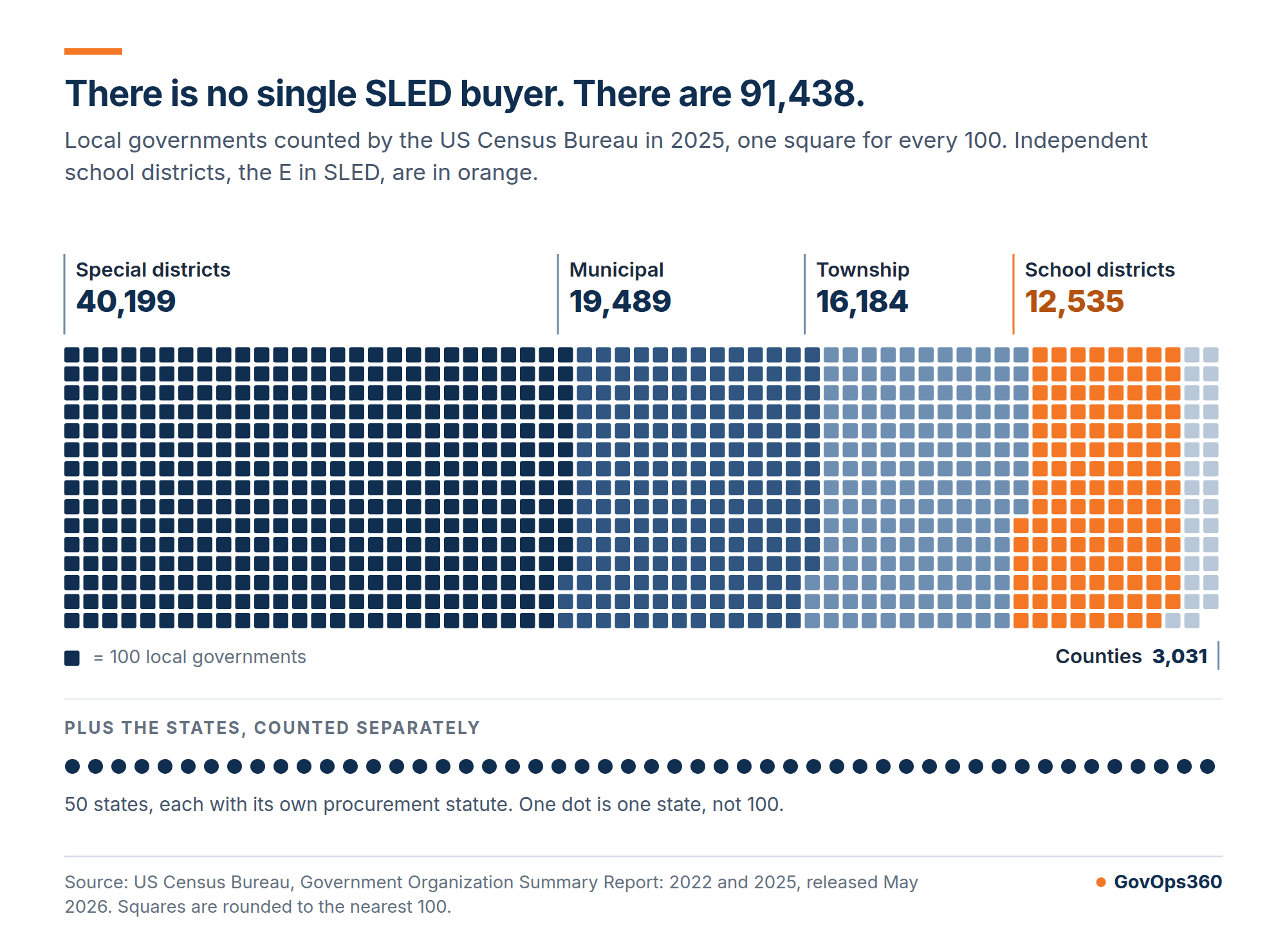
SLED contracting is a genuinely different business from federal work, and the differences are structural rather than cosmetic. There is no FAR. There is no SAM.gov. There is no single place where opportunities are posted, because there is no single buyer: the Census Bureau counted 91,438 local governments in 2025, on top of the states themselves.
This guide covers what SLED means and who is in it, what replaces the FAR, the one situation where federal rules follow the money into a state purchase, whether you actually need SAM.gov and a UEI, how registration works, where bids are posted, how cooperative purchasing lets one award reach thousands of buyers, what the thresholds look like, and the specific habits that cost federal contractors their first SLED bid.
SLED stands for State, Local and Education. The three letters describe three tiers of buyer that share almost nothing except being public and not being federal.
- State. The 50 state governments plus the District of Columbia and the territories. Each one has its own procurement statute, its own central purchasing office and its own vendor portal.
- Local. Counties, cities, towns, townships and special districts. The Census Bureau counted 3,031 county governments, 19,489 municipal governments, 16,184 township governments and 40,199 special district governments in 2025.
- Education. Public school districts, community colleges and public universities. The same count found 12,535 independent school districts, and that figure excludes school systems run as a department of a city or county rather than as a separate government.
Add those together and the local total is 91,438 separate governments, each with its own authority to buy. Short definitions for the terms in this article are in the GovCon glossary. That number is the single most useful fact about this market, and it explains almost every difference in this article.
What Counts as the Education in SLED?
Three groups, and they behave differently. K-12 districts are the 12,535 independent school districts plus dependent school systems inside city and county governments, and they buy heavily through cooperatives. Community colleges sit sometimes under a state system and sometimes under a local district. Public universities often have their own procurement authority, their own thresholds and their own portals, and are the closest thing in SLED to a federal agency in size and process.
The practical point is that “education” is not one buyer type. A university procurement office and a rural school district of 400 students both sit inside the E, and they are not the same customer.
SLED vs Federal Contracting: What Actually Differs
The instinct after federal work is to assume SLED is federal contracting with smaller numbers. The dollar figures are smaller in most cases, but almost nothing else transfers.
| Federal | SLED | |
|---|---|---|
| Governing rules | One rulebook, the FAR, plus agency supplements such as the DFARS | A separate procurement statute and regulations for every state, and often for every large local government and university |
| Registration | SAM.gov, once, with a UEI, and it covers every federal agency | Per entity. A state vendor portal, then separate registrations for counties, cities, districts and universities |
| Where bids appear | SAM.gov is the governmentwide point of entry | No equivalent. Each state runs its own portal and most local governments run their own, or post to a newspaper of record |
| Protests | GAO, the agency, or the Court of Federal Claims, with defined timelines | Set by state statute. Forums, standing and deadlines all vary, and some jurisdictions offer very little |
| Route to award | Compete the solicitation, or hold a vehicle and compete the order | Compete the solicitation, or hold a cooperative contract the buyer can use without running its own solicitation |
The last row is the one worth reading twice. Cooperative purchasing has no real federal equivalent, and it is the reason a small company can sell into hundreds of districts without bidding hundreds of times. It gets its own section below.
What Replaces the FAR in SLED Contracting?
Nothing, and everything. There is no national procurement code for state and local government. Each state has its own statute, and none of them is the FAR, usually with implementing regulations underneath it, and large local governments and universities frequently have their own on top of that.
The closest thing to a common ancestor is the American Bar Association Model Procurement Code for State and Local Governments, adopted by the ABA House of Delegates in 1979, extended with a Model Procurement Ordinance for Local Governments in 1982, revised in 2000, given recommended regulations in 2002 and joined by the Model Code for Public Infrastructure Procurement in 2007. States including Kentucky, Louisiana, Utah and South Carolina enacted legislation modeled on it.
That shared ancestry is why state codes feel familiar to each other: competitive sealed bidding as the default method, competitive sealed proposals as the alternative, small purchase procedures below a threshold, and named exceptions for sole source and emergency. It is also why the details never match. The structure is inherited; the thresholds, the forms, the protest rules and the preferences are local.
When Federal Rules Follow the Money
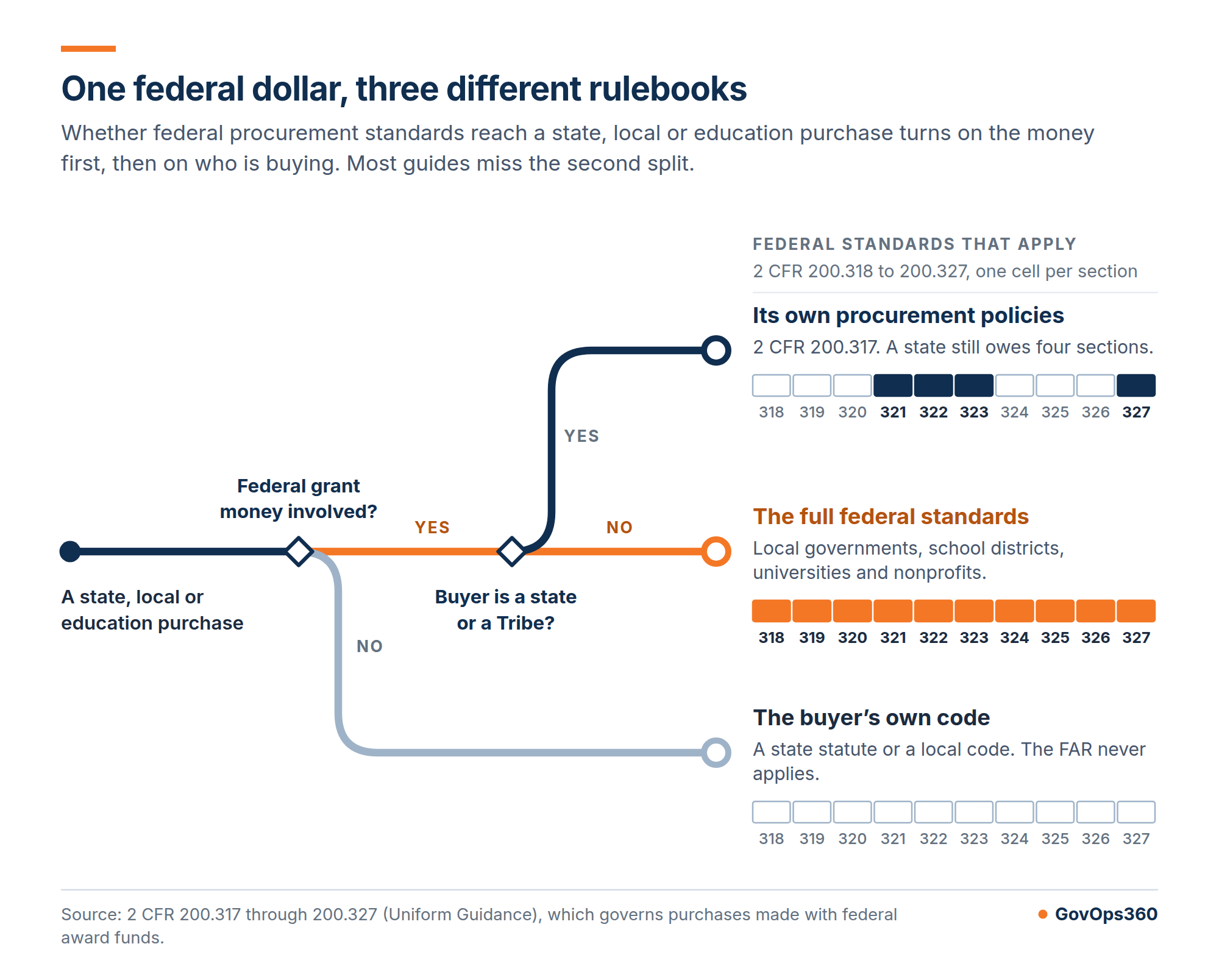
There is one large exception, and most guides on this subject miss it. When a state or local entity spends federal grant money, the federal procurement standards in the Uniform Guidance at 2 CFR Part 200 attach to that purchase. Who they bind depends on what kind of buyer it is, and the split is sharp.
- A state, or an Indian Tribe. Under 2 CFR 200.317, it follows the same policies and procedures it uses for procurements with its own non-federal funds. It must still comply with 2 CFR 200.321, 200.322, 200.323 and 200.327 regardless.
- Everyone else. Local governments, school districts, universities and nonprofits must follow the full federal procurement standards at 2 CFR 200.318 through 200.327.
So a state agency buying with federal money uses its own rulebook, while a school district buying with the same federal money runs a federal-standard procurement. If a district solicitation suddenly reads like a federal one, that is usually why, and it tells you the funding source before anybody mentions it.
Do You Need SAM.gov and a UEI for SLED Work?
Usually not, and the widespread advice that you do is wrong more often than it is right. The requirement comes from 2 CFR Part 25, and Part 25 reaches recipients and subrecipients of federal awards. A company selling goods or services is normally neither.
2 CFR 200.331 draws the line, and it turns on substance rather than the label on the agreement. An entity is a contractor where it provides goods and services within its normal business operations, provides similar goods or services to many different purchasers, operates in a competitive environment, and supplies goods or services ancillary to the program. An entity is a subrecipient where it determines eligibility for assistance, has its performance measured against program objectives, makes programmatic decisions, and carries out a public purpose specified in the authorizing statute.
Read against that test, a vendor selling laptops to a district, or IT services to a city, is a contractor. No UEI is required by Part 25. There are three situations where you will need one anyway:
- The solicitation asks for it. Plenty of state and district solicitations require a UEI or SAM registration whether or not the regulation does. That is the buyer’s choice and it is binding on the bid.
- You are actually a subrecipient. If you are running part of a federally funded program rather than supplying it, 2 CFR Part 25 applies and registration is required before the award.
- You also sell federally. Most companies in this market do, and the registration is already there.
The registration itself, what a UEI is and how it relates to a CAGE code, is covered in the UEI and CAGE guide. The point here is only that SLED work does not create the requirement on its own.
How to Register to Sell to State and Local Agencies
There is no single registration, which is the whole difficulty. The work is a sequence, and doing it in the wrong order wastes the most time.
- Pick the jurisdictions before registering anywhere. Registration is per entity and each one is a small administrative cost. Registering broadly and hoping is how companies end up with forty logins and no pipeline.
- Register with the state central purchasing office. Every state runs a vendor portal, for example Cal eProcure in California and the Electronic State Business Daily in Texas. This is usually where state-level bids and vendor notifications live.
- Register separately with the local entities you have chosen. Counties, cities, districts and universities generally maintain their own vendor lists, and being on the state list does not put you on theirs.
- Complete any state-level certifications you qualify for. Small, minority-owned, women-owned, veteran-owned and in-state preferences are creatures of state statute and are certified at state level, not by the SBA. A federal certification does not transfer automatically.
- Get onto a cooperative contract, or a reseller agreement with someone who holds one. This is the highest-leverage step and it is covered below.
One habit worth adopting from the start: record what each portal calls you, because vendor numbers, commodity codes and classification schemes differ by jurisdiction and nobody reconciles them for you.
Where SLED Opportunities Are Actually Posted
Everywhere and nowhere. There is no SAM.gov for SLED, and that is a structural fact rather than a gap waiting to be filled. With 91,438 local governments plus the states, no single point of entry has ever existed.
In practice opportunities surface through four channels, and most companies watch one of them.
- State portals. Every state runs one. Cal eProcure and the Texas Electronic State Business Daily are two of the larger examples. They carry state agency solicitations and sometimes little else.
- Individual entity sites. Counties, cities, districts and universities post to their own procurement pages. This is where most of the volume is and it is the hardest to watch.
- Newspapers of record and legal notices. Many state statutes still require publication in a newspaper, so some solicitations are legally advertised somewhere no software is looking.
- Cooperative portals. NASPO ValuePoint, Sourcewell, OMNIA Partners and E&I publish their own solicitations when they compete a new contract, and those are the ones that reach the most buyers per award.
The consequence is that a SLED pipeline is an aggregation problem before it is a capture problem. Federal contractors are used to one feed being close to complete. Here, watching one feed means seeing a small and unrepresentative slice.
Cooperative Purchasing Vehicles Compared
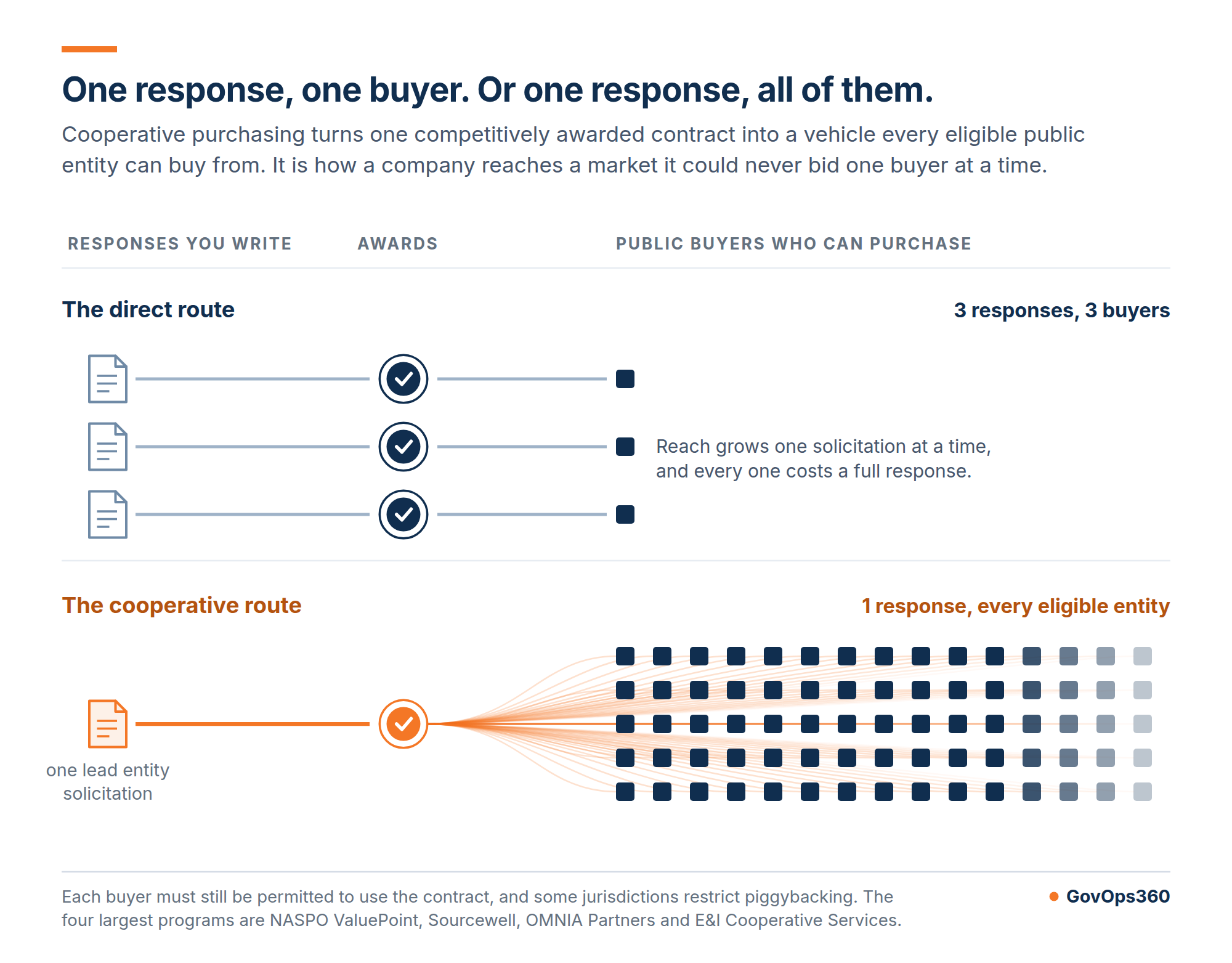
Cooperative purchasing is the mechanism that makes this market reachable. One public entity competes and awards a contract under its own rules, and other public entities are then allowed to buy from it without running their own solicitation. For a vendor, one award can reach thousands of buyers, in the way a federal IDIQ reaches many ordering activities.
Four names carry most of the volume, and they are not interchangeable.
| Cooperative | What it is | Who can buy | Published scale |
|---|---|---|---|
| NASPO ValuePoint | The cooperative arm of the National Association of State Procurement Officials, governed by state procurement leaders. Contracts are competed and awarded by a lead state, then joined by others through a participating addendum | States, local governments and public entities nationwide | More than $21 billion in annual spend, 450 or more suppliers, 62 portfolio categories, 29 states in the Lead State Model |
| Sourcewell | A service cooperative created by the Minnesota legislature as a local unit of government, which competitively solicits and awards contracts other agencies may use | Government and education entities, registering free as participating agencies | More than 50,000 participating government, education and nonprofit organizations |
| OMNIA Partners | A group purchasing organization whose public sector contracts are competitively solicited by lead public agencies | State and local government, K-12, higher education and special districts. Membership is free | More than 600,000 member organizations, around 1,000 contracts, more than $35 billion in purchasing power |
| E&I Cooperative Services | A member-owned, non-profit cooperative built specifically for education procurement, governed by a board elected by member institutions | Education institutions, K-12 and higher education | More than 260 competitively solicited contracts, with profit returned to members |
Two cautions. A cooperative contract is not a license to sell: each buying entity still has to be legally permitted to use it, and some jurisdictions restrict or prohibit piggybacking. And the contract itself is won through a real competitive solicitation, usually a demanding one, because the award is large enough to be worth the effort.
What Are Typical SLED Procurement Thresholds?
There is no such thing as a typical SLED threshold and any article that gives you one number is guessing. Thresholds are set by 50 separate state statutes, and large local governments and universities often set their own beneath them. The only honest answer is that you read the threshold for the jurisdiction you are bidding in, every time.
What can be stated precisely is the shape they take, because most state codes inherited it from the same model. Below a small purchase threshold, informal quotes, which work much like a federal RFQ. Above it, a formal competitive process, usually sealed bids for goods and construction and sealed proposals where evaluation factors other than price matter. Above a higher threshold, added approval or publication requirements.
And where federal grant money is involved, one set of thresholds is written down and applies. 2 CFR 200.320 sets informal methods below the micro-purchase threshold, where a purchase may be awarded without competitive quotes if the price is reasonable and documented, and simplified acquisitions between the micro-purchase and simplified acquisition thresholds, where quotations must be obtained from an adequate number of qualified sources. Above the simplified acquisition threshold, formal methods apply: sealed bids, or proposals where sealed bidding is not appropriate. The section also allows a recipient to self-certify a micro-purchase threshold up to $50,000 with appropriate justification, and higher with cognizant agency approval.
How Long Does a SLED Procurement Take?
No published figure covers this, and any average would be meaningless across 91,438 buyers. The variables that actually move the timeline are visible in the solicitation, though, and they are worth reading for.
- Whether an elected body has to approve the award. A council, board or commission vote adds however long it takes for the next meeting, and meeting calendars are published.
- Whether the budget year has started. Many SLED buyers cannot award before their fiscal year opens, and school district calendars in particular concentrate buying into predictable windows.
- Whether it is a cooperative purchase. Buying from an existing cooperative contract removes the solicitation stage entirely, which is most of the elapsed time.
Why Federal Contractors Lose Their First SLED Bid
The losses are rarely about capability. They are about carrying federal habits into a process that does not reward them, and the same five show up repeatedly.
- Bidding a federal-length proposal. Many SLED solicitations are evaluated by a small committee, sometimes including people whose main job is not procurement. Volume is not read as rigor here.
- Missing a mandatory local requirement. In-state preference, local business certification, a specific bond, a notarized form, a mandatory pre-bid meeting. These are frequently pass or fail, and they are not the federal set.
- Treating price as one factor among many. A large share of SLED awards go to the lowest responsive bidder because the statute requires it, not because the buyer prefers it. Reading a sealed-bid procurement as a best-value one loses it before submission.
- Registering federally and waiting. SAM.gov does not put you in front of any SLED buyer, and nothing about a federal past performance record is automatically visible to them.
- Ignoring cooperatives. Competing one solicitation at a time in a market of 91,438 buyers is arithmetic that does not work. The vendors doing well here hold cooperative contracts and sell against them.
One more, less obvious than the others: assuming a protest exists. Protest rights in SLED are set by state statute, and the forum, standing and deadlines vary widely. In some jurisdictions the remedy is thin enough that the practical answer to a bad award is to bid better next time.
How to Track Opportunities Across 50 States and Thousands of Districts
A federal pipeline is a filtering problem: one large feed, too many results, narrow it down. A SLED pipeline is the opposite. The feed does not exist, so the work is assembly, and it fails in four specific ways.
- Coverage is unknown. With no single source, nobody can say what share of relevant solicitations was actually seen. A quiet quarter and a broken watch look identical.
- Registrations expire quietly. Dozens of separate vendor registrations, each with its own renewal, certification expiry and contact record. The first sign of a lapse is usually not being invited.
- Cooperative contracts have their own clocks. Terms, renewal options and participating addenda run on separate schedules from the underlying contract, and a missed renewal removes the access that took a year to win.
- The same customer looks like three customers. A county, its school district and the city inside it are separate buyers with separate portals, and the relationship built with one is invisible to the others.
That gives four questions worth being able to answer on any working day:
- Which jurisdictions are we registered in, and which of those registrations or certifications expire in the next 90 days?
- Which cooperative contracts do we hold or resell against, and when does each one renew?
- Which solicitations closed in our categories this quarter that we never saw?
- Where have we sold before in this county, city or district, and to which of its neighbors?
GovOps360 keeps the jurisdiction, the registration and its expiry, the cooperative contract behind the sale and the outcome in one record, so a lapsed certification is visible before it costs a bid rather than after. GovFind finds the opportunity. GovOps360 wins it.
See Where GovOps360 Fits Your Pipeline
Bring the states and districts you already sell to, and the cooperative contracts you hold. We will walk through how the coverage gaps and renewal dates would be tracked, and tell you where another tool is the better fit.
Frequently Asked Questions
1. Why does SLED also mean a police agency?
2. Is SLED contracting easier to enter than federal contracting?
3. Are there state-level small business set-asides?
4. Do I need a UEI to sell to a school district?
5. Does the FAR apply to state and local purchases?
6. What is a cooperative purchasing contract?
7. What is a piggyback contract?
8. How many state and local government buyers are there?
References and Sources
Government counts are from the Census Bureau Government Organization Summary Report: 2022 and 2025, released May 2026. Every regulatory citation was read against the Code of Federal Regulations, and every cooperative purchasing figure against the operator’s own published material, on 5 September 2026.
- US Census Bureau, Government Organization Summary Report: 2022 and 2025, released May 2026, the source for every government count in this article
- 2 CFR 200.317, procurements by states, and the split between state and non-state recipients
- 2 CFR 200.320, the informal, formal and noncompetitive procurement methods that apply to federal award spending
- 2 CFR 200.321, contracting with small, minority, women-owned, veteran-owned and labor surplus area firms, and the six affirmative steps
- 2 CFR 200.331, subrecipient and contractor determinations, the test that decides whether a UEI is required
- 2 CFR 25.110, the exemptions from the unique entity identifier and SAM registration requirements
- NASPO ValuePoint, the Lead State Model and the published scale of its portfolio
- Sourcewell, its statutory basis as a Minnesota service cooperative and its participating agency model
- OMNIA Partners Public Sector, eligibility and published membership scale
- E&I Cooperative Services, the member-owned education procurement cooperative
- The ABA Model Procurement Code Revision Project, on the 1979 code and its later revisions
- Cal eProcure, the California state vendor and bid portal, as an example of a state portal
Related reading: UEI and CAGE covers the federal registration this market does not require, FAR vs DFARS covers the federal rulebook that has no state equivalent, and RFQ meaning covers the quote-based buying that state small purchase procedures resemble.

Alaa Negeda
Senior Solution Architect with 23 years of experience in different Technology sectors. Diligent, forward-thinking, and adaptable to dynamic company, customer, and project needs.
Related Articles
 Sep 30,2026
 RFP vs RFQ vs RFI: Which Solicitation You Are Looking At and What to Do
 Sep 28,2026
 DDQ Meaning: What a Due Diligence Questionnaire Asks and How to Answer It
 Sep 25,2026