



 By Alaa Negeda
What Is a Firm Fixed Price Contract?
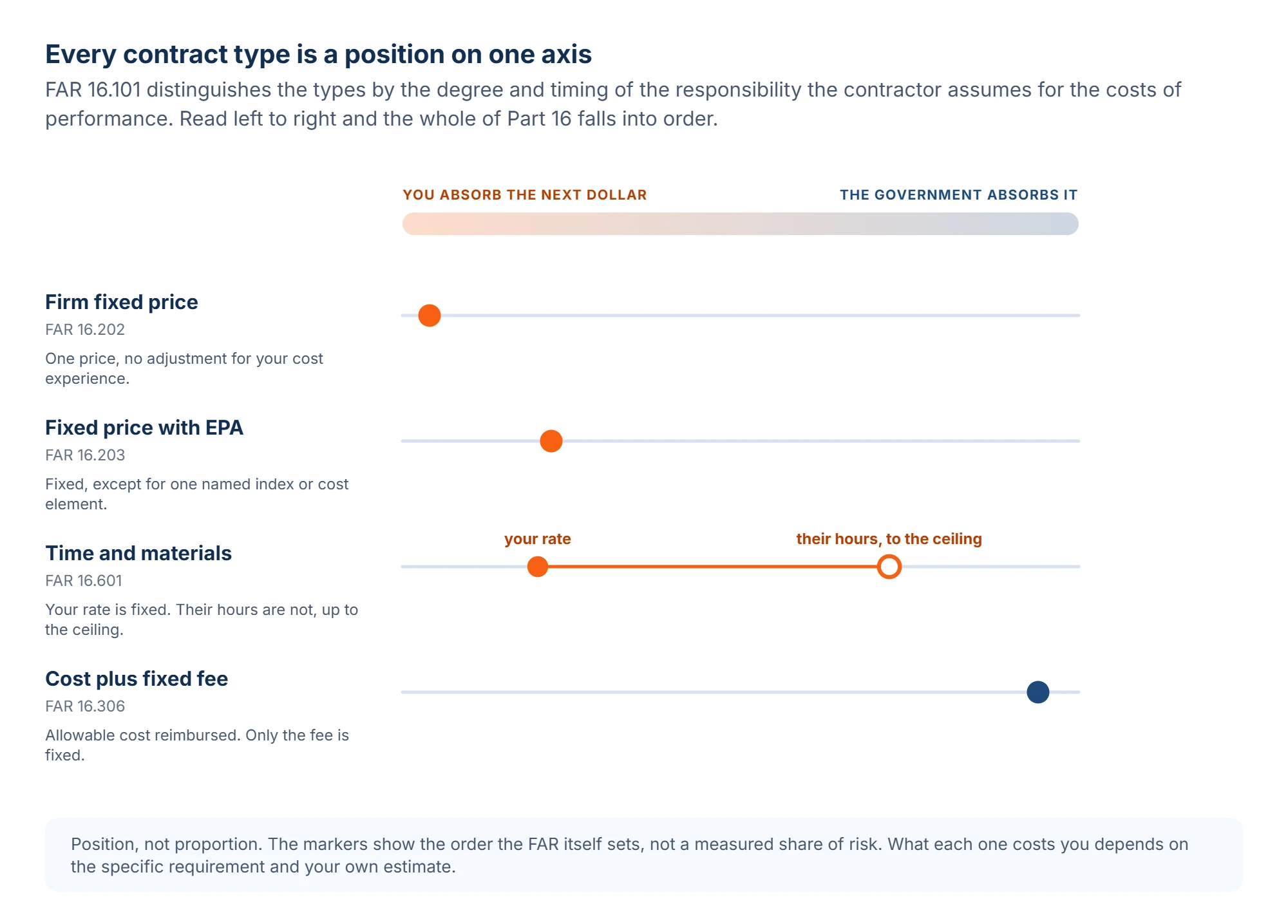
Every federal contract type is an answer to one question: who absorbs the next dollar of cost that nobody planned for. A firm fixed price contract puts that dollar on you. A cost-plus contract puts most of it on the government. Everything else sits somewhere between those two ends.
That framing is not a metaphor. It is how FAR Part 16 is actually organized, and the regulation says so in its own words for each type. Read the types that way and the choice stops being jargon and starts being a pricing decision.
One thing changed in 2026 that most explanations of this topic have not caught up with. Executive Order 14402 made fixed price the default across the federal government, with written justification and agency-head approval now required above set dollar thresholds before an agency may use anything else. That is covered in full below.
This guide defines each type against its FAR authority, sets out who carries the risk in each, explains what LPTA now requires rather than what it used to mean, and covers the two failure modes that cost contractors real money.
A firm fixed price contract sets one price that does not move with what performance actually costs you. FAR 16.202-1 defines it as a contract that “provides for a price that is not subject to any adjustment on the basis of the contractor’s cost experience in performing the contract.”
The same section is unusually blunt about what that means commercially. The type “places upon the contractor maximum risk and full responsibility for all costs and resulting profit or loss,” and “provides maximum incentive for the contractor to control costs and perform effectively.” Both halves of that sentence are the deal: you keep the savings, and you eat the overrun.
FAR 16.202-2 sets out when it is suitable, and the conditions are all about whether a fair price can be established up front: adequate price competition, reasonable comparison with prior purchases, available cost or pricing information that supports realistic estimates, or performance uncertainties that can be identified, costed and accepted by the contractor.
FFP is also the FAR’s stated preference. FAR 16.103 says a firm-fixed-price contract, “which best utilizes the basic profit motive of business enterprise, shall be used when the risk involved is minimal or can be predicted with an acceptable degree of certainty.”
There is a close relative worth knowing. A fixed-price contract with economic price adjustment, under FAR 16.203, allows movement on defined indexes or actual labor and material costs, and is available only where there is serious doubt about the stability of market or labor conditions and the contingency can be identified and covered separately. It is a fixed-price contract with one named escape valve, not a soft fixed price.
What Is a Time and Materials Contract?
A time and materials contract pays for effort rather than outcome. FAR 16.601(b) describes it as acquiring supplies or services on the basis of direct labor hours at specified fixed hourly rates that include wages, overhead, general and administrative expense and profit, plus actual cost for materials.
Read that carefully, because there are two different risks inside one contract type.
- The hourly rate is fixed, so efficiency risk is yours. If a labor category costs you more than the rate you bid, the difference comes out of your margin on every hour.
- The number of hours is not fixed, so volume risk is largely the government’s, up to the ceiling. That ceiling is where the type turns dangerous, and it has its own section below.
T&M is not freely available. FAR 16.601(c) states that a time-and-materials contract “may be used only when it is not possible at the time of placing the contract to estimate accurately the extent or duration of the work or to anticipate costs with any reasonable degree of confidence.”
FAR 16.601(d)(1) adds the paperwork gate: the contracting officer prepares a determination and findings that no other contract type is suitable, signed before the base period or any option is executed, and approved by the head of the contracting activity when the base period plus options exceeds three years.
A labor-hour contract, at FAR 16.602, is the same thing without materials. The FAR calls it “a variation of the time-and-materials contract, differing only in that materials are not supplied by the contractor,” and the same application and limitation rules apply.
What Is a Cost Plus Fixed Fee Contract?
A cost plus fixed fee contract reimburses your allowable costs and pays a fee that was negotiated at the start and does not move. FAR 16.306(a) defines it as a cost-reimbursement contract providing “payment to the contractor of a negotiated fee that is fixed at the inception of the contract,” and states plainly that “the fixed fee does not vary with actual cost.”
The FAR then says the quiet part out loud: CPFF “provides the contractor only a minimum incentive to control costs.” That single sentence explains most of the political pressure this contract type has been under, and it is the reason for the 2026 change covered further down.
The mechanics that matter to a bidder are in the parent subpart. FAR 16.301-1 describes cost-reimbursement types as providing for payment of allowable incurred costs to the extent prescribed in the contract, and establishing “an estimate of total cost for the purpose of obligating funds and establishing a ceiling that the contractor may not exceed (except at its own risk) without the approval of the contracting officer.”
So cost-plus is not a blank check. There is a funding ceiling, crossing it without approval is at your risk, and the fee stays where it was negotiated no matter how the cost side moves. If your costs run 20 percent over, the government may cover the allowable portion, but your fee does not grow with it, so your effective margin falls.
What Does LPTA Mean?
LPTA stands for lowest price technically acceptable. It is not a contract type at all, which is the first thing to get straight: it is a source selection method under FAR Part 15, and an LPTA competition can be awarded as a firm fixed price contract, a T&M contract or something else entirely.
FAR 15.101-2 describes it as appropriate when best value is expected to result from selecting the technically acceptable proposal with the lowest evaluated price. The solicitation sets acceptability standards for the non-cost factors, proposals are judged acceptable or not rather than ranked, and tradeoffs are not permitted. There is no credit for exceeding the standard.
What almost every explanation of LPTA still misses is that it is now a restricted method rather than a freely available one, and that is covered in the LPTA versus tradeoff section below.
FFP vs T&M vs CPFF: Who Carries the Risk?
This is the comparison that actually decides how you price, and it can be built entirely out of the FAR’s own language rather than opinion. FAR 16.101 says the types are distinguished by the degree and timing of the responsibility assumed by the contractor for the costs of performance and by the profit incentive offered. That is the axis.
| Contract type | Who absorbs an overrun | What the FAR says about it | Gate before an agency may use it |
|---|---|---|---|
| Firm fixed price (FAR 16.202) | The contractor, entirely | “Maximum risk and full responsibility for all costs”; “maximum incentive to control costs” | None. It is the preferred type where risk is minimal or predictable (FAR 16.103) |
| Fixed price with economic price adjustment (FAR 16.203) | The contractor, except for the named index or cost element | Available only where there is serious doubt about market or labor stability | The contingency must be identifiable and covered separately |
| Time and materials (FAR 16.601) | Split: you carry the rate, the government carries the hours up to the ceiling | Ceiling price “that the contractor exceeds at its own risk” | Determination and findings that no other type is suitable, signed before award |
| Labor hour (FAR 16.602) | Same as T&M, without materials | A variation of T&M “differing only in that materials are not supplied by the contractor” | Same as T&M |
| Cost plus fixed fee (FAR 16.306) | The government, for allowable costs up to the estimated cost ceiling | “The fixed fee does not vary with actual cost”; “only a minimum incentive to control costs” | Adequate accounting system, approved written acquisition plan, and not for commercial items (FAR 16.301-3) |
Two things fall out of that table that are worth saying explicitly.
- Risk and paperwork move together. The types that shift cost risk to the government are exactly the types that carry a determination, an approval or an accounting-system test. If a solicitation offers you a cost-reimbursement type, the agency has already had to justify it.
- T&M is not a middle ground, it is two different risks stapled together. Treating it as “fixed price with flexibility” is how firms lose money on it, which is the failure mode covered below.
Which FAR Part Governs Contract Type Selection?
FAR Part 16, Types of Contracts. It sorts everything into two broad families, fixed-price contracts at Subpart 16.2 and cost-reimbursement contracts at Subpart 16.3, with time-and-materials and labor-hour arrangements at Subpart 16.6 and indefinite-delivery arrangements at Subpart 16.5.
Part 16 also closes the door on improvisation. FAR 16.102 states that “contract types not described in this regulation shall not be used, except as a deviation under subpart 1.4.” If someone describes an arrangement that does not map to a named type, it is either a combination of named types or it is not permitted.
The selection standard is at FAR 16.103: negotiate a contract type and price that “will result in reasonable contractor risk and provide the greatest incentive for efficient and economical performance.” FAR 16.104 then lists the factors the contracting officer weighs, including price competition, the type and complexity of the requirement, urgency, period of performance, your technical capability and financial responsibility, the adequacy of your accounting system, and acquisition history.
That list is worth reading as a bidder rather than as a lawyer. Two of those factors are about you specifically. If your accounting system cannot support a cost-reimbursement contract, the type is closed to you before the competition starts, and no amount of proposal quality changes that.
At What Point Is Contract Type Decided?
Before you ever see the solicitation. Contract type is an acquisition planning decision, worked out with the requirement and reflected in the acquisition plan, and by the time the RFP is issued it is normally settled and stated in Section B.
The practical consequence is that the window to influence it is the market research and RFI stage, not the proposal stage. If a draft RFP proposes a type that does not fit the risk, that is a question to raise in writing during the comment period. Once the solicitation is final you are pricing to the type you were given.
The 2026 Change: Fixed Price Is Now the Default
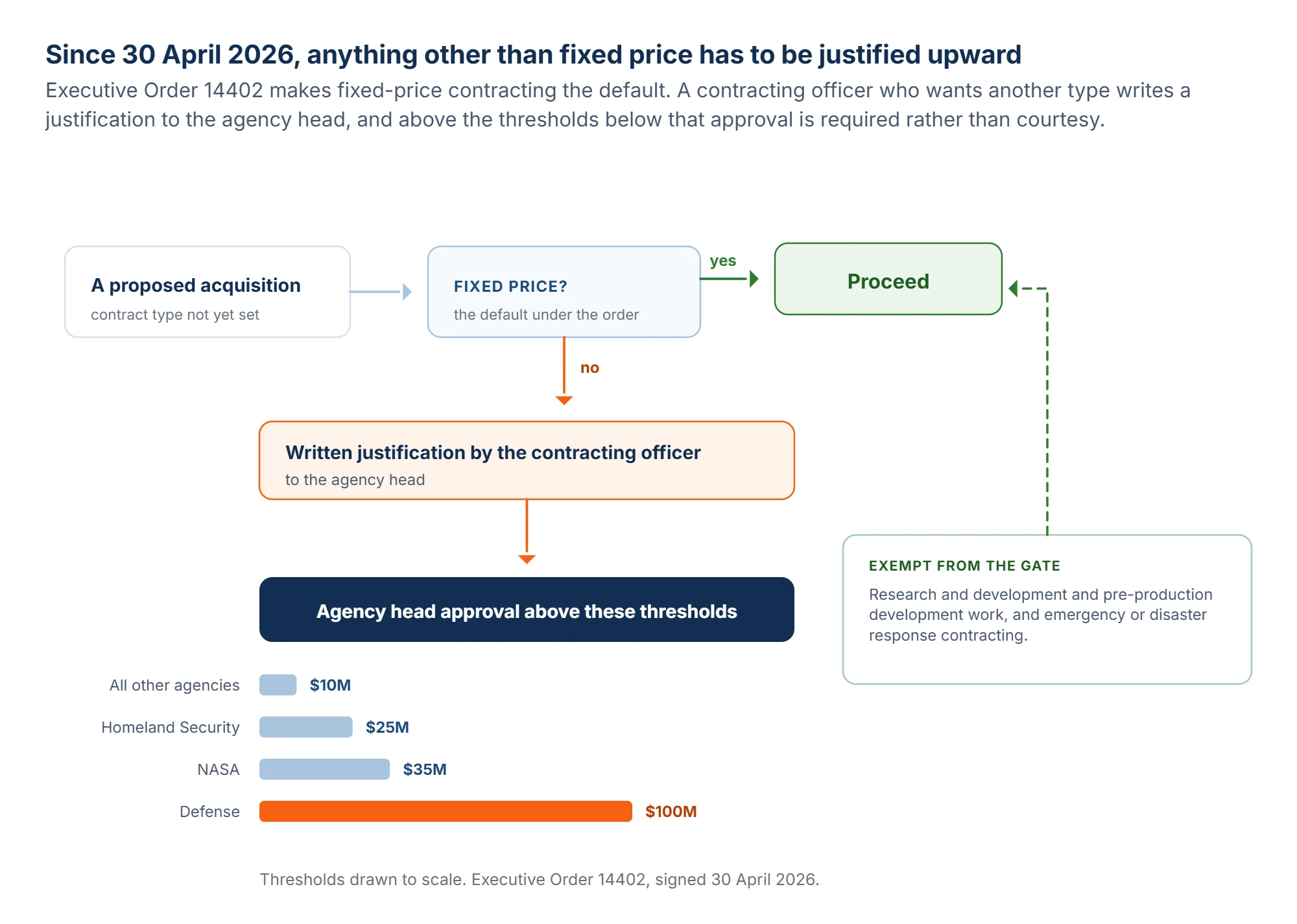
Executive Order 14402, Promoting Efficiency, Accountability, and Performance in Federal Contracting, was signed on 30 April 2026 and it changes the starting assumption for every federal acquisition. Fixed-price contracting is now the default and preferred method, and agencies are directed to use fixed-price contracts to the maximum extent consistent with law.
The part that has teeth is the approval mechanism. Using anything other than a fixed-price contract now requires the contracting officer to justify it in writing to the agency head, and above set dollar thresholds that approval is required rather than optional:
- $100 million for the Department of Defense.
- $35 million for NASA.
- $25 million for the Department of Homeland Security.
- $10 million for all other agencies.
The order carves out research and development and pre-production development work, and emergency or disaster response contracting. It also directed agency heads to review and seek to modify their ten largest non-fixed-price contracts within 90 days, and directed the Administrator for Federal Procurement Policy to propose FAR amendments and build a training program within 120 days.
This is already flowing into the rulebook. The Revolutionary FAR Overhaul published updates to its Part 16 model deviation text on 1 July 2026 implementing the order, and agencies including GSA, NASA, the Department of Transportation and the EPA have issued their own Part 16 deviations. That means the contract-type rules applied to your next solicitation may be your agency’s deviation text rather than the FAR Part 16 language quoted in this article. Check which one the solicitation cites before you argue a point from the FAR.
What it means commercially is simpler than the paperwork suggests. Expect more work to arrive as firm fixed price, expect scope that used to be cost-reimbursable to be repackaged with a fixed price and performance incentives, and expect the burden of estimating uncertainty to land on your side of the table more often than it used to.
When Can an Agency Use a Cost-Reimbursement Contract?
Only when the requirement genuinely cannot be priced. FAR 16.301-2 permits cost-reimbursement types only when circumstances do not allow the agency to define its requirements sufficiently for a fixed-price type, or when “uncertainties involved in contract performance do not permit costs to be estimated with sufficient accuracy to use any type of fixed-price contract.”
Then FAR 16.301-3 adds three limitations, and one of them is about you rather than the requirement:
- Your accounting system must be adequate for determining costs applicable to the contract or order. This is a capability test that happens before award, and it is the single most common reason a smaller firm cannot bid cost-reimbursement work.
- A written acquisition plan must be approved and signed at least one level above the contracting officer.
- Cost-reimbursement contracts are prohibited for the acquisition of commercial products and commercial services.
Layer Executive Order 14402 on top of those and the practical picture for 2026 is that a cost-reimbursement award now needs the requirement to be genuinely unpriceable, your accounting system to pass, an approved acquisition plan, and a written justification to the agency head. Each of those is a place the award can be redirected to a fixed-price type instead.
LPTA vs Best Value Tradeoff: Which One Applies?
Both live on the same continuum in FAR Part 15, and the difference is whether the government is allowed to pay more for something better.
Under the tradeoff process at FAR 15.101-1, it may be in the government’s interest to award to other than the lowest priced offeror. The solicitation must state whether the non-cost factors combined are significantly more important than, approximately equal to, or significantly less important than price. When a higher priced proposal wins, “the perceived benefits of the higher priced proposal shall merit the additional cost,” and the rationale has to be documented in the file.
Under LPTA at FAR 15.101-2, none of that is available. Proposals are acceptable or not, and among the acceptable ones the lowest evaluated price wins.
Here is the part that has changed and that most pages have not updated. LPTA is now conditional. FAR 15.101-2 requires an agency to satisfy a set of criteria before using it, including that the agency can comprehensively describe its minimum requirements in performance objectives, measures and standards; that it would realize no value or minimal value from a proposal exceeding those minimums; that the technical proposals require minimal subjective judgment; that it is highly confident a review of all proposals would identify no other value characteristics; that the lowest price reflects total cost of ownership; and that the contracting officer documents the justification in the file.
The regulation goes further and tells agencies to avoid LPTA for acquisitions predominantly involving information technology services, cybersecurity services, systems engineering and technical assistance, advanced electronic testing, audit or audit readiness services, health care services, telecommunications, or other knowledge-based professional services, and for personal protective equipment.
So if you are a professional services firm and a solicitation for knowledge-based work arrives as LPTA, that is not simply an unwelcome commercial choice. It is a choice the regulation tells the agency to avoid, and it is a legitimate question to raise before the proposal is due rather than after award.
Common LPTA Bidding Mistakes
- Bidding your best solution instead of the acceptable one. Exceeding the standard earns nothing and prices you out. Read the acceptability standards as a specification, not as a floor.
- Assuming acceptable means minimal. The opposite failure. If any element is judged unacceptable, price never gets looked at, and there is no tradeoff to rescue you.
- Pricing to win and staffing to the bid. On an LPTA award that lands as a firm fixed price contract, the thin price you needed to win is the price you have to perform at for the life of the contract.
- Not checking whether LPTA was permitted at all. For the service categories named above, the regulation tells agencies to avoid it. That is worth a question during the solicitation period.
Why Firms Lose Money on T&M Ceilings
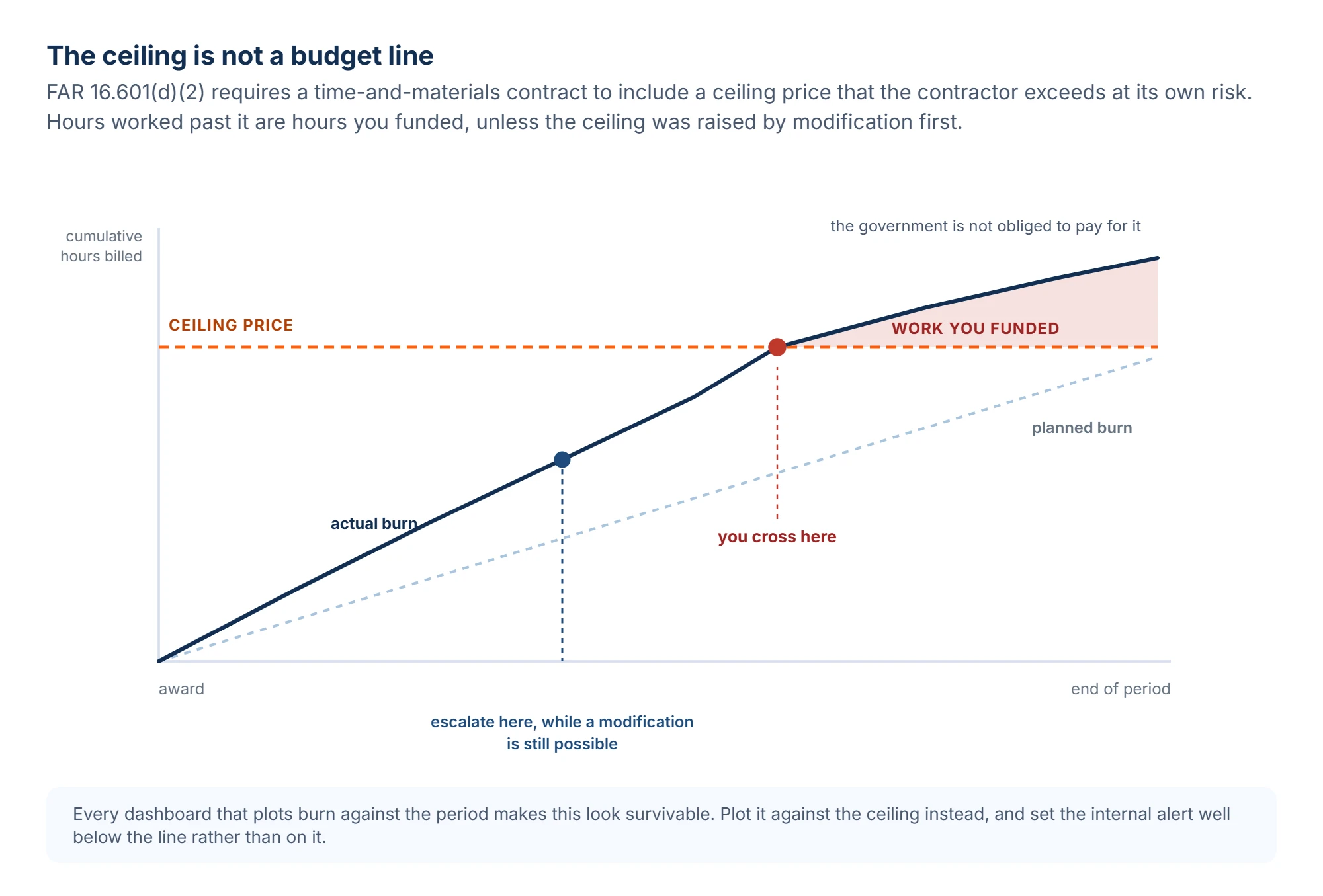
The T&M ceiling is the most misread number in federal contracting. FAR 16.601(d)(2) requires that the contract or order include “a ceiling price that the contractor exceeds at its own risk.” That is the whole sentence, and every word of it matters.
The ceiling is not a budget you are working toward and it is not a target. It is the point past which the government is not obliged to pay you. Work performed above it is work you funded.
The failure pattern is consistent and it looks like this:
- The contract is treated as though the ceiling were the value of the work, so the team plans to spend all of it.
- Burn runs slightly ahead of plan for several months, which nobody escalates because there is still headroom.
- The customer asks for something reasonable and in scope, and the team does it, because the relationship matters.
- Hours cross the ceiling near the end of a period of performance, when there is no time to negotiate a modification.
- The work is delivered anyway, and the invoices for the excess hours are not payable.
Nothing in that sequence involves anyone behaving badly. It happens because a ceiling looks like a budget on every dashboard that is not specifically designed to treat it as a hard stop.
The controls that actually prevent it are unglamorous. Track burn against the ceiling rather than against the period, set an internal alert well below the ceiling rather than at it, escalate in writing the first time actual burn passes planned burn, and get any scope conversation that adds hours into a modification before the hours are worked rather than after.
How Contract Type Changes Your Wrap Rate, Fee and Pipeline Pricing
Contract type is not a compliance detail that gets handled after pricing. It changes what the number means.
- On firm fixed price, your rate has to carry the risk premium for everything you cannot see, because there is no mechanism to recover it later. Underestimate the uncertainty and the margin is gone.
- On T&M, the fixed hourly rate has to be right for the labor category over the whole period of performance, including the escalation you will actually face. There is no adjustment mechanism on the rate.
- On cost plus fixed fee, the cost side is largely reimbursed but the fee is fixed at the start, so cost growth quietly compresses your effective margin rather than showing up as a loss.
Which means the same opportunity, priced honestly, produces different numbers depending on the type, and a pipeline that carries one blended assumption across everything is mispricing most of it. Our wrap rate calculator guide covers how the indirect build works, and the federal bid pricing guide covers the full worked example.
Across a portfolio the questions worth answering are simple and are the ones most teams cannot answer quickly:
- Which of your active pursuits are fixed-price, and does your rate structure carry a risk premium on those?
- Which contracts are T&M, what is the ceiling on each, and how much headroom is left right now?
- Which are cost-reimbursement, and has cost growth eroded the effective fee since award?
- With fixed price now the default, how much of next year’s pipeline should be repriced on the assumption that it arrives as FFP?
GovOps360 holds the pursuit, the contract type, the ceiling and the burn in one record, so a T&M ceiling with three months of headroom is visible against the pipeline rather than buried in a finance report that arrives after the fact. GovFind finds the opportunity. GovOps360 wins it.
See Where GovOps360 Fits Your Pipeline
Bring a pursuit you lost and one you won. We will model both, show you where the platform helps and tell you where another tool on this list is the better fit.
Frequently Asked Questions
1. Is IDIQ a contract type?
Not in the pricing sense. Indefinite-delivery arrangements sit at FAR Subpart 16.5 and describe how and when orders are placed, not how they are priced. Each order under an IDIQ still carries its own type, so an IDIQ can hold fixed price and T&M orders side by side.
2. What is a hybrid contract?
The FAR does not define the term. What people mean is a single contract whose line items carry different types, for example a fixed price deliverable alongside a T&M support line. FAR 16.104 lists combining contract types as a factor a contracting officer weighs when selecting.
3. What does "firm price" mean?
It is not a FAR term. In practice people use it as shorthand for firm-fixed-price, meaning a price that does not adjust for the contractor cost experience under FAR 16.202-1. If you see it in a solicitation, check which named FAR type is actually being cited.
4. Can a T&M contract exceed its ceiling?
The work can, but the payment obligation does not follow it. FAR 16.601(d)(2) requires a ceiling price that the contractor exceeds at its own risk, so hours worked above the ceiling are not payable unless the ceiling is raised by modification first.
5. What is the difference between a labor-hour and a T&M contract?
Materials. FAR 16.602 calls a labor-hour contract a variation of the time-and-materials contract differing only in that materials are not supplied by the contractor. The application rules and the determination and findings requirement are the same for both.
6. Is LPTA still allowed?
Yes, but conditionally. FAR 15.101-2 requires the agency to meet a list of criteria first, including that it would gain minimal value from exceeding the minimum requirements, and it tells agencies to avoid LPTA for knowledge-based services such as IT, cybersecurity and audit work.
7. Does Executive Order 14402 ban cost-reimbursement contracts?
No. It makes fixed price the default and requires written justification to the agency head to use anything else, with approval required above $100 million for Defense, $35 million for NASA, $25 million for DHS and $10 million elsewhere. R&D and emergency work are carved out.
8. Which contract type should a small business prefer?
The one your accounting system and your cash position can carry. Cost-reimbursement work requires an accounting system adequate for determining contract costs under FAR 16.301-3, which is a real barrier. Fixed price has no such gate but puts every overrun on you.
References and Sources
All FAR citations verified against acquisition.gov and ecfr.gov, and Executive Order 14402 against federalregister.gov, on 5 September 2026.
- FAR Subpart 16.1, Selecting Contract Types, including FAR 16.101, 16.102, 16.103 and 16.104
- FAR Subpart 16.2, Fixed-Price Contracts, including FAR 16.202 and 16.203
- FAR Subpart 16.3, Cost-Reimbursement Contracts, including FAR 16.301-1, 16.301-2, 16.301-3 and 16.306
- FAR Subpart 16.6, Time-and-Materials, Labor-Hour, and Letter Contracts, including FAR 16.601 and 16.602
- 48 CFR 16.601, with the paragraph structure for the application and limitation provisions
- FAR 15.101-1, Tradeoff Process
- FAR 15.101-2, Lowest Price Technically Acceptable Source Selection Process
- Executive Order 14402, Promoting Efficiency, Accountability, and Performance in Federal Contracting, 30 April 2026
- Revolutionary FAR Overhaul, updates to Parts 16 and 52 implementing EO 14402, 1 July 2026
- Revolutionary FAR Overhaul, FAR part deviation guide and published agency deviations
- FAR Part 16, Types of Contracts
Related reading: the wrap rate calculator guide and how to price a federal bid cover the indirect build behind every number above, and the GovCon glossary holds the FFP, T&M, CPFF and LPTA entries.

Alaa Negeda
Senior Solution Architect with 23 years of experience in different Technology sectors. Diligent, forward-thinking, and adaptable to dynamic company, customer, and project needs.
Related Articles

 Sep 30,2026
 RFP vs RFQ vs RFI: Which Solicitation You Are Looking At and What to Do
 Sep 28,2026
 DDQ Meaning: What a Due Diligence Questionnaire Asks and How to Answer It
 Sep 25,2026