



 By Alaa Negeda
What Is a Wrap Rate in Government Contracting?
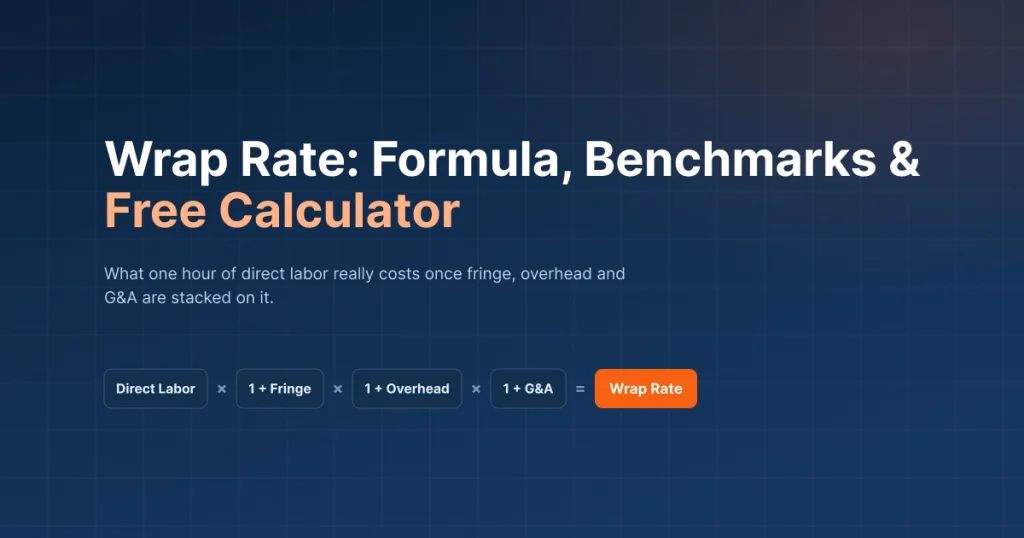
Your wrap rate is the multiplier that turns one dollar of direct labor into the fully burdened cost of putting that person on a federal contract. Pay an engineer $50.00 an hour at a wrap rate of 1.95, and that engineer costs your company $97.50 an hour before you add a single point of profit.
Every federal price you submit is built on this number, a time-and-materials hourly rate, a firm-fixed-price lump sum, a cost-plus estimate. Get it wrong on the high side and you lose on price. Get it wrong on the low side and you win work you cannot perform profitably, or you trigger a cost realism adjustment that erases the advantage anyway.
Here is the part that surprises most contractors: there is no wrap rate in the FAR. Search the Federal Acquisition Regulation, DFARS, or the Cost Accounting Standards and the term never appears. What the regulations govern are indirect cost pools, allocation bases, and indirect cost rates. “Wrap rate” is industry shorthand for what happens when you stack those regulated pieces on top of a direct labor dollar, which is exactly why so many contractors compute it inconsistently.
Wrap rate vs. burden rate vs. fully burdened labor rate
Four terms get used interchangeably on capture calls, and the imprecision causes real pricing errors. Here is how practitioners actually use them:
- Wrap rate: the dimensionless multiplier, written as 1.95 or 1.95x. Applied to direct labor.
- Burden rate: usually a synonym for wrap rate; sometimes used for a single layer, as in “the fringe burden.”
- Indirect rate: the FAR and CAS-correct term for each individual pool rate: your fringe rate, overhead rate and G&A rate, each expressed as a percentage of its own allocation base.
- Fully burdened labor rate (or loaded rate): the dollar result: $97.50 per hour. The wrap rate is the multiplier; the fully burdened rate is what it produces.
When a contracting officer asks for your fully burdened rate, they want dollars. When a teaming partner asks for your wrap, they want the multiplier. Answering the wrong one is a common and entirely avoidable stumble in quoting and pricing conversations.
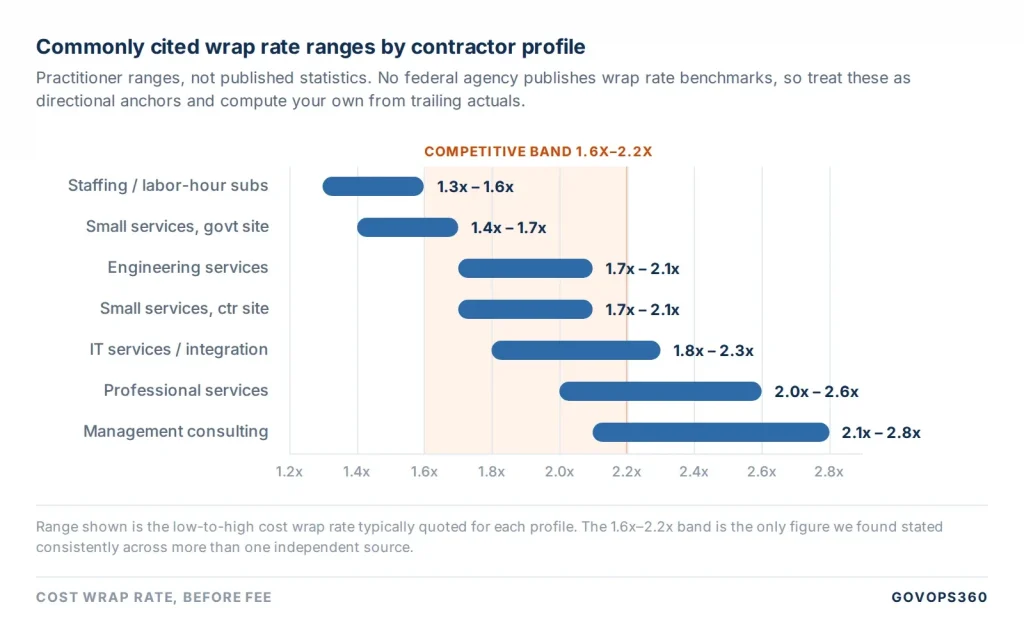
1.6x – 2.2x
The band most commonly cited as competitive for federal services contractors
3 Cost Pools
Fringe, overhead and G&A: the standard indirect structure behind nearly every federal labor rate
6 Months
Your deadline to submit a final indirect cost rate proposal after fiscal year end (FAR 52.216-7)
The Wrap Rate Formula (and the Math Error That Costs Bids)
Wrap Rate Formula: How the calculation works
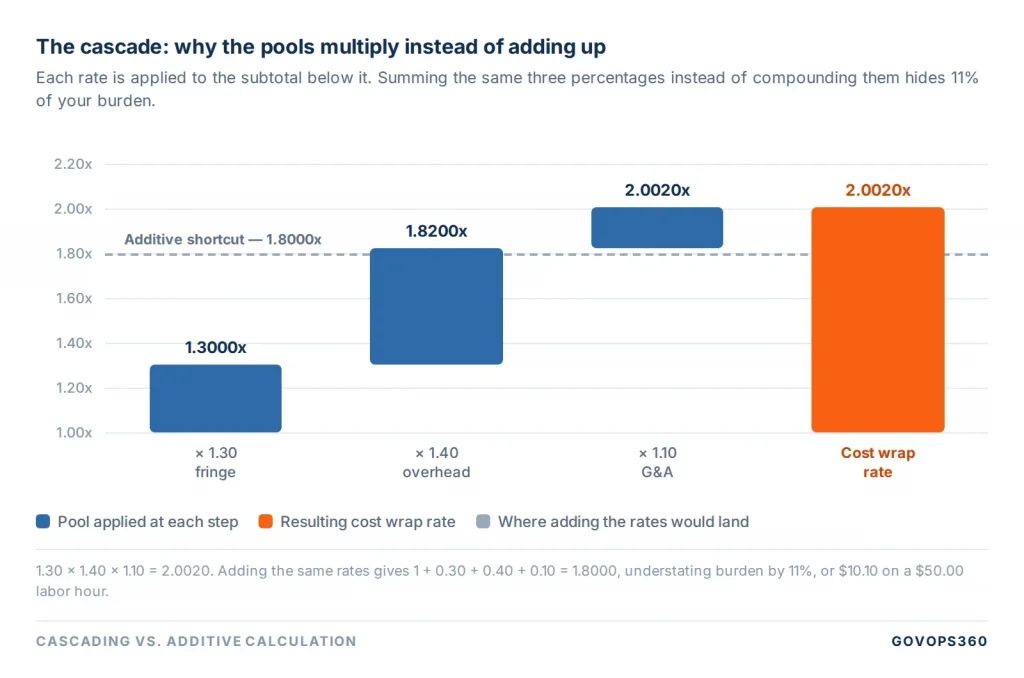
The wrap rate is not a sum. It is a product. Each pool is applied to a base that already contains the pool before it:
- Step 1, Fringe: Direct Labor × (1 + Fringe Rate) = Labor + Fringe
- Step 2, Overhead: (Labor + Fringe) × (1 + Overhead Rate) = Total Cost Input
- Step 3, G&A: Total Cost Input × (1 + G&A Rate) = Fully Burdened Cost
Compressed into a single expression:
Wrap Rate = (1 + Fringe) × (1 + Overhead) × (1 + G&A)
That result is your cost wrap: break-even, no profit. Multiply once more by (1 + Fee) and you have your price wrap, the number you actually bid.
A worked wrap rate calculation
Take a labor category at $10.60 per hour carrying $5.76 of fringe, 27.42% overhead and 8.10% G&A, figures published by GovCon accounting vendor Sympaq:
- Direct labor: $10.60
- Plus fringe of $5.76: $16.36
- Times 1.2742 for overhead: $20.85
- Times 1.0810 for G&A: $22.54
Fully burdened cost is $22.54 per hour. Divide by the $10.60 direct rate and the wrap rate is 2.1263. Note that the fringe here is a dollar amount rather than a percentage. Both conventions are in use, and confusing them is its own source of error.
Why adding your rates together understates the burden
The single most common wrap rate mistake is adding the percentages instead of compounding them. Take a clean set of numbers, 30% fringe, 40% overhead, 10% G&A:
- Correct (cascading): 1.30 × 1.40 × 1.10 = 2.0020
- Incorrect (additive): 1 + 0.30 + 0.40 + 0.10 = 1.8000
The gap is 11%, and it is not rounding. It is the cross-terms. Expand the product and you get 1 + a + b + c + ab + ac + bc + abc. The additive shortcut deletes every product term, and because overhead is applied to fringe-loaded labor and G&A is applied to everything beneath it, those cross-terms are exactly where the money sits.
On a $2 million direct labor bid, an 11% understatement of burden is roughly $220,000 of cost you did not price. You are still obligated to perform.
Cost wrap vs. price wrap
Federal solicitations require cost and fee to be shown separately, so keep the two numbers distinct in your own models from the start:
- Cost wrap = (1 + Fringe) × (1 + Overhead) × (1 + G&A). Break-even.
- Price wrap = Cost wrap × (1 + Fee). What you bid.
Fee on federal services work commonly runs 5% to 10% depending on contract type and how risk is allocated, a practitioner range rather than a regulated one. On firm-fixed-price work you carry the performance risk and can defend a higher fee. On cost-plus-fixed-fee the fee is negotiated as a dollar amount rather than a live percentage, and statutory limits apply.
Free Wrap Rate Calculator
Enter your rates below. The calculator applies them in the correct cascading order, shows every intermediate step, and reports both your cost wrap and your price wrap. It also shows what the additive shortcut would have produced, so you can see the size of the error in your own numbers rather than in a textbook example.
Nothing is transmitted or stored. The calculation runs entirely in your browser.
Wrap Rate Calculator
Applies fringe, overhead and G&A in the correct cascading order, then adds fee. Runs entirely in your browser, nothing is sent or stored.
Cost wrap rate
2.0020
Break-even multiplier, no fee
Price wrap rate
2.1622
What you bid, fee included
| Direct labor | $50.00 |
|---|---|
| + Fringe | $15.00 |
| = Labor + fringe | $65.00 |
| + Overhead | $26.00 |
| = Total cost input | $91.00 |
| + G&A | $9.10 |
| Fully burdened cost | $100.10 |
| + Fee | $8.01 |
| Billing rate | $108.11 |
| Annual fully burdened cost | $186,186 |
Assumes the standard cascade: fringe on direct labor, overhead on labor plus fringe, G&A on total cost input (CAS 410). If your G&A uses a value-added or single-element base, or you carry separate on-site and off-site overhead pools, enter the rate that applies to this labor category and place of performance.
How to read your wrap rate result
- Cost wrap is your break-even multiplier. Any price below direct labor times cost wrap loses money on that labor hour.
- Price wrap is your bid multiplier. Test it against incumbent rates on GSA Advantage price lists and against public award data for the same labor category and place of performance.
- The additive comparison shows how much burden a summed calculation would have hidden. If your own pricing spreadsheet produces the smaller number, you have found a real problem.
- Annual fully burdened cost converts the hourly figure at your billable-hour assumption. 1,860 hours is a common productive-year assumption after holidays and leave; use your own.
Use provisional (billing) rates for in-year bidding and your most recent negotiated final rates for anything that will be audited. Where provisional rates and actuals have drifted apart, the gap surfaces later as a year-end adjustment, see FAR Subpart 42.7 on billing and final rate mechanics.
Inside the Wrap Rate: The Six Layers of a Federal Labor Dollar
FAR 31.001 defines indirect cost pools as “groupings of incurred costs identified with two or more cost objectives but not identified specifically with any final cost objective.” FAR 31.203 then requires that a contractor “accumulate indirect costs by logical cost groupings” and allocate each to a base that reflects the benefit received.
That is the entire legal architecture. The FAR does not mandate three pools, or four, or their names. It requires that your groupings be logical, your bases causal-beneficial, and your treatment consistent. Nearly every federal services contractor lands on the same structure anyway, because it is the one DCAA expects to see and the one that survives an incurred cost audit.
- 1
Direct Labor
The unburdened wage. Identified specifically with a single final cost objective.
- 2
Fringe
Payroll taxes, leave, health and retirement. Compensation tied to the employee, applied to direct labor.
- 3
Overhead
Facilities, supervision, equipment. Applied to labor plus fringe. Often split on-site and off-site.
- 4
G&A
Company-wide management and administration, allocated over a total activity base under CAS 410.
- 5
Handling
Material and subcontract handling pools, so pass-through dollars carry the cost they actually cause.
- 6
Fee
Profit. Added after cost, and kept on a separate line in every federal proposal.
1- Direct Labor: The Base Everything Multiplies
Direct labor is the unburdened wage paid to the person doing contract work. FAR 31.201-4 sets the allocability test: a cost is allocable if it is “assignable or chargeable to one or more cost objectives”, by direct assignment, by benefit-based apportionment, or because it is necessary to the overall operation of the business.
Getting the base right matters more than any other input, because every pool above it is a multiplier. Two errors dominate. First, contractors handle uncompensated overtime inconsistently, which quietly distorts the effective hourly rate. Second, they leave costs in the base that belong in a pool, a project manager supporting six contracts is not direct labor on any one of them.
Escalate the base for out-year pricing. A five-year IDIQ priced at today’s wages is a five-year margin decline built into the award.
2- Fringe: The Pool You Can Least Afford to Guess At
Fringe covers payroll taxes, paid time off, health insurance, retirement contributions and other employee benefits. FAR 31.205-6 governs the allowability of compensation and requires that it “be for work performed by the employee in the current year.” Contracts awarded after 24 June 2014 are also subject to the OFPP compensation benchmark cap, which makes a portion of senior executive compensation unallowable.
Fringe is applied to direct labor and typically runs from the mid-20s to the high-30s as a percentage for federal services firms. It is the most stable pool year over year and the least amenable to competitive manipulation. Benefits you cut to win a bid are benefits your cleared staff notice, and cleared staff are the asset you are actually selling.
Watch anything covered by the Service Contract Act. Health and welfare determinations set a floor on fringe for covered labor categories that has nothing to do with your corporate benefit design.
3- Overhead: Where On-Site and Off-Site Diverge
Overhead absorbs the cost of the environment the work happens in: facilities, utilities, depreciation, program supervision, non-billable technical support. It is applied to labor plus fringe, not to bare labor, which is precisely why the cascade matters.
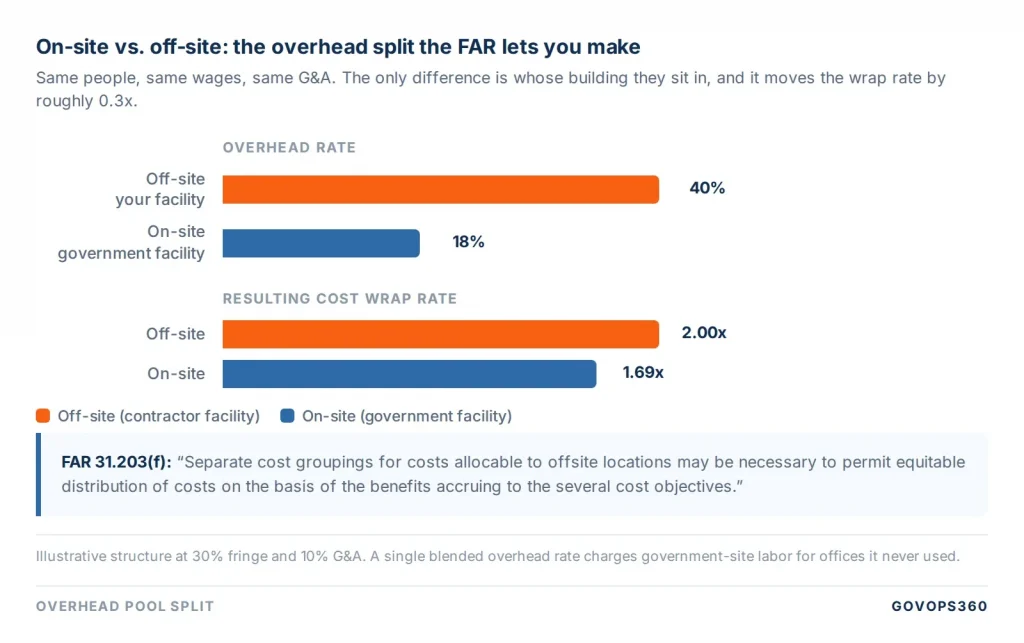
FAR 31.203(f) authorizes splitting this pool: “Separate cost groupings for costs allocable to offsite locations may be necessary to permit equitable distribution of costs on the basis of the benefits accruing to the several cost objectives.”
That one sentence is worth real money. When your people sit in a government facility, they consume the government’s space, power and furniture, not yours. A contractor carrying a single blended overhead rate charges government-site work for offices it never used, and prices itself out of exactly the recompetes it should win. Contractors running a separate on-site pool routinely bid 15 to 30 points of overhead below their off-site rate on the same labor category.
4- G&A: The Pool With Three Legal Bases
G&A is the cost of running the company as a whole, executive management, corporate finance, legal, HR, and business development not chargeable elsewhere. CAS 410-40 requires that it “be grouped in a separate indirect cost pool which shall be allocated only to final cost objectives” using “a cost input base representing the total activity of the business unit.”
The base you choose changes your wrap rate materially, and CAS 410-50(d) recognizes three:
- Total Cost Input (TCI): all direct and indirect cost except G&A. The default, which the standard calls “generally acceptable.”
- Value-Added: total cost input less material and subcontract cost. Appropriate where including pass-through dollars “would significantly distort the allocation.”
- Single Element: direct labor dollars or hours. Permitted “where it produces equitable results,” but inappropriate where labor is an insignificant portion of total cost.
A subcontract-heavy integrator on a TCI base spreads G&A over a large denominator and posts a low percentage, but every subcontractor dollar then carries G&A. The same firm on a value-added base posts a much higher percentage over a much smaller base. Neither is a trick; both are compliant. Which one serves you depends on the shape of the bid in front of you, and you cannot switch opportunistically, because consistency is the requirement.
5- Material and Subcontract Handling
Where a contractor passes through significant material or subcontract dollars, a separate handling pool captures the real cost of procuring and administering them: purchasing, subcontract administration, receiving, property management. It is applied to material and subcontract cost rather than to labor, which stops those dollars from either escaping cost recovery entirely or absorbing a full labor-based burden they never caused.
FAR 31.203 draws a hard line here. Once a base is accepted, “the contractor shall not fragment the base by removing individual elements.” Carving a large, low-effort subcontract out of the base to make one bid look better is a finding waiting to happen.
6- Fee and Profit: Kept Separate, Always
Fee sits outside the wrap rate. FAR 16.601 makes the separation explicit for time-and-materials work, requiring that the contract “specify separate fixed hourly rates that include wages, overhead, general and administrative expenses, and profit for each category of labor.”
Two disciplines follow. Model cost and fee as separate lines so you can answer a cost realism question without rebuilding your spreadsheet. And never use fee as the shock absorber when a price target is missed, a bid that only closes by cutting fee to 2% is a bid that closes at a loss the first time an assumption moves.
What Actually Moves Your Wrap Rate
Two contractors with identical people, identical salaries and identical office space can post wrap rates 30 points apart. The difference is almost never efficiency. It is structure, how many pools you carry, what sits in each, and what base each pool is allocated over.
Redstone Government Consulting puts it bluntly: collapsing into a simplified two-tier or single-pool structure “typically yield[s] higher wrap rates by pushing more costs to pools and reducing bases.” A leaner rate structure is easier to administer and worse to bid with. That trade is worth making deliberately rather than by accident.
Pool Count
More granular pools charge each contract only for what it causes. Fewer pools blend costs and inflate labor-based rates.
G&A Base
TCI, value-added or single element. A CAS 410 compliance decision with a direct, immediate pricing consequence.
Site Split
A separate on-site overhead pool under FAR 31.203(f) can move 15 to 30 points of overhead off government-site work.
Contract Type
T&M bids the loaded rate directly. FFP buries it. Cost-plus reimburses against provisional, then final, rates.
How contract type changes the conversation
- Time-and-materials and labor-hour. Your wrap rate is visible. FAR 16.601 requires separate fixed hourly rates by labor category, inclusive of wages, overhead, G&A and profit. The ceiling price caps total contract value, not the individual rate, so an aggressive rate is locked in for the life of the vehicle.
- Firm-fixed-price. The wrap rate disappears into a single number. The government never sees it; you live with it. Escalation assumptions matter more here than anywhere else.
- Cost-plus-fixed-fee. You bill at provisional rates and true up to final negotiated rates. FAR 52.216-7 requires an adequate final indirect cost rate proposal “within the 6-month period following the expiration of each of its fiscal years.” Let that discipline slip and you accumulate unbilled receivables and audit exposure at the same time.
- GSA MAS. Schedule labor rates are negotiated as fully burdened ceiling rates that then cap task-order pricing. Confirm current mechanics against the live MAS solicitation before you model, Schedule pricing policy changes more often than the FAR does.
Tracking which vehicle each pursuit runs on, and which rate set applies, is a contract lifecycle problem as much as a pricing one.
Wrap Rate Benchmarks: What a Competitive Rate Looks Like
Read this before you read the table
No government agency publishes wrap rate benchmarks. DCAA does not. GSA does not. What circulates as an “industry average” almost always traces back to a vendor blog with no underlying dataset, including the ranges on the page currently ranking first for this term, which labels its own figures as estimates without citing a source.
We are going to show you ranges anyway, because directional anchoring is genuinely useful when you are staring at your first rate model. But treat them as what they are: figures that recur across GovCon accounting practitioners, not measured statistics. The only number we found stated consistently across more than one independent source is the competitive band of roughly 1.6x to 2.2x for federal services contractors.
The benchmark that actually matters is your own, your rates computed from your own trailing actuals, tested against your own win/loss record by labor category.
| Contractor Profile | Fringe | Overhead | G&A | Wrap Rate |
|---|---|---|---|---|
| Staffing / labor-hour subcontracting | 20–28% | 10–20% | 5–10% | 1.3x – 1.6x |
| Small services, government site | 25–32% | 15–25% | 8–12% | 1.4x – 1.7x |
| Engineering services | 20–30% | 30–45% | 6–12% | 1.7x – 2.1x |
| Small services, contractor site | 25–35% | 30–45% | 8–15% | 1.7x – 2.1x |
| IT services / systems integration | 25–35% | 35–50% | 8–15% | 1.8x – 2.3x |
| Professional services | 28–38% | 40–60% | 10–18% | 2.0x – 2.6x |
| Management consulting | 30–40% | 45–65% | 12–20% | 2.1x – 2.8x |
What Makes a Wrap Rate Competitive
Competitive is relative to the labor category, the place of performance and the evaluation method, never to a universal number. A 2.4x wrap rate is uncompetitive for on-site help desk labor and entirely normal for cleared systems engineering delivered from your own facility.
Three tests are worth running before you accept your own rate as competitive:
- Against the incumbent. Public award data and GSA Advantage price lists give you real rates for the same labor category. If you are 20% above the incumbent on a price-sensitive recompete, the rate is the problem, not the proposal.
- Against your own history. Sort your last twenty bids by wrap rate and mark the wins. The band where you actually win is your real competitive range, and it is usually narrower than you expect.
- Against absorption. A rate is only competitive if it is achievable at your projected volume. Rates built on optimistic revenue plans collapse the moment the volume does not arrive.
Why a Very Low Wrap Rate Is a Red Flag
Bidding an unrealistically low rate does not just risk performance. On cost-reimbursement work it does not even help you win.
FAR 15.404-1(d) defines cost realism analysis as “the process of independently reviewing and evaluating specific elements of each offeror’s proposed cost estimate to determine whether the estimated proposed cost elements are realistic for the work to be performed; reflect a clear understanding of the requirements; and are consistent with the unique methods of performance and materials described in the offeror’s technical proposal.”
Cost realism analysis is required on cost-reimbursement contracts. Where an evaluator concludes your rates are unrealistic, the government evaluates you at probable cost: its own adjusted number, not yours. You are scored on the higher figure and remain contractually bound to the lower one. Worse, the adjustment itself signals that you do not understand the requirement, which damages the technical score you were counting on.
Practitioner guidance puts the upper caution line near 2.5x, above which overhead structure starts to look inefficient. There is an equally real lower line. A rate that cannot cover your own indirect costs is not aggressive pricing, it is a documented loss.
How Size and Place of Performance Drive the Range
Small contractors are not automatically cheaper. A three-person firm has no volume to absorb its G&A pool, so the same $300,000 of corporate cost lands on a fraction of the base, which is why very small firms often post higher G&A percentages than mid-tier competitors, not lower.
Where small firms genuinely win is overhead: no leased engineering space, no layered program supervision, staff working at the government site under a FAR 31.203(f) on-site pool. That is a structural advantage on services recompetes, and it evaporates the moment the work moves off-site.
Large primes carry the opposite profile, efficient G&A spread over a very large base, heavy overhead from facilities, security infrastructure and indirect technical support. Their advantage is absorption; their exposure is fixed cost when volume drops.
Benchmark Against Your Own Actuals
The number that predicts your win rate is not a sector average. It is the gap between your provisional rates and your trailing twelve months of actuals.
Pull your indirect pools monthly, recompute each rate against its actual base, and compare against the provisional rates you are billing and bidding at. When the two diverge by more than a couple of points, act, either revise the provisional rates with your contracting officer under FAR Subpart 42.7, or fix the underlying cost behavior.
DCAA publishes the ICE Model, a standard package for preparing incurred cost proposals in compliance with FAR 52.216-7, with a current Power Query version released in July 2026. Contractors who maintain their ICE schedules continuously rather than assembling them once a year know their real rates all year long, and bid accordingly.
Seven Mistakes That Wreck a Wrap Rate
Every one of these turns up in real pricing reviews. Most are silent. They do not throw an error, they simply produce a number that is wrong in a direction you will not discover until the contract is already performing.
- Adding the rates instead of compounding them. The most frequent error by a wide margin. On a typical 30/40/10 structure it hides roughly 11% of your burden.
- Applying overhead to bare labor. Overhead belongs on labor plus fringe. Applied to unburdened wages, it understates the pool and leaves part of your fringe permanently unrecovered.
- Misclassifying costs between pools. Contract-specific business development booked to G&A, or shared program management booked as direct. CAS 410 defines G&A as the cost of managing the business unit as a whole, contract-caused cost belongs lower in the stack.
- Fragmenting the allocation base. FAR 31.203 is explicit: once a base is accepted, “the contractor shall not fragment the base by removing individual elements.” Pulling a large subcontract out to improve one bid is an audit finding in waiting.
- Running one blended overhead rate. Skipping the FAR 31.203(f) on-site/off-site split makes government-site labor uncompetitive while off-site work quietly rides on someone else’s cost recovery.
- Bidding stale provisional rates. Rates negotiated eighteen months ago against a revenue plan that never happened are not your rates. They are an expired forecast.
- Forgetting escalation on multi-year vehicles. A five-year IDIQ priced at year-one wages loses margin every year by construction. Escalate the base, and escalate the pools that move with it.
How to actually lower your wrap rate
Three levers move the number, and only one of them is cost-cutting:
- Restructure the pools. Add granularity. Separate on-site from off-site. Add a subcontract handling pool if you pass through material dollars. Each change moves cost onto the base that causes it, which lowers the labor-based rates you bid with, without removing a dollar of cost from the business.
- Grow the base. Indirect rates are fractions. More direct labor volume against the same pool lowers every rate in the stack. This is why absorption strategy and pricing strategy are the same conversation.
- Reduce the pool. The obvious lever and the slowest one. Real, but it will not save a bid due Friday.
Where GovOps360 fits
GovOps360 connects the rate structure your accounting team maintains to the pipeline you are actually bidding. Opportunities surfaced through capture intelligence carry a live pricing view, so a capture manager can see whether a labor category prices competitively before a proposal team is stood up, instead of finding out at pink team. Update a rate once and it propagates to every open pursuit, which is the difference between a rate structure that supports bidding and one that merely documents last year.
That is the whole idea behind GovFind finds the opportunity. GovOps360 wins it.
Conclusion
Your wrap rate is the most consequential number in your pricing model and, in most small and mid-tier contractors, the least examined. It is not a fixed company statistic. It is the output of decisions you control: how many pools you carry, what base each is allocated over, whether you split on-site from off-site, and how honestly your provisional rates track your actuals.
Compute it correctly, cascading, never additive. Keep cost and fee on separate lines. Split the pools the FAR expressly lets you split. Recompute monthly against real actuals rather than annually against a plan. Do those four things and your wrap rate stops being something you discover at year end and becomes something you use to win.
Run your own numbers through the calculator above, then compare the result against the bids you have won this year. If the winning band and your current rate are not the same band, you have just found your pricing problem.
Price Your Next Federal Bid With Confidence
See how GovOps360 connects live rate structures to your capture pipeline, so every bid prices against what your business actually costs today.
Frequently Asked Questions
1. What is a wrap rate in government contracting?
2. What is the formula for wrap rate?
3. How do you calculate a wrap rate step by step?
4. What is the average wrap rate for government contracts?
5. What is a typical G&A rate for government contractors?
6. What is the difference between a wrap rate and a fully burdened labor rate?
7. Does a lower wrap rate always win the bid?
References & Sources
- FAR 31.001, Definitions (indirect cost pool)
- FAR 31.201-4, Determining allocability
- FAR 31.203, Indirect costs (including 31.203(f), offsite cost groupings)
- FAR 31.205-6, Compensation for personal services
- FAR 15.404-1, Proposal analysis techniques (cost realism analysis)
- FAR 16.601, Time-and-materials contracts
- FAR Subpart 42.7, Indirect cost rates
- FAR 52.216-7, Allowable Cost and Payment
- 48 CFR Part 9904, Cost Accounting Standards (CAS 410, CAS 418)
- DCAA, ICE Model for incurred cost proposals
- Deltek Clarity Government Contracting Industry Study
Wrap rate range figures cited in this article are practitioner estimates that recur across GovCon accounting sources, not published government statistics. No federal agency publishes wrap rate benchmarks. Regulatory language is quoted from the sources above; verify against the current edition before relying on it for a submission.

Alaa Negeda
Senior Solution Architect with 23 years of experience in different Technology sectors. Diligent, forward-thinking, and adaptable to dynamic company, customer, and project needs.
Related Articles

 Sep 30,2026
 RFP vs RFQ vs RFI: Which Solicitation You Are Looking At and What to Do
 Sep 28,2026
 DDQ Meaning: What a Due Diligence Questionnaire Asks and How to Answer It
 Sep 25,2026