



 By Alaa Negeda
Introduction: The Federal Contracting Gap
Every year, government contractors leave hundreds of millions of dollars on the table not because their solutions are inferior, but because their proposals arrive late, carry compliance gaps, or fail to address evaluation criteria with precision. In a $700+ billion annual procurement market (U.S. GAO, FY2024), the margin between winning and losing a federal contract increasingly comes down to one thing: your RFP response process.
Federal proposal development is unlike any other sales activity. Every submission must navigate FAR clauses, agency-specific supplements, compliance matrices, and page-limit requirements all under tight deadlines and against competitors who have spent years refining their workflows. For teams still running manual processes, this creates a compounding structural disadvantage.
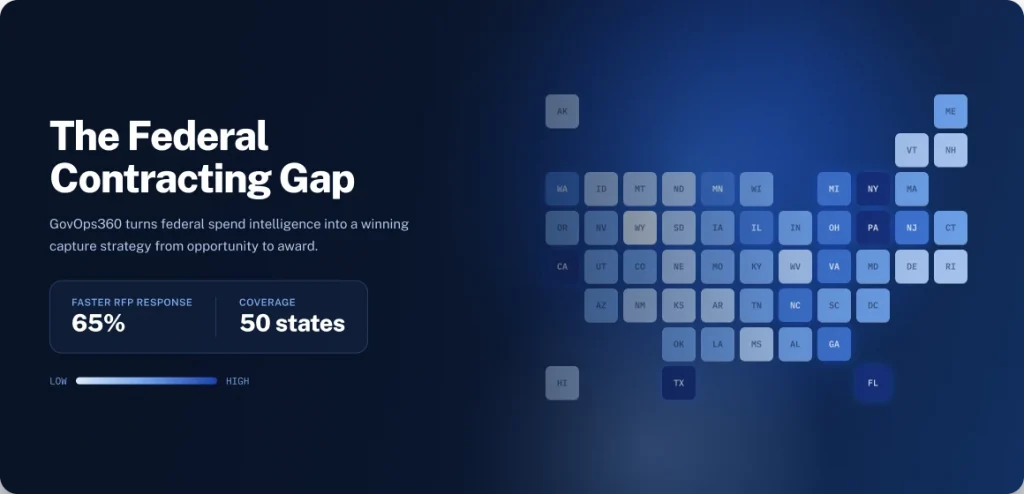
That is where federal RFP response software changes the game. AI-powered platforms now automate the highest-friction points in the proposal lifecycle from requirement extraction and compliance mapping to go/no-go scoring and amendment tracking. According to GovOps360’s analysis of federal procurement workflows, contractors using integrated AI proposal platforms reduce response preparation time by up to 65% while improving compliance accuracy across every submission.
$700B+
Annual US federal procurement market (GAO FY2024)
65%
Reduction in RFP prep time using AI-powered proposal platforms
1,000+
Person-hours per month spent on 15 RFPs using manual workflows
What Makes Federal RFPs Different From Commercial Proposals
Definition: Federal RFP
A Federal Request for Proposal (RFP) is a formal solicitation issued by a U.S. government agency requiring contractors to submit structured proposals demonstrating technical capability, past performance, and pricing evaluated against mandatory compliance frameworks and scored by a government review panel.
Commercial proposals compete on persuasion and price. Federal proposals compete on compliance, traceability, and structured alignment with agency-defined evaluation criteria and the gap between them is wide.
Federal RFPs are governed by the Federal Acquisition Regulation (FAR), agency-specific supplements such as DFARS for defense contracts, and cybersecurity frameworks including CMMC. Every section of a federal proposal must map directly to solicitation requirements, with zero room for creative interpretation.
-
Compliance matrices: Every RFP requirement must be explicitly addressed and traceable within the proposal. AI compliance matrix generation is now standard practice among competitive contractors.
-
Evaluation scoring: Proposals are assessed across Technical, Management, Past Performance, and Price volumes often with prescribed page limits per section.
-
CUI handling: Many solicitations contain Controlled Unclassified Information (CUI), requiring secure AI proposal writing environments throughout the development process.
-
Mandatory formatting: Non-compliance with formatting rules, fonts, margins, section labels triggers automatic disqualification regardless of solution quality.
-
Auditability: Federal evaluators require clear traceability showing how proposal content addresses each requirement, making structured compliance documentation non-negotiable.
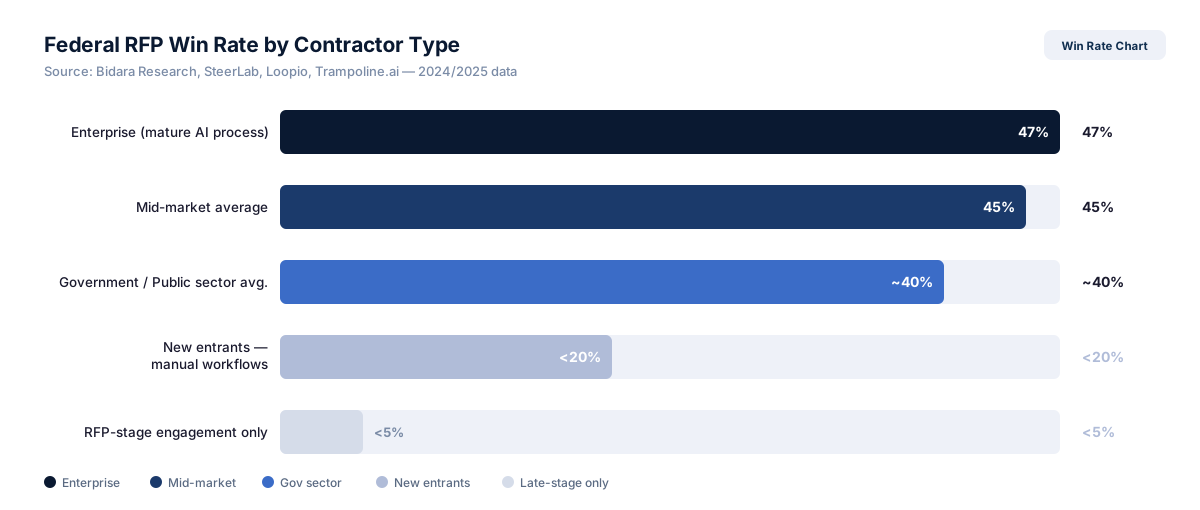
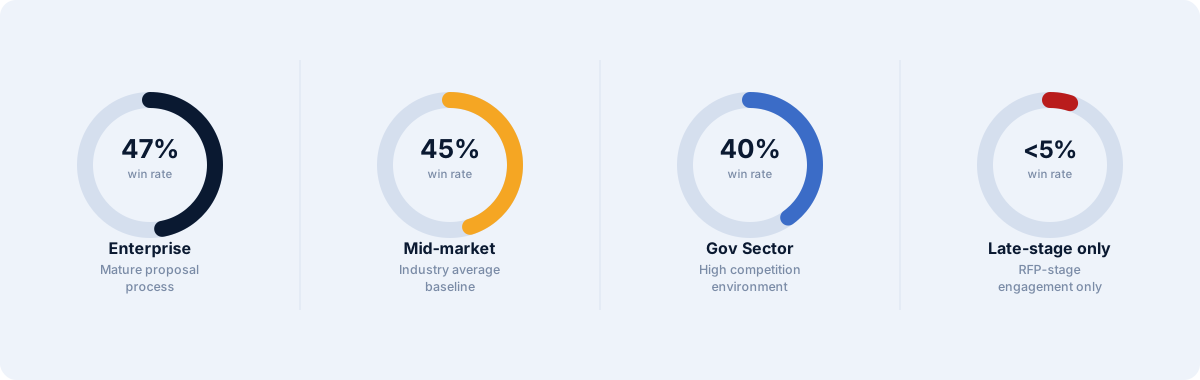
Win rates reflect these barriers. Experienced federal contractors operate at a 40-50% win rate. New entrants often see rates below 20%. The evaluation process is objective, auditable, and unforgiving of minor errors making the case for government proposal AI tools stronger every procurement cycle.
The Real Cost of Manual RFP Responses
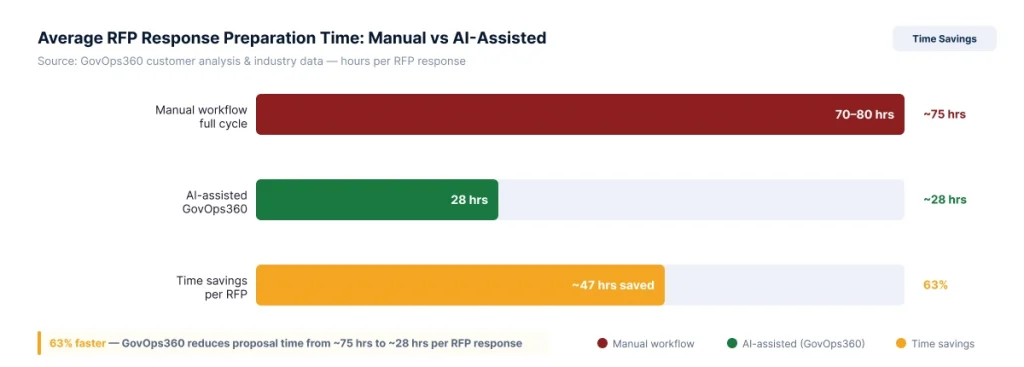
Manual proposal development is structurally broken for the volume and complexity of modern federal contracting. Consider a mid-size contractor pursuing 15 RFPs per month. At an industry average of 70+ hours per response, that team invests over 1,000 person-hours monthly in proposal development alone before accounting for revisions, compliance reviews, or lost bids.
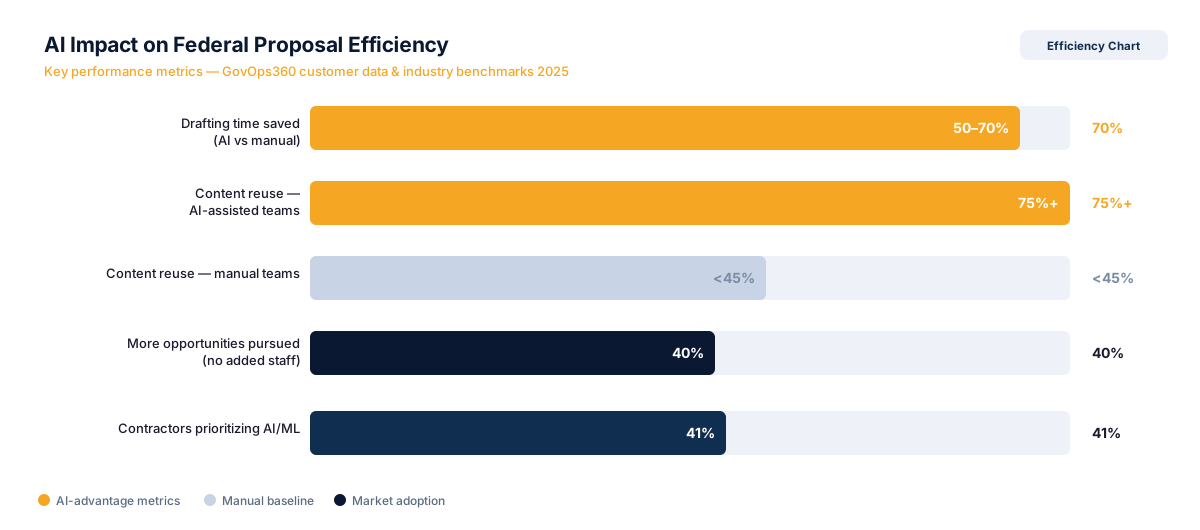
Fewer than 45% of existing proposal content is reused efficiently in manual workflows. Teams recreate sections from scratch, rely on outdated boilerplate, and introduce inconsistencies across proposal volumes. Federal RFP response software and proposal writing with intelligent content libraries directly addresses this gap, raising reuse rates to 75%+ for teams that implement AI-assisted knowledge management.
Beyond labor costs, the hidden risks compound over time. Missed compliance requirements, outdated pricing references, and inconsistent messaging across volumes can each trigger rejection. Even a single non-compliant section voids an otherwise strong bid wasting months of capture effort. For contractors pursuing growth without proportional headcount increases, RFP response automation is the only scalable answer.
Six Ways AI Transforms Federal RFP Responses
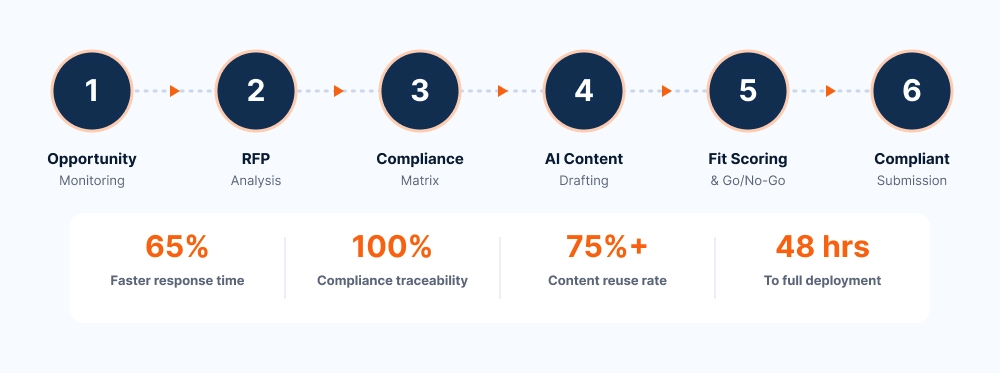
Government proposal AI tools target the six highest-friction points in the federal proposal lifecycle. Here is how each capability translates to measurable outcomes.
Opportunity Monitoring
Always-on pipeline scanning before solicitation release
RFP Analysis & Extraction
Auto-parse all requirements and evaluation criteria
Compliance Mapping
100% requirement traceability matrix generated
Draft Generation
50-70% faster first draft with AI writing
Quality Check
Gap detection, consistency scan & compliance verification
Submit & Track
Amendment alerts + complete audit trail
1- Automated Compliance Mapping
AI parses every requirement in an RFP solicitation and maps each one to corresponding proposal sections ensuring 100% requirement traceability before a single word of content is drafted. Real-time gap flagging alerts teams to missing coverage before submission, eliminating the compliance blind spots that routinely disqualify strong proposals.
Advanced federal RFP response software interprets FAR clauses, monitoring language, and agency-specific instructions without manual cross-referencing. Over time, the system learns from past submissions, refining its mapping logic so each successive proposal is more precise than the last.
2- Fast, High-Quality Content Generation
AI-assisted drafting reduces first-draft time by 50-70% compared to manual authoring. Executive summaries, technical narratives, and management approaches that previously took days are generated in hours allowing your team to focus on differentiation, strategy, and customization rather than baseline writing.
3- Intelligent Content Reuse
Most proposal content can be adapted from previous submissions but manual search across shared drives is unreliable and slow. Government proposal AI tools build a structured, searchable knowledge base from every past proposal, enabling precise retrieval and smart adaptation of existing content. Reuse rates climb from under 45% to over 75% for teams using AI-assisted content libraries, according to GovOps360’s customer data.
4- Go/No-Go Decision Support
AI-driven go/no-go decision tools analyze win probability using historical win/loss data, agency preference patterns, contract values, and capability alignment. Contractors that implement structured go/no-go scoring shift their pursuit mix toward higher-probability bids, improving overall win rates without increasing proposal volume or headcount.
5- Accuracy and Consistency at Scale
AI performs automated quality checks across the entire proposal document, flagging inconsistencies, outdated references, and compliance gaps before submission. The result is a cohesive, unified response rather than a patchwork of individually authored sections.
6- Real-Time Collaboration Across Distributed Teams
RFP response automation platforms centralize inputs, manage version control automatically, and track changes across all contributors in real time. When a solicitation is amended, affected sections are flagged for review instantly eliminating the costly version control failures that derail distributed proposal teams.
Security & Compliance: What Every Federal Contractor Must Verify
Definition: CUI
Controlled Unclassified Information (CUI) refers to government-created or government-controlled information that requires safeguarding under law, regulation, or policy. Many federal RFPs contain CUI meaning your AI proposal tool must operate within a secure, CUI-compliant environment, not a general-purpose commercial AI service.
Adopting AI tools for federal proposal development introduces security obligations that consumer-grade AI platforms are not designed to meet. Before deploying any government proposal AI tool, contractors must verify compliance across four critical dimensions.
CMMC Alignment
For DoD contracts, your AI tools must align with Cybersecurity Maturity Model Certification (CMMC) requirements including controls over how data is stored, processed, and transmitted. CMMC compliant AI proposal tools are a minimum requirement for defense sector work.
CUI-Compliant Hosting
Federal proposals frequently handle CUI. Your platform must operate within a secure, isolated hosting environment completely separate from general-purpose AI models that could expose sensitive government data.
FAR Compliance
Secure AI proposal writing for government must meet Federal Acquisition Regulation standards for accuracy and transparency. Automated content must be reviewable, correctable, and attributable to a human decision-maker.
Full Audit Trails
Federal proposals require complete traceability. Your AI platform must produce thorough audit logs documenting content creation, review decisions, and amendment responses supporting both compliance reviews and post-award debriefs.
GovOps360 is purpose-built for this environment. The platform operates within a secure, CUI-compliant AI proposal framework that isolates federal proposal data from general-purpose AI infrastructure meeting the security standards that government contracting demands without sacrificing the speed and automation that make AI valuable.
How GovOps360 Helps Federal Contractors Win More
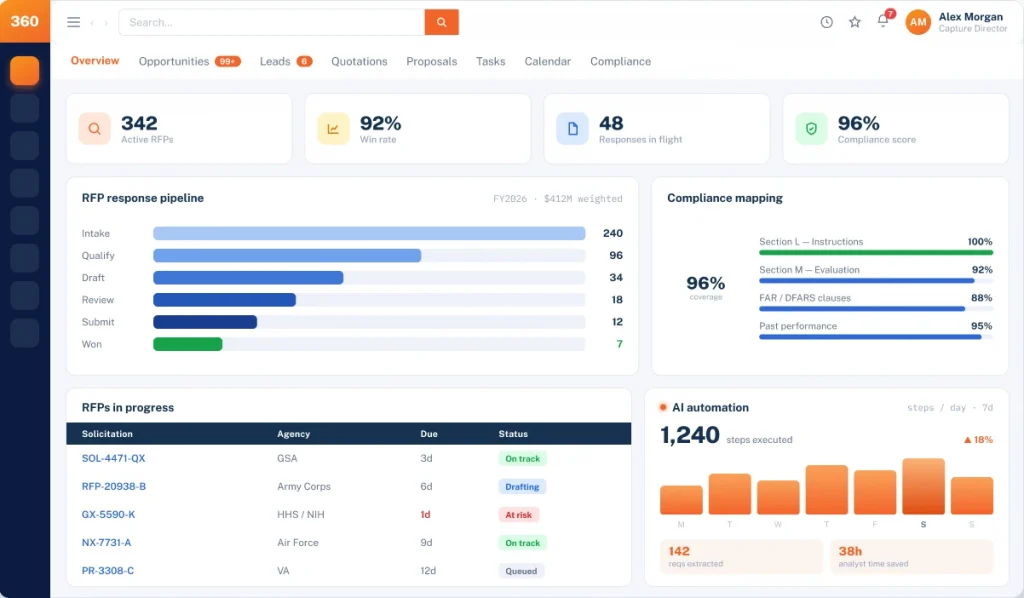
GovOps360 is not a drafting assistant. It is an execution-driven federal contracting platform that manages the entire proposal lifecycle from opportunity identification through submission with minimal manual intervention.
Where traditional government proposal tools require teams to manually initiate each workflow step, GovOps360 introduces agentic AI: a system that executes multi-step processes continuously, maintaining context across the full capture lifecycle without constant human prompting.
| Capability | Traditional Tools | GovOps360 |
|---|---|---|
| Opportunity monitoring | ✗ Manual cross-reference | ✓ AI-generated matrix, 100% traceability |
| Content generation | ✗ Individual authoring, 70+ hrs | ✓ 50–70% faster AI drafting |
| Go/no-go scoring | ✗ Gut feel / spreadsheet | ✓ AI win probability scoring |
| Amendment tracking | ✗ Manual monitoring | ✓ Real-time automated alerts |
| Content reuse | ✗ <45% reuse efficiency | ✓ 75%+ with AI knowledge base |
| CUI compliance | ✗ Not guaranteed | ✓ Isolated secure environment |
| Audit trail | ✗ Limited / manual | ✓ Complete, auto-generated logs |
Opportunity Monitoring & Lead Management
GovOps360’s AI lead management system monitors federal procurement databases continuously surfacing relevant opportunities and alerting your team before solicitation release. This pre-RFP positioning, combined with fit scoring, is what separates contractors with consistent 40%+ win rates from those below 20%.
Intelligent RFP Analysis & Requirement Extraction
When a solicitation drops, GovOps360 immediately parses the full document extracting all requirements, identifying evaluation criteria, flagging CUI sections, and generating a structured compliance matrix. What previously required two days of manual work by a senior capture manager is completed in under an hour.
Agentic Proposal Development
GovOps360’s agentic AI layer executes without waiting for prompts: pulling relevant past proposal content, mapping it to current requirements, generating draft sections, and flagging compliance gaps all while tracking amendments and updating the proposal automatically when solicitation changes occur. Explore why GovOps360 is built differently.
Fit Scoring & Win Probability Analysis
Every opportunity receives a structured fit score based on your organization’s historical performance, capability profile, and agency procurement patterns. This data-driven go/no-go support ensures proposal resources are invested in pursuits with the highest probability of winning powered by AI analysis, not intuition.
What to Expect From AI in Federal Contracting Beyond 2026
The trajectory of AI in federal proposal development points toward fully integrated, always-on systems that manage entire contracting workflows rather than isolated tasks. Based on current adoption trends and GovOps360’s platform direction, here is what federal contractors should prepare for.
-
Persistent intelligence: AI systems will monitor solicitation databases continuously, track amendment histories, and maintain proposal readiness reducing time-to-response from weeks to days across the entire pursuit pipeline.
-
Automated compliance validation: Compliance artifact generation and verification will become fully automated, eliminating spreadsheet-based tracking. CMMC compliant AI proposal tools will become standard infrastructure, not a differentiator.
-
Predictive win probability: As systems accumulate historical contract data, go/no-go scoring will reach statistical confidence levels allowing BD directors to model win probability before committing a single hour of proposal staff time.
-
Human-AI workflow integration: Capture manager roles shift from execution to strategy and validation. AI handles requirement extraction, compliance mapping, and draft generation. Humans focus on pricing strategy, differentiators, and executive review.
-
Cross-platform integration: Federal RFP response software will integrate directly with CRM systems, past performance databases, and contract management platforms creating a unified, auditable record of the full capture lifecycle.
Contractors that invest in advanced federal proposal AI tools now build a compounding competitive advantage: better historical data, smarter scoring models, and faster response cycles while competitors are still closing the gap.
Conclusion
Federal contracting has always rewarded preparation. What has changed in 2026 is that preparation now means AI-powered proposal development not just larger teams and longer hours. Contractors who continue to rely on manual RFP response workflows face a structural disadvantage that compounds with every procurement cycle.
AI-powered federal RFP response software tools deployed securely and compliantly address the five core failure points of manual proposal development: slow drafting, compliance gaps, poor content reuse, undisciplined pursuit decisions, and version control failures. The result is not just faster proposals. It is better proposals, on more opportunities, with fewer people.
GovOps360 is built specifically for this environment: a platform that combines secure, CUI-compliant AI infrastructure with agentic workflows that manage the proposal lifecycle from opportunity identification through final submission.
Ready to Win More Federal Contracts?
See how GovOps360’s AI-powered proposal platform reduces RFP response time by up to 65% while improving compliance accuracy across every submission.
Frequently Asked Questions
1. What is federal RFP response software and how does it work?
2. How is GovOps360 different from other government proposal AI tools?
3. What is agentic AI and how does it apply to federal contracting?
4. Can AI fully replace federal proposal teams?
5. How does AI help with federal bid go/no-go decisions?
6. What compliance requirements must AI proposal tools meet for federal contracting?
7. What is the biggest shift expected in federal contracting AI beyond 2026?
References & Sources
- Deltek 2025 Clarity Government Contracting Report
- Bidara Research — RFP Statistics & Win Rates
- SteerLab — RFP Win Rate Benchmarks by Industry
- Trampoline.ai — The Pre-RFP Battlefield: Where Government Contracts Are Actually Won
- Loopio — RFP Statistics & Win Rates
- Art of Procurement — State of AI in Procurement
- EM360 Tech — Future of Procurement Beyond RFPs and Pure Automation
- ValueSpectrum — AI RFP Automation Market Report 2025

Alaa Negeda
Senior Solution Architect with 23 years of experience in different Technology sectors. Diligent, forward-thinking, and adaptable to dynamic company, customer, and project needs.
Related Articles

 Dec 29,2025
 How to Conduct GovCon Competitive Intelligence Using AI (and Win More Bids)
 Dec 21,2025